
What Is a Platform Acquisition in Business Strategy?
What Is a Platform Acquisition in Business Strategy?
A platform acquisition is the first purchase a buyer makes to enter an industry, with the explicit goal of using that business as a base to roll up smaller competitors and build scale. Private equity firms, independent searchers, and strategic corporate buyers all use this approach as the entry point for a buy-and-build strategy. It matters because the platform sets the ceiling on everything that follows: the operating systems, the management bench, and the valuation multiple the whole roll-up eventually commands.
- Definition: the foundational deal that launches a roll-up strategy
- Buyers: private equity groups, searchers, and strategic acquirers
- Why it matters: it drives multiple arbitrage and sets the platform for future add-ons
Key Takeaways
A platform acquisition succeeds when it combines a repeatable operating model, management continuity, and integration capability strong enough to absorb future add-ons profitably.
| Point | Details |
|---|---|
| Platform defines the strategy | It’s the foundational deal that a roll-up strategy is built around, not just a first purchase. |
| Documentation drives price | Buyers pay a premium for written SOPs and management depth that reduce integration risk. |
| Multiple arbitrage is the mechanism | Combining smaller businesses bought at lower multiples can raise the combined exit multiple. |
| Diligence takes longer | Expect 60 to 90 days for platform-level diligence versus a standard add-on deal. |
| Compass prepares sellers for this | Compass Business Acquisitions builds valuations and marketing specifically around platform readiness. |
Table of Contents
- What Makes a Business a Platform Company
- Characteristics Buyers Screen for in a Platform Target
- The Economics Behind Buy-and-Build Value Creation
- Platform vs. Add-On, Bolt-On, and Tuck-In Deals
- How to Evaluate a Platform Target: Checklist and Red Flags
- Preparing a Service Business to Be Platform-Ready
- Should You Hire a Broker for a Platform Deal?
- When a Platform Acquisition Makes Sense
- A Practitioner’s View on Platform Deals
- Get a Platform-Ready Valuation from Compass Business Acquisitions
- Sources
What Makes a Business a Platform Company
A platform company looks different from a typical small business on paper, even when the revenue numbers are similar. Buyers pay attention to whether the operation can run without its founder standing over every decision, because that’s what makes it capable of absorbing more deals later.
- Repeatable operating model: documented standard operating procedures that a new manager can follow without tribal knowledge
- Management depth: a leadership team that survives beyond the founder, or a credible succession plan
- Absorption capacity: systems and staff that can take on add-on acquisitions without breaking what already works
- Premium pricing: buyers consistently pay more for businesses that show these traits, because the alternative is building that infrastructure from scratch
In service businesses specifically, platform status hinges on a common operating model that runs across every location and team, not on any particular piece of software or equipment.
Characteristics Buyers Screen for in a Platform Target
Before a buyer commits capital to a platform acquisition, they run the target through a mental checklist. Miss two or three of these traits and the deal usually gets repriced or walked away from entirely.
- Predictable cash flow. Margins that hold steady across at least two or three years, not a single strong year propped up by one contract.
- Documented playbooks. Sales processes, service delivery steps, and hiring procedures written down, not living only in the owner’s head.
- Scalable back office. Accounting, HR, and reporting systems that can handle triple the transaction volume without a full rebuild.
- Low customer concentration. No single client representing an outsized share of revenue, and renewal or retention rates that hold up under scrutiny.
- Leadership continuity. Either the owner is willing to stay through a transition, or there’s a general manager already running day-to-day operations.
Pro Tip: If you’re a seller eyeing a platform-style exit, start documenting your SOPs a year before you list. Buyers discount heavily for “founder-dependent” businesses, and that discount often exceeds the cost of writing the manuals.
The Economics Behind Buy-and-Build Value Creation
Platform acquisitions create value through a mechanism private equity calls multiple arbitrage. Smaller companies typically sell at lower valuation multiples than larger ones in the same industry, simply because size reduces risk in a buyer’s eyes. Combine several small businesses under one platform, and the resulting company often commands a higher multiple than the sum of its parts traded for individually, according to Visbl’s breakdown of buy-and-build economics.
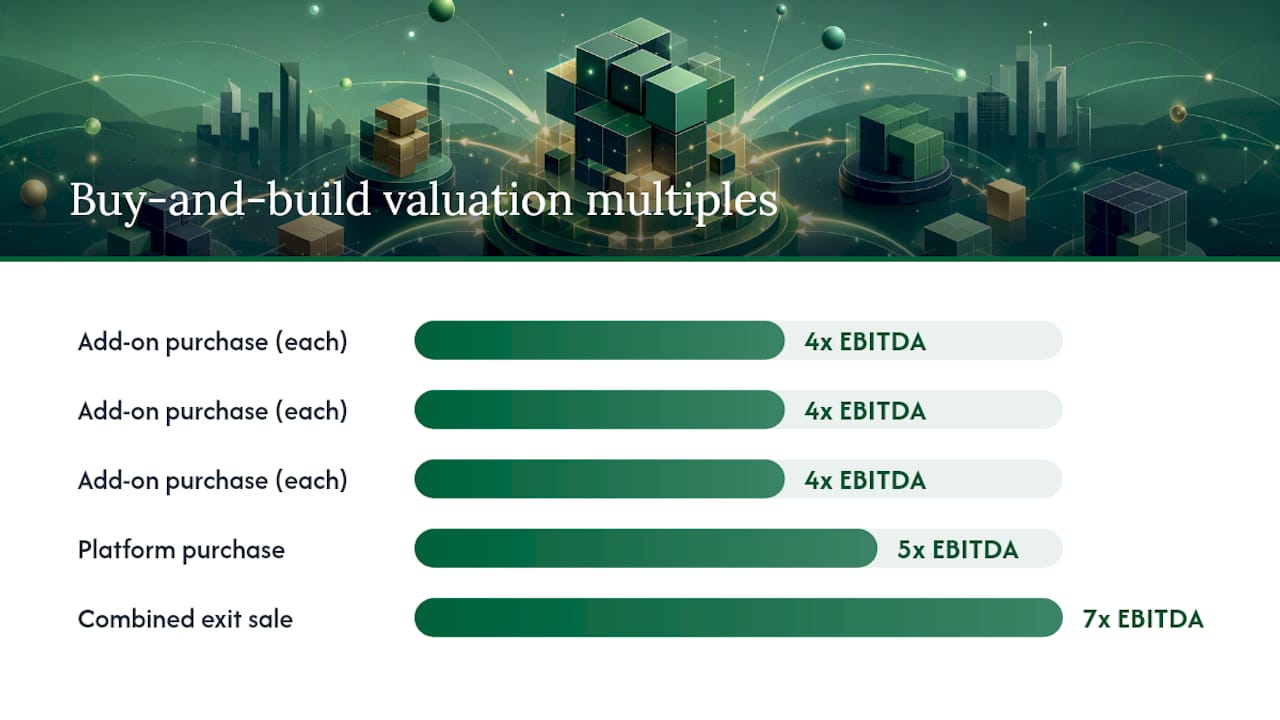
Picture a platform bought at a 5x EBITDA multiple, then three add-ons purchased at 4x each. If the combined, larger entity later sells at 7x EBITDA, the arbitrage between the acquisition multiples and the exit multiple is where much of the return comes from, not just organic growth.
Synergies compound that effect. Cost savings show up in shared back-office functions and bulk purchasing. Cross-sell revenue emerges when the platform’s customer base gets access to the add-on’s services, and vice versa. Centralized services, like a single finance team supporting five locations, cut overhead per unit.
None of this works without integration capability. A platform with a proven playbook for bringing new companies onboard absorbs add-ons smoothly; one without it burns cash and management attention fixing avoidable problems. Learn more about how buyers structure this kind of portfolio approach before committing capital to a first deal.
Platform vs. Add-On, Bolt-On, and Tuck-In Deals
The terms get thrown around loosely, but they describe distinct roles in a roll-up strategy, and mixing them up leads to mispriced deals.
- Platform acquisition: the founding purchase, usually the largest and most expensive, priced to reflect its infrastructure and management depth
- Add-on or bolt-on acquisition: a smaller company folded into an existing platform to add revenue, geography, or capability, typically bought at a lower multiple than the platform itself
- Tuck-in acquisition: a bolt-on so thoroughly absorbed that its brand and operations disappear into the platform within months
- Standalone, one-off deal: the right call when a buyer wants a single business with no roll-up ambition, since paying platform-level diligence costs for a deal that will never scale makes no sense
Buyer objectives diverge sharply here. A platform buyer is underwriting years of integration work. A bolt-on buyer is underwriting a faster, narrower fit into something that already exists.
How to Evaluate a Platform Target: Checklist and Red Flags
Run any potential platform through both a numbers check and a systems check before making an offer. The financials tell you if the business is healthy; the systems check tells you if it can actually serve as a base for more acquisitions.
- Pull three years of revenue and EBITDA margin trends, not just the trailing twelve months.
- Calculate customer concentration. High reliance on a single client deserves scrutiny.
- Request the actual SOP documents, not a verbal description of “how we do things.”
- Estimate integration costs for the systems, staff, and locations you’d need to bring under one roof.
- Ask what happens to leadership if the deal closes tomorrow.
Sellers should prepare answers for the diligence questions buyers ask most: what percentage of revenue depends on the owner personally, how are contracts structured, and what would break if key employees left.
Common red flags that derail platform roll-ups: unwritten pricing exceptions for favored customers, key employees with no employment agreements, and financials that don’t reconcile cleanly between the general ledger and tax returns. Expect the initial diligence phase on a platform deal to run 60 to 90 days, longer than a typical add-on, because buyers are underwriting the infrastructure as much as the revenue. Review the buyer’s checklist for signs a business is worth acquiring before you start outreach.
Preparing a Service Business to Be Platform-Ready
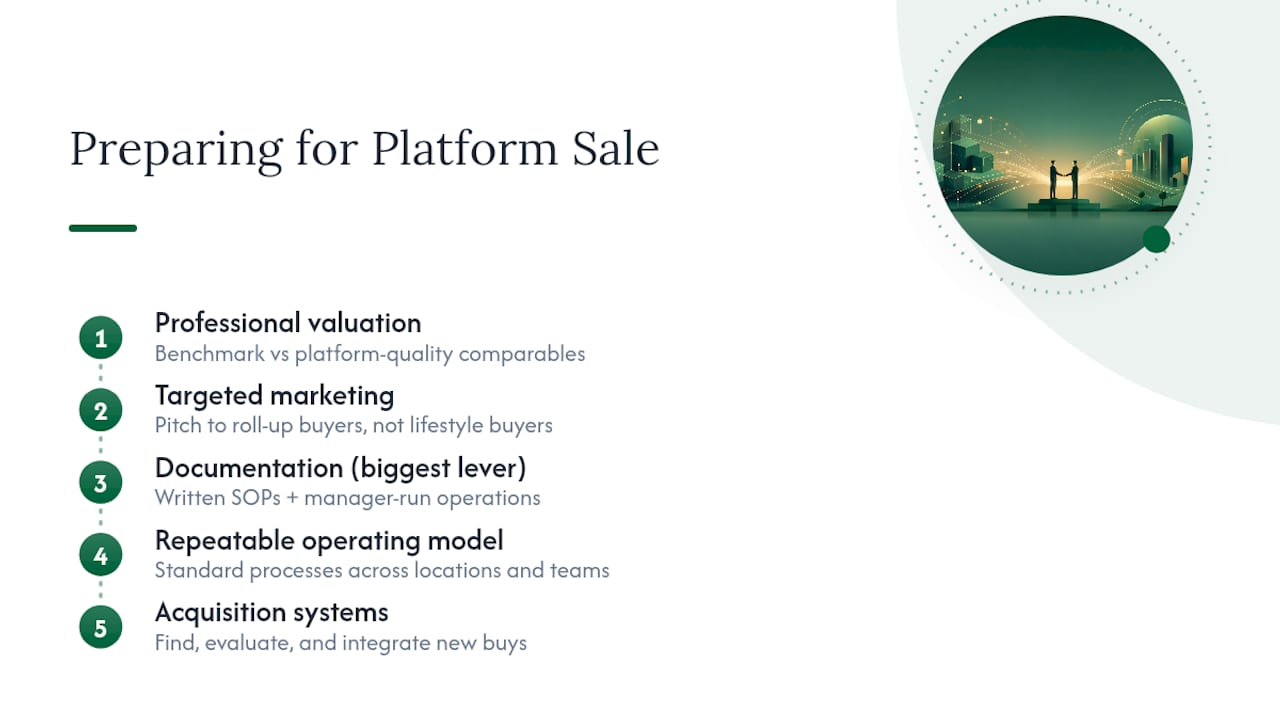
Compass Business Acquisitions works with owners of service businesses who want to position their company as a platform rather than a one-off sale. The preparation looks different from a standard listing. It starts with a professional valuation that benchmarks the business against platform-quality comparables, then moves into targeted marketing aimed specifically at buyers running roll-up strategies rather than lifestyle buyers looking for a job replacement.
The single biggest lever is documentation. A business with written SOPs and a manager who can run operations without the owner in the room reads as platform-ready to a buyer within the first diligence call.
A repeatable operating model across locations and teams, paired with systems for finding, evaluating, and integrating new acquisitions, is what separates a platform company from a business that simply happens to be for sale.
That’s the standard Compass Business Acquisitions applies when preparing a seller’s materials, and it’s the same standard strategic sale preparation work is built around.
Should You Hire a Broker for a Platform Deal?
Advisors earn their fee on platform deals by handling three things most buyers underestimate: sourcing enough qualified targets, running a defensible valuation, and managing negotiation without tipping your hand on price ceiling.
- What advisors do: source off-market deals, structure valuations, negotiate terms, and plan integration sequencing
- When internal capability suffices: you already have deal experience and a warm network of targets
- When external help pays for itself: you need confidentiality, a wider deal funnel, or leverage in negotiation you can’t generate alone
- Financing readiness matters too: advisors like Nexus Growth Services can help buyers get credit and funding structured before an offer goes out, which often shortens the entire timeline
Choosing the wrong advisor, or skipping one entirely, tends to show up later as slower deal timing or a leaked negotiation.
When a Platform Acquisition Makes Sense
A platform acquisition makes sense when you have the capital and management bandwidth to integrate multiple businesses over several years, not just the budget for one purchase. If that describes your position, the next step is running the checklist above against real targets, documenting your own SOPs if you’re on the sell side, and getting a professional valuation before you price anything.
A Practitioner’s View on Platform Deals
Most buyers overweight revenue size and underweight integration capability when they’re screening platform targets. A $5 million business with clean SOPs and a general manager who can run the show is often a better platform than a $15 million business that collapses without its founder. The revenue number is easy to see. The operating discipline behind it takes real diligence work to uncover, and it’s the trait that actually determines whether a roll-up strategy compounds or stalls after the second acquisition.
Sellers make the same mistake in reverse. They assume a bigger number on the income statement guarantees platform status, then get surprised when buyers discount the offer over founder dependency. If you’re weighing a platform-style exit, spend the year before you list fixing that, not just growing revenue.
Compass Business Acquisitions works with owners and buyers who want a straight answer on whether a business is platform-ready, and helps structure the valuation and marketing around that answer.
— Sierra
Get a Platform-Ready Valuation from Compass Business Acquisitions
Compass Business Acquisitions gives you something a generic listing site can’t: a valuation built specifically around whether your business reads as platform-ready to a roll-up buyer, not just a generic multiple pulled from industry averages.
If you’re a seller wondering how your business would price as a platform target, the Business Evaluation Calculator gives you an immediate estimate based on real transaction data. Buyers looking for platform or add-on targets can browse active opportunities and get matched with sellers whose goals align with theirs through the buyer services page. Compass handles the valuation, the targeted marketing, and the negotiation, so you’re not managing a roll-up search alone. Run your numbers through the calculator today, or reach out to start a conversation about what your platform-readiness actually looks like.