
Why Business Model Fit Matters in Acquisitions
Why Business Model Fit Matters in Acquisitions
Business model fit is defined as the degree to which two companies align across their strategic goals, operational processes, and organizational culture before and after a deal closes. This alignment is the single most reliable predictor of acquisition success, yet most buyers focus almost entirely on financial metrics during due diligence. The industry term for this concept is “strategic fit,” and it covers far more than revenue compatibility. Understanding why business model fit matters in acquisitions means recognizing that misalignment in operations, culture, or value creation logic can quietly destroy deal value long after the ink dries. Compassbusinessacquisitions works with buyers and sellers who want to get this right from the start.
Why business model fit matters in acquisitions
Business model fit is the foundation of every successful acquisition strategy. Financial due diligence tells you what a company is worth today. Business model alignment tells you whether it will still be worth that in three years. MIT Sloan Management Review reports that 46% of S&P 500 deals are ultimately undone due to strategic misalignment or cultural mismatch. That figure represents hundreds of billions of dollars in destroyed value across the market.
The average time from acquisition to divestiture in failed deals is about a decade. That means poor fit does not announce itself immediately. It compounds quietly through operational friction, employee turnover, and missed synergies until the acquirer has no choice but to sell. Buyers who treat business model alignment as a secondary concern are essentially accepting a delayed but predictable loss.

What components make up business model fit?
Business model fit has three core dimensions: strategic alignment, operational fit, and cultural fit. Each one predicts a different category of integration risk.
Strategic alignment
Strategic alignment means both companies share a compatible vision for how value is created and delivered. This includes pricing models, customer segments, growth priorities, and competitive positioning. A subscription software company acquiring a project-based consulting firm faces an immediate strategic misalignment. Their revenue logic, customer relationships, and growth levers point in opposite directions.
Operational fit
Operational fit covers processes, technology stacks, data architectures, and capability structures. The Journal of Management Studies confirms that acquisition success depends not only on choosing the right target but also on selecting an integration approach that matches how value is created. When two companies run incompatible ERP systems or organize their supply chains differently, integration costs spike and timelines slip.
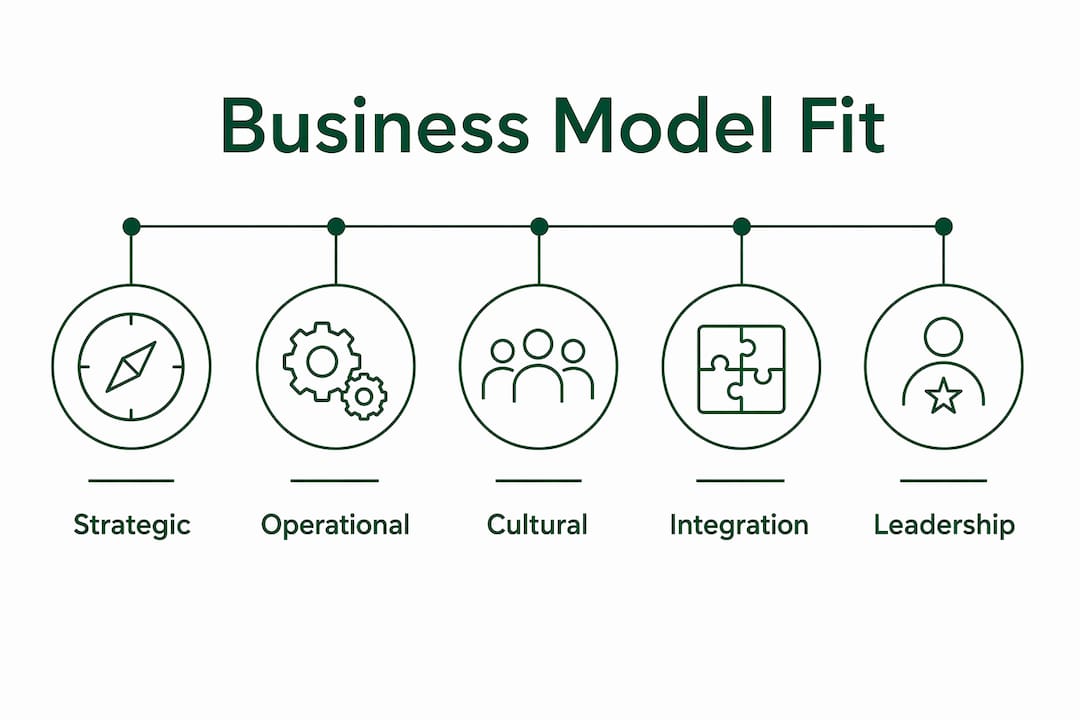
Cultural fit
Cultural fit is the most underestimated dimension. Leadership styles, decision-making speed, employee expectations, and communication norms all shape how well two organizations merge. A fast-moving startup acquired by a process-heavy corporation will lose its best people within 18 months if cultural integration is ignored.
| Dimension | Key Elements | Primary Risk if Misaligned |
|---|---|---|
| Strategic alignment | Vision, value creation logic, customer segments | Conflicting priorities, lost synergies |
| Operational fit | Processes, technology, data architecture | Integration delays, cost overruns |
| Cultural fit | Leadership style, norms, employee engagement | Talent loss, morale collapse |
How does misalignment in business models impact acquisition success?
Misalignment creates friction that compounds over time. The damage is rarely visible on day one. It shows up in missed integration milestones, rising employee attrition, and budget overruns that erode the original deal thesis.
Operational misfit produces a specific set of problems. Research on mismatched business architectures identifies four recurring failure patterns:
- Role ambiguity: Employees from both companies compete for the same responsibilities, creating confusion and political conflict.
- Process collisions: Incompatible workflows force teams to run parallel systems, doubling administrative overhead.
- Technology conflicts: Incompatible platforms create data silos, reporting errors, and costly migration projects.
- Knowledge loss: Key employees leave during integration uncertainty, taking institutional knowledge with them.
Cultural mismatches accelerate these problems. When employees do not trust the new leadership or feel their work culture is being erased, engagement drops and performance follows. The result is a business that looks intact on paper but is hollowing out from the inside.
“Acquisitions with high degrees of strategic and cultural fit tend to weather unforeseen storms better than those without.” — MIT Sloan Management Review
The long-term consequences are severe. Failed integrations lead to costly divestitures, reputational damage, and lost market position. Buyers who skip a thorough market analysis before acquiring are especially exposed to these risks.
Why integration strategy must match business model alignment
No single integration approach works for every deal. The Journal of Management Studies is direct on this point: integration style must align with the acquiring firm’s strategic orientation to capture deal value. Applying the wrong integration model to the right target is just as damaging as choosing the wrong target.
Two strategic orientations define the spectrum:
- Innovation-driven firms benefit from flexible integration. Tight control structures kill the creativity and speed that made the acquired company valuable. Keeping the target operationally independent while sharing resources and distribution is often the right call.
- Market-oriented firms benefit from tighter integration. These companies create value through scale, consistency, and customer reach. Merging operations, aligning sales teams, and standardizing processes captures the synergies that justified the deal.
McKinsey research reinforces this. Effective operating model design early in the merger process is critical to realizing deal goals and minimizing disruption at day one. Speed and clarity on the target operating model directly affect integration outcomes.
Pro Tip: Before signing a letter of intent, map your own firm’s strategic orientation. Write down how your company creates value, then test whether the target’s model reinforces or contradicts that logic. If you cannot answer that question clearly, you are not ready to integrate.
Understanding the full range of acquisition strategy types helps buyers match integration intensity to deal purpose from the outset.
How to evaluate business model fit during acquisition planning
Evaluating business model compatibility requires a structured process built into due diligence, not added as an afterthought. Buyers who treat fit assessment as a checklist item miss the deeper patterns that predict integration success.
A practical evaluation process follows these steps:
- Map capability architectures. Document how each company organizes its core capabilities: operations, technology, talent, and customer delivery. Capability architecture connects operating model to business behavior, making hidden incompatibilities visible before closing.
- Assess strategic orientation. Identify whether the target is innovation-driven or market-oriented. Confirm whether your firm’s orientation is compatible or complementary.
- Conduct cultural interviews. Talk to managers and frontline employees at the target, not just executives. Ask how decisions get made, how conflict is handled, and what the company values most.
- Design the interim operating model. Define how the combined business will operate on day one. McKinsey identifies operating model clarity at this stage as a direct driver of integration success.
- Apply a joint business design freeze. This process involves synchronized planning of operations, culture, and systems integration to align buyer and target business models before integration begins. It prevents costly redesigns after closing.
Risk factors to watch for include overlapping leadership roles with no clear resolution plan, technology platforms with no integration roadmap, and revenue models that require different sales motions. Each one signals a fit problem that will cost more to fix after closing than before.
Pro Tip: Build a one-page business model canvas for both your firm and the target. Place them side by side. Any box where the two canvases conflict is a due diligence priority, not a post-closing problem.
Working with experienced advisors who understand deal outcomes and broker value gives buyers an external perspective on fit issues that internal teams often rationalize away.
Key takeaways
Business model fit is the primary determinant of acquisition success, and misalignment in strategy, operations, or culture is the leading cause of deal failure and costly divestitures.
| Point | Details |
|---|---|
| Define fit before financials | Assess strategic, operational, and cultural alignment before finalizing any deal valuation. |
| Misalignment compounds over time | Poor fit creates friction that grows quietly for years, often ending in divestiture. |
| Match integration style to orientation | Innovation-driven firms need flexible integration; market-oriented firms need tighter control. |
| Use capability architecture mapping | Visualizing how each company operates reveals hidden incompatibilities before closing. |
| Apply a joint design freeze | Synchronized planning of operations and systems prevents costly post-closing redesigns. |
The case for treating fit as a non-negotiable
Most acquisition failures I have seen follow the same pattern. The buyer ran thorough financial due diligence, negotiated a fair price, and then discovered six months after closing that the two businesses simply did not work together. The financials were accurate. The fit assessment was absent.
The uncomfortable truth is that business model misalignment is not a surprise. It is a predictable risk that buyers choose to ignore because fit is harder to quantify than EBITDA. Entrepreneurs especially fall into this trap. They are confident in their ability to fix operational problems after closing. That confidence is often misplaced.
What actually works is treating fit assessment as a risk management exercise, not a cultural formality. That means mapping capability architectures, testing strategic orientation compatibility, and designing the operating model before you sign. The companies that do this consistently outperform those that rely on post-closing goodwill and improvised integration plans.
The other mistake I see regularly is applying a one-size-fits-all integration approach. Buying a creative agency and immediately imposing the same reporting structures you use in your manufacturing business will destroy the thing you paid for. Flexibility in integration is not weakness. It is respect for how the acquired business creates value.
Long-term acquisition success comes from buyers who understand that the deal is not the finish line. It is the starting point of a much harder process. Getting fit right before closing is the only reliable way to make that process work.
— Sierra
Compassbusinessacquisitions: expert support for fit-driven acquisitions
Compassbusinessacquisitions specializes in connecting buyers and sellers whose business models are genuinely compatible, not just financially attractive. Every engagement includes a professional valuation and a fit assessment that covers strategic orientation, operational compatibility, and cultural alignment.

Whether you are preparing to sell your business or searching for the right acquisition target, Compassbusinessacquisitions brings the market insight and deal experience to identify fit before it becomes a problem. The firm’s network spans multiple industries and regions, giving clients access to opportunities that match their growth goals and operational strengths. Buyers can explore current listings and connect with advisors who prioritize alignment from the first conversation.
FAQ
What is business model fit in an acquisition?
Business model fit is the alignment between two companies across their strategic goals, operational processes, and organizational culture. It determines whether the combined entity can create more value together than either could separately.
Why do so many acquisitions fail due to poor fit?
46% of S&P 500 deals are eventually undone because of strategic misalignment or cultural mismatch. Poor fit creates compounding friction that erodes deal value over years, often ending in divestiture.
How do you assess business model compatibility during due diligence?
Map the capability architectures of both companies, assess strategic orientation, conduct cultural interviews with managers and employees, and design an interim operating model before closing. These steps surface incompatibilities while they are still fixable.
Does integration style affect acquisition outcomes?
The Journal of Management Studies confirms that integration approach must align with the acquiring firm’s strategic orientation. Innovation-driven firms need flexible integration; market-oriented firms need tighter operational control.
What is a joint business design freeze?
A joint business design freeze is a synchronized planning process that aligns operations, culture, and systems integration between buyer and target before integration begins. It prevents costly redesigns after the deal closes.