
Cross-Border Business Acquisition: A 2026 Guide
Cross-Border Business Acquisition: A 2026 Guide
A cross-border business acquisition is defined as a transaction where a buyer in one country purchases and takes control of a company based in another country. The industry term for this is “foreign takeover,” though the broader category is cross-border M&A. These deals differ from domestic acquisitions in nearly every dimension: regulation, currency exposure, tax structure, and cultural integration all add layers that require specialized planning. Cross-border M&A accounted for 30% of global deal volume in 2025, totaling $1.4 trillion. That scale confirms this is not a niche strategy. It is a primary growth tool for companies operating across markets.
What is a cross-border business acquisition and why does it matter?
A cross-border business acquisition occurs when one company gains controlling interest in a foreign firm through purchase of shares, assets, or both. The acquiring company does not simply invest. It takes operational and governance control. This distinguishes an acquisition from a minority stake or a joint venture, where control may be shared or limited.
The complexity of these deals goes well beyond paperwork. Multi-jurisdictional regulation, currency risk, and cultural differences all require coordinated legal, tax, and financial advice across every affected country. A domestic deal might involve one set of lawyers and one regulator. A cross-border deal routinely involves teams in three or more countries working simultaneously.

Notable examples illustrate the scale and variety of these transactions. AB InBev’s acquisition of Anheuser-Busch created the world’s largest brewer by combining Belgian and American operations. Apple’s acquisition of Dialog Semiconductor, a UK-based chip designer, gave Apple direct control over power management technology it had previously sourced externally. Both deals required multi-country regulatory clearance and deep integration planning before and after closing.
What strategic advantages drive companies to pursue cross-border acquisitions?
Companies pursue international business buyouts for concrete, measurable reasons. The most common motivations fall into four categories.
- Market access. Acquiring a foreign company provides immediate entry into an established customer base, distribution network, and brand presence. Building those assets organically takes years. Kraft’s acquisition of Cadbury gave Kraft instant access to Cadbury’s distribution in over 60 countries.
- Technology and talent. Apple acquired Dialog Semiconductor specifically to bring chip design capabilities in-house. The deal was not about market share. It was about owning the intellectual property and engineering talent that powered its devices.
- Portfolio diversification. Geographic expansion reduces dependence on any single economy. A U.S. company with operations in Southeast Asia is less exposed to a domestic recession than one operating only in North America.
- Supply chain control. Vertical integration through cross-border deals gives acquirers direct control over inputs, manufacturing, or distribution. This reduces cost volatility and supplier dependency.
BCG’s 2025 research found that intra-regional cross-border deals generate an average two-year relative total shareholder return of +1.2%, compared to -0.9% for domestic deals and +0.6% for inter-regional deals. That data point is significant. It means buying a company in a neighboring country or region tends to outperform both staying home and reaching across the globe.
Pro Tip: Conduct a thorough market analysis before acquiring any foreign target. Understanding local competitive dynamics, pricing norms, and customer behavior prevents costly post-deal surprises.
Synergies in cross-border deals are real but not automatic. Sophisticated buyers plan integration and mitigation well before signing. Waiting until after closing to address operational overlap, redundant headcount, or technology incompatibility is the most common reason deals underdeliver.
What legal and regulatory challenges are unique to cross-border acquisitions?
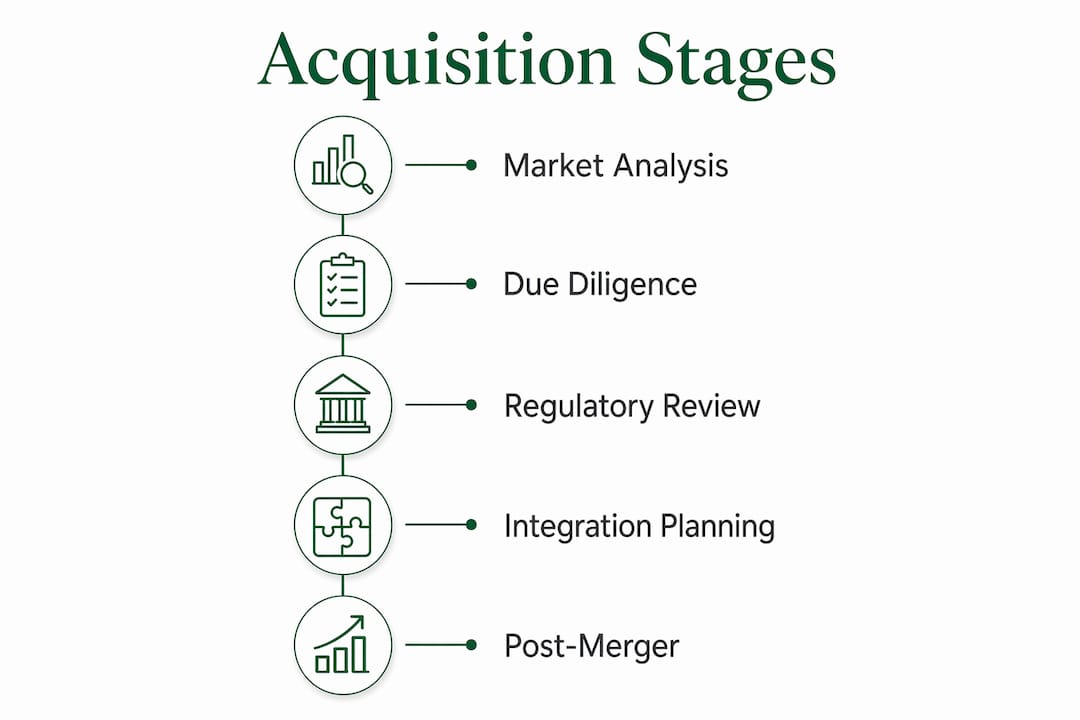
Legal complexity is the defining characteristic of cross-border M&A. Every jurisdiction involved has its own rules, and no single regulator has authority over all of them. The following sequence describes how regulatory review typically unfolds in a major cross-border deal.
- Pre-signing assessment. Advisors in each affected country identify which filings are mandatory and which are voluntary. Missing a mandatory filing can void a transaction or trigger penalties.
- Simultaneous filings. The U.S. Hart-Scott-Rodino (HSR) Act and the EU Merger Regulation (EUMR) both require pre-closing notification above certain thresholds. Any single regulator can block or delay closing, regardless of what other regulators approve.
- CFIUS review. In the United States, the Committee on Foreign Investment in the United States (CFIUS) screens deals involving foreign buyers for national security risk. Under the Foreign Investment Risk Review Modernization Act (FIRRMA), CFIUS jurisdiction expanded to cover minority investments in sensitive technology, infrastructure, and data companies. CFIUS review timelines range from approximately 30 business days for a mandatory declaration to 45 days plus a full investigation period for a complete notice, which can extend the total process to six months.
- Conditions and remedies. Regulators may approve a deal with conditions: divestitures, behavioral commitments, or ongoing reporting obligations. Buyers who anticipate these conditions early can negotiate deal terms that account for them.
- Tax and treaty navigation. Cross-border deals trigger complex tax questions. Double taxation treaties between countries determine how profits, dividends, and capital gains are taxed post-acquisition. Structuring the deal through the wrong holding company jurisdiction can cost millions in avoidable tax.
“Legal requirements like CFIUS jurisdiction cannot be contractually avoided. Compliance within mandated timelines is not optional.” — AcquisitionStars Cross-Border M&A Legal Guide
Employment law adds another layer. Worker protections, termination rules, and works council consultation requirements vary widely across the EU, Asia, and Latin America. A buyer who plans to restructure the workforce post-acquisition must understand local labor law before signing, not after.
How do cultural and operational integration issues affect deal success?
Cultural differences are the most underestimated risk in cross-border acquisitions. Regulatory approval is a milestone. Actual value creation happens during integration, and integration is where most deals lose ground.
- Communication norms. Decision-making speed, hierarchy, and directness vary significantly across cultures. A U.S. acquirer expecting fast, flat-organization decisions may clash with a Japanese target where consensus-building is standard practice.
- Corporate governance. Board structures, shareholder rights, and executive accountability differ by country. Germany’s two-tier board system, for example, gives employee representatives formal governance power. Buyers unfamiliar with this structure often underestimate its impact on post-deal operations.
- Workforce integration. Managing teams across multiple time zones, languages, and employment contracts requires dedicated HR planning. Retaining key talent at the acquired company is often the single most important integration task.
- Currency risk. Post-acquisition, the acquirer consolidates financials across currencies. Exchange rate movements can erode reported earnings even when the underlying business performs well. Hedging strategies must be in place before the deal closes.
BCG’s research confirms that intra-regional deals outperform inter-regional ones in part because cultural and operational proximity reduces integration friction. Buying a Canadian company is easier to integrate than buying a Vietnamese one, not because the Vietnamese business is less valuable, but because the integration complexity is lower.
Early regulatory calendaring and coordination with global advisors improve both the probability of closing and the quality of value capture post-deal. Buyers who treat integration planning as a post-signing task consistently underperform those who start before the term sheet is signed.
What are the different types of cross-border acquisitions?
Cross-border deals take several structural forms. The right structure depends on the buyer’s goals, the regulatory environment, and the level of control required. Understanding the types of acquisition strategies available is a prerequisite for choosing the right approach.
| Deal Type | Key Characteristic | Typical Business Goal |
|---|---|---|
| Full acquisition (foreign takeover) | Buyer acquires 100% or majority control | Complete integration, technology ownership |
| Multinational merger | Two companies combine as equals across borders | Scale, market consolidation |
| Joint venture | Shared ownership and control in a new entity | Market entry with limited risk exposure |
| Vertical acquisition | Buyer acquires supplier or distributor | Supply chain control, margin improvement |
| Market-extension acquisition | Buyer enters a new geographic market | Revenue growth, customer base expansion |
| Conglomerate acquisition | Buyer acquires unrelated business in another country | Portfolio diversification |
Full acquisitions give the buyer the most control but carry the highest integration burden and regulatory scrutiny. Joint ventures offer a lower-risk entry point but limit the buyer’s ability to capture the full value of the target. Multinational mergers, like the AB InBev and Anheuser-Busch deal, require approval from regulators in every major market where both companies operate.
Deal structure choices directly affect control rights, integration complexity, and compliance exposure. A joint venture avoids the full weight of CFIUS review in many cases, while a full acquisition of a U.S. technology company almost always triggers mandatory CFIUS filing under FIRRMA.
Pro Tip: Work with advisors who specialize in cross-border deal outcomes before selecting a deal structure. The wrong structure can create years of regulatory and operational problems that no amount of post-deal management can fully resolve.
My honest read on what actually determines cross-border deal success
Cross-border acquisitions reward preparation more than any other deal type. The buyers who consistently close deals and capture value are not the ones with the largest balance sheets. They are the ones who start regulatory planning before the term sheet, assign integration leads before signing, and treat cultural due diligence as seriously as financial due diligence.
Geopolitical shifts have made this even more true in 2026. CFIUS scrutiny has expanded. The EU has introduced its own foreign subsidy screening mechanism. Several Asian markets have tightened inbound investment rules. The regulatory environment is not static, and buyers who assume last year’s playbook still applies are taking real risk.
The multi-jurisdictional advisor coordination problem is also underappreciated. Legal teams in New York, Brussels, and Tokyo do not naturally synchronize. Someone on the deal team must own the global timeline and hold every advisor accountable to it. Without that coordination, filings slip, deadlines are missed, and deals fall apart at the finish line.
The BCG data on intra-regional outperformance is worth taking seriously. It does not mean you should avoid inter-regional deals. It means you should price the integration complexity honestly and build the resources to manage it before you sign. Speed matters in competitive processes, but speed without preparation is how buyers overpay and underdeliver.
— Sierra
How Compassbusinessacquisitions supports your acquisition goals
Compassbusinessacquisitions brings deep market knowledge and a proven track record to buyers and sellers navigating complex acquisition processes, including cross-border transactions.

Whether you are looking to acquire a business in a new market or position your company for a successful sale, Compassbusinessacquisitions provides professional valuations, targeted marketing, and direct access to a qualified buyer and seller network. The firm prioritizes strategic alignment between parties, which means transactions close with the right fit, not just the highest bid. For buyers facing multi-market complexity, Compassbusinessacquisitions connects you with advisors and opportunities that match your growth objectives. Contact Compassbusinessacquisitions to discuss your acquisition goals and get a clear picture of what your next deal could look like.
FAQ
What is a cross-border business acquisition?
A cross-border business acquisition is a transaction where a buyer in one country purchases and gains controlling interest in a company based in another country. It is also called a foreign takeover or international M&A deal.
How long does a cross-border acquisition take to close?
Timelines vary based on regulatory complexity. CFIUS mandatory declaration reviews take approximately 30 business days, while full notice reviews can extend the process to six months or longer when a full investigation is required.
What is CFIUS and why does it matter for cross-border deals?
CFIUS is the Committee on Foreign Investment in the United States, which reviews foreign acquisitions of U.S. companies for national security risk. Under FIRRMA, its jurisdiction expanded to include minority investments in sensitive technology and data businesses.
Do cross-border acquisitions outperform domestic deals?
BCG’s 2025 research shows intra-regional cross-border deals generate an average two-year relative total shareholder return of +1.2%, compared to -0.9% for domestic deals. Inter-regional deals average +0.6%, making geographic proximity a meaningful performance factor.
What is the biggest risk in a cross-border acquisition?
Cultural and operational integration failure is the most common reason cross-border deals underdeliver. Regulatory approval is a milestone, but value is created or destroyed during the integration phase that follows closing.