
How to Market Your Business to Ideal Buyers
How to Market Your Business to Ideal Buyers
The most effective way to market your business to ideal buyers is straightforward: define a narrow buyer profile, prepare clean and verifiable financials, and run a confidential, controlled outreach process from teaser to final bid. Broad listings attract tire-kickers. Targeted outreach attracts qualified buyers who can close. According to SBA guidance, a formal marketing plan that describes your audience, competitive advantage, and measurable actions is a foundational step in preparing a business for sale — not an optional add-on.
Here is where to start in the next 7–30 days:
- Pull your last three years of profit and loss statements and reconcile them against tax returns.
- Identify your top three buyer categories (strategic acquirer, private equity, individual operator) and rank which fits your goals.
- Draft a one-page anonymous teaser that describes the business without naming it.
- List the five contracts or customer relationships a buyer will ask about first.
- Decide whether you need an M&A advisor before any outreach begins.
Pro Tip: Call an advisor before you tell anyone the business is for sale. Once word spreads informally, you lose pricing leverage and risk alarming employees, customers, and suppliers.
Compassbusinessacquisitions is one advisor option worth contacting early. The firm specializes in professional valuations, confidential marketing, and buyer-seller matching for small and medium-sized U.S. businesses.
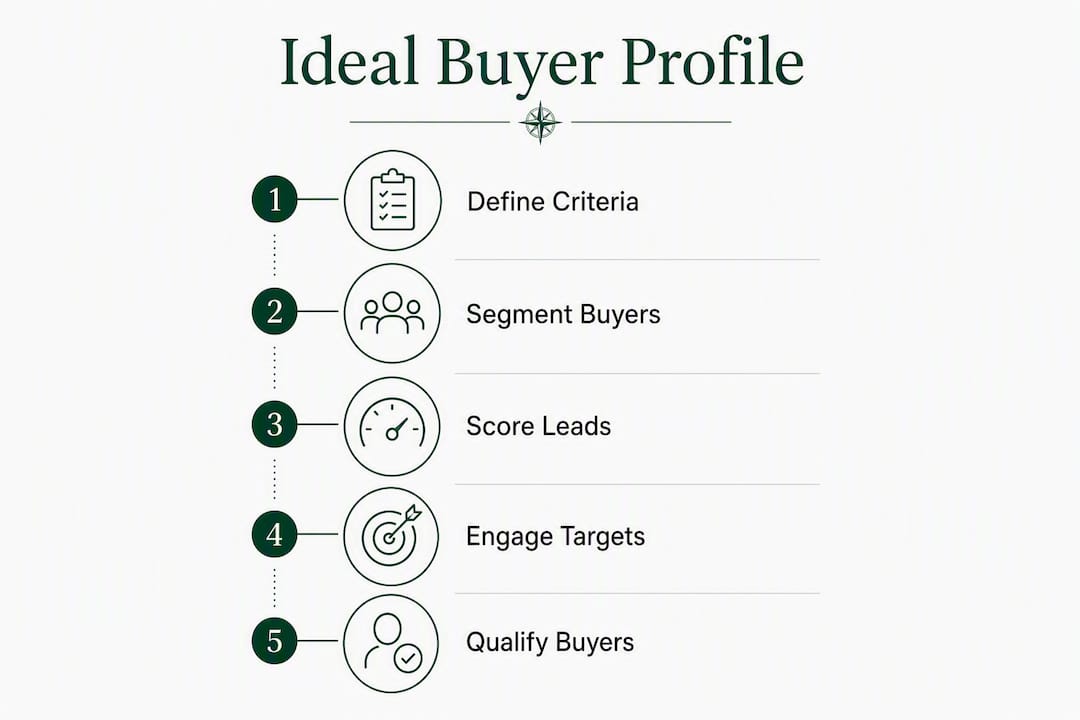
Table of Contents
- What are the main buyer types and what does each one want?
- How do you build an ideal-buyer profile for your business?
- What should you fix and document before marketing your business?
- How do you run a confidential, targeted marketing process?
- Where do you find qualified buyers in the U.S.?
- How do you separate serious buyers from time-wasters?
- What deal structures and timelines should you expect?
- When should you hire an M&A advisor and what should you ask them?
- The 30–60–90 day playbook for marketing your business
- What seller mistakes destroy value and how do you fix them?
- How does valuation work and what should you budget for transaction costs?
- Post-sale integration considerations by buyer type
- Key Takeaways
- The case for confidentiality-first selling
- Compassbusinessacquisitions: professional guidance for sellers ready to move
- Useful sources and further reading
What are the main buyer types and what does each one want?
Understanding buyer categories is the first filter in any targeted outreach plan. Each type pays for different things, structures deals differently, and moves on a different timeline. Matching your business to the right category before you market it determines whether you get one strong offer or a dozen weak ones.

Strategic buyers
Strategic buyers are operating companies in your industry or an adjacent one. They pay a premium for synergies: your customer list, your technology, your geographic footprint, or your team. They typically favor stock purchases (to absorb assets cleanly) and often offer the highest headline price. The tradeoff is a longer diligence process and a higher likelihood of post-close integration changes, including staff reductions.
Financial buyers and private equity
Private equity firms and family offices buy businesses as investments. They focus on EBITDA, recurring revenue, and growth trajectory. A PE firm will often use leverage (debt financing) to fund part of the acquisition, so they need predictable cash flow to service that debt. Earnouts are common when there is uncertainty about future performance. Timelines run 60–120 days from LOI to close, and they expect a clean data room from day one.
Search funds and ETA buyers
Search fund operators, also called Entrepreneurship Through Acquisition (ETA) buyers, are typically individuals backed by a small investor group who are searching for one business to acquire and operate personally. Harvard Business Review has covered this model extensively as a growing path into business ownership. These buyers prioritize stable cash flow, a manageable transition period, and a seller willing to stay involved for 3–12 months. They tend to be thorough, motivated, and personally invested in the outcome.
Individual and operator buyers
Owner-operators are individuals buying a job as much as an investment. They often use SBA 7(a) loans to finance the purchase, which means the business must meet SBA eligibility criteria and the buyer must qualify for financing. These buyers move more slowly, require more seller education, and are sensitive to price. They are, however, often the best cultural fit for businesses where the owner’s personal relationships are central to operations.
| Buyer Type | What They Pay For | Common Structure | Typical Timeline | Decision Driver |
|---|---|---|---|---|
| Strategic | Synergies, market share | Stock sale, cash at close | 90 days | Strategic fit |
| Private Equity | EBITDA, recurring revenue | Asset sale, earnout possible | 60–120 days | Return on investment |
| Search Fund / ETA | Stable cash flow, transition support | Asset sale, seller note common | 90 days | Operational fit |
| Individual Operator | Lifestyle, cash flow | Asset sale, SBA financing | 90 days | Affordability, simplicity |
Pro Tip: If your primary goal is preserving the business’s culture and retaining your team, a search fund or individual operator buyer is usually a better fit than a PE firm, even if the PE offer is higher on paper.
How do you build an ideal-buyer profile for your business?
In sales and marketing, this is called an Ideal Customer Profile (ICP). For a business sale, the concept is identical: a precise description of the buyer most likely to close, pay a fair price, and honor the seller’s post-sale goals. Organizations focused on precise buyer profiling often see improvements in pipeline efficiency when targeting the right accounts, and the same principle applies directly to buyer outreach.
The five-layer profiling framework
Build your ICP across five dimensions:
- Deal-level filters: — Minimum and maximum deal size, preferred deal structure (cash vs. earnout), financing capacity, and SBA eligibility (for individual buyers).
A simple buyer scorecard
Score each prospective buyer on four criteria before investing time in a full pitch:
- Financial capacity (0–30 points): Proof of funds, financing pre-approval, or fund size documentation.
- Strategic fit (0–25 points): Industry alignment, operational overlap, or stated acquisition thesis.
- Ability to close (0–25 points): Prior deal history, advisor representation, and realistic timeline.
- Cultural fit (0–20 points): Stated plans for staff, brand, and operations post-close.
A buyer scoring below 60 out of 100 should receive a teaser only. Above 75, they earn a CIM and a management meeting. A validated ICP is a hypothesis until tested with real conversations: run 10–20 targeted conversations with potential buyers or their advisors and measure whether they describe the same acquisition criteria in similar terms. That pattern confirms your profile.
Pro Tip: A 30-minute ICP exercise using three data inputs — competitor negative reviews, churn interviews, and public forum threads — can produce a defensible buyer profile faster than most owners expect. Adapt this for your sale by reviewing why past acquisition conversations fell apart.
What should you fix and document before marketing your business?
Preparation is where most sellers lose money. Buyers discount aggressively for uncertainty. Clean, organized documentation removes uncertainty and supports your asking price. Practical checklists confirm that up-to-date financials, forward projections, and management documentation are the first documents buyers request — and the first place they look for reasons to lower their offer.
Priority preparation checklist
- Three years of audited or reviewed financial statements (P&L, balance sheet, cash flow)
- Reconciled tax returns matching financial statements
- Normalized EBITDA schedule (add-backs documented and defensible)
- Customer concentration analysis (ideally ensuring no single customer dominates revenue)
- All material contracts: leases, supplier agreements, customer MSAs, and IP assignments
- Employee documentation: org chart, key-person agreements, non-competes
- Documented operating procedures for core business functions
- KPI dashboard: monthly revenue, gross margin, customer retention, and pipeline
For a deeper walkthrough of what buyers examine, the Compass guide to preparing your business for a strategic sale covers financial, legal, and operational preparation in detail.
Documents to prepare for marketing
- One-page anonymous teaser — describes the business by industry, revenue range, and key metrics without identifying it.
- Confidential Information Memorandum (CIM) — a 20–40 page document covering business overview, financial history, growth opportunities, and management team. Released only after NDA.
- Normalized financial model — three years of actuals plus a two-year projection, with add-backs clearly labeled.
- Ownership summary — cap table, any minority interests, and any outstanding obligations.
- Customer KPI summary — retention rate, average contract value, top-10 customer breakdown.
For practical guidance on packaging business assets for sale, including teaser and CIM structure, Compassbusinessacquisitions has published a detailed seller resource.
Estimated preparation timeline
Financial cleanup typically takes 30–60 days if books are in reasonable order, or 60–90 days if reconciliation is needed. Contract organization runs 2–4 weeks. CIM drafting takes 3–6 weeks with advisor support. Operational fixes (reducing owner dependency, documenting processes) can take 3–6 months and are worth starting well before any marketing begins.
Where preparation most directly improves valuation: demonstrating recurring revenue, reducing customer concentration, and documenting that the business runs without the owner present. Each of these directly reduces buyer-perceived risk, which translates into a higher multiple.
How do you run a confidential, targeted marketing process?
Narrow, targeted outreach consistently yields higher conversion and preserves seller leverage versus broad broadcasting. The controlled process below is the industry standard for small and mid-market transactions.
The controlled outreach sequence
- Teaser distribution — Send the anonymous one-page teaser to a pre-screened buyer list. No business name, no financials, no identifying details.
- NDA execution — Interested buyers sign a mutual NDA before receiving any identifying information.
- CIM release — Qualified, signed buyers receive the full CIM and financial model.
- Management meetings — Shortlisted buyers meet the owner and key management. These are structured presentations, not open-ended conversations.
- Indication of Interest (IOI) or Letter of Intent (LOI) — Buyers submit written offers with price, structure, and key conditions.
- Exclusivity and due diligence — The strongest buyer enters exclusivity. Full diligence begins.
- Definitive agreement and close — Legal documents are finalized, conditions are satisfied, and the transaction closes.
Channel selection by buyer type
- Direct outreach to buyer lists: Most effective for PE firms and search funds, where contact information is publicly available through fund websites and search-fund directories.
- Broker-managed introductions: Advisors like Compassbusinessacquisitions maintain proprietary buyer networks and can reach qualified buyers without public disclosure.
- Curated marketplaces: Useful for individual and operator buyers. Listings should be anonymized and require NDA before details are shared.
- Industry associations and trade networks: Effective for strategic buyers who are active in your sector.
Sample teaser messaging hooks by buyer type
- For PE firms: “Recurring revenue SaaS business, $2.4M EBITDA, 90% retention, minimal capex, owner transitioning.”
- For strategic buyers: “Regional leader in [sector], 15-year customer relationships, complementary geography to acquirers in [adjacent market].”
- For search fund operators: “Stable, cash-flowing business with documented processes, owner willing to stay 12 months, SBA-eligible.”
Pro Tip: Never send a teaser that names the business, its location, or its customers. Use anonymized descriptions and require NDA before any identifying detail is shared. A staged data room — where documents are released in layers as buyer commitment increases — protects sensitive information and increases bid quality.
Where do you find qualified buyers in the U.S.?
Building a targeted buyer list is a research exercise before it is an outreach exercise. Combining industry association lists, marketplace search, and professional directories produces a high-probability buyer pool that is far more efficient than generic advertising.
Buyer sourcing checklist
- Industry associations: Most trade associations publish member directories. Strategic buyers in your sector are often active members.
- PE and family-office directories: Directories such as PitchBook, AxialMarket, and Grata list funds by deal size, sector focus, and geography.
- Search-fund rosters: Stanford’s search-fund database and the Search Fund Primer list active searchers by year and sector preference.
- LinkedIn: Filter by title (VP of Corporate Development, Principal at [PE firm]) and industry to identify decision-makers at likely acquirers.
- Public filings: SEC EDGAR filings and press releases identify companies that have made acquisitions in your sector in the past 24 months — strong signals of continued appetite.
- Professional networks: Your attorney, CPA, and banker likely know buyers actively looking in your space.
- Curated marketplaces: Platforms that require buyer registration and NDA before listing details are visible.
Channel selection by buyer type
Operator and individual buyers are most often found through curated marketplaces and SBA lender networks. PE firms and family offices respond best to direct outreach through their fund contact pages or through an intermediary with a prior relationship. Search fund operators are reachable through alumni networks (Stanford, Harvard Business School) and the ETA community on LinkedIn.

Sample initial outreach message
Keep the first message under 100 words. State that you represent a business in a specific sector, give one or two financial metrics (revenue range, EBITDA margin), confirm confidentiality, and ask whether the buyer is actively looking in this space. Do not name the business. Do not attach documents. Follow up once after 5–7 business days if there is no response, then move on.
How do you separate serious buyers from time-wasters?
Qualification is the most underrated step in the process. Every hour spent with an unqualified buyer is an hour not spent with a serious one. The goal is to surface financial capacity, strategic rationale, and genuine intent as early as possible.
Qualification checklist
- Proof of funds or financing pre-approval: — A serious buyer can produce a bank letter, fund commitment, or SBA pre-qualification within 48–72 hours of request.
Questions to ask early
- What is your financing source, and is it committed or contingent?
- What acquisitions have you closed, and what was the approximate deal size?
- What would you change about the business in the first 90 days?
- Who else is involved in your decision-making process?
- What is your target close date?
Red flags and corrective actions
- No proof of funds after two requests: Remove from the pipeline.
- Aggressive price reduction before seeing the CIM: A pattern of lowballing before diligence signals a bad-faith negotiator.
- Unrealistic deadlines: A buyer demanding a 30-day close on a $5M transaction has not done this before.
- Requests for employee names or customer lists before NDA: A confidentiality violation waiting to happen.
When a red flag appears, the corrective action is the same in every case: slow down the information flow, request the missing documentation, and do not advance to the next stage until it is provided.
What deal structures and timelines should you expect?
Understanding deal formats before you receive an offer prevents costly surprises and protects your negotiating position. The structure of a deal determines realized price as much as the headline number does.
Common deal structures
- Asset sale: — The buyer purchases specific assets (equipment, contracts, IP, goodwill) rather than the legal entity. Most common for small businesses. Sellers typically prefer stock sales for tax reasons; buyers prefer asset sales for liability protection.
- Seller note: — The seller finances a portion of the purchase price, typically 10–30%, repaid over 3–7 years. Common in SBA transactions and with individual buyers.
Typical transaction timeline
- Preparation and marketing: 30–90 days
- Teaser distribution and NDA execution: 2–4 weeks
- CIM release and management meetings: 3–6 weeks
- LOI negotiation and execution: 1–3 weeks
- Due diligence: 45–90 days
- Definitive agreement drafting: 2–4 weeks
- Close: 1–2 weeks after agreement execution
Total elapsed time from first outreach to close typically runs 4–9 months for a well-prepared transaction. For a detailed walkthrough of the closing sequence, the Compass guide to the business sale closing process covers each stage with practical checklists.
Due diligence: what buyers will examine
- Financial statements, tax returns, and bank statements (3 years minimum)
- Customer contracts and concentration analysis
- Employee agreements, benefits, and any pending HR matters
- Intellectual property ownership and registration
- Lease agreements and real property obligations
- Pending or threatened litigation
- Environmental and regulatory compliance
Negotiation points that shift value
Representations and warranties (reps and warranties) define what the seller is certifying as true at close. Broad reps increase seller risk; negotiate for narrow, knowledge-qualified reps. Indemnity caps (typically 10–20% of purchase price) and survival periods (12–24 months) are standard negotiating points. Escrow holdbacks (5–15% of proceeds held for 12–18 months) are common and should be minimized where possible. This is where experienced legal counsel and an M&A advisor add the most measurable value.
When should you hire an M&A advisor and what should you ask them?
Advisors act as a buffer during intense negotiation and diligence phases, preserving owner readiness and preventing rushed concessions. The question is not whether an advisor adds value — they consistently do — but whether your transaction is complex enough to justify the cost.
Signals you should hire an advisor now
- Your business has more than $500K in annual EBITDA (the buyer universe expands significantly, and so does deal complexity).
- You have limited time to manage a sale process while running the business.
- You expect multiple buyer types to be interested and want competitive bidding.
- Confidentiality is critical (employees, customers, or competitors cannot know the business is for sale).
- You have never sold a business before and do not know what a fair deal looks like.
Questions to ask a prospective advisor
- How many transactions in my industry and deal size range have you closed in the past three years?
- What does your buyer network look like for this type of business?
- How do you structure your fee? What is the success fee percentage, and is there a retainer?
- What is your typical timeline from engagement to close?
- Can you provide references from sellers in comparable transactions?
- How do you handle confidentiality during the marketing process?
Advisor value matrix
| Task | With an Advisor | Without an Advisor |
|---|---|---|
| Buyer list building | Proprietary network + research | Manual research only |
| Teaser and CIM preparation | Advisor-drafted, professionally positioned | Owner-drafted, variable quality |
| Buyer vetting | Advisor screens before owner time is spent | Owner handles all inquiries |
| Negotiation | Advisor as buffer, preserves relationship | Owner negotiates directly, risks leverage |
| Diligence management | Advisor coordinates data room and requests | Owner manages while running business |
| Deal management | Advisor tracks milestones and deadlines | Owner tracks independently |
Common fee terms
Success fees for small and mid-market transactions typically follow a Lehman-formula structure or a flat percentage of the transaction value, often ranging from 5–10% for smaller deals (under $2M) and 3–6% for mid-market deals ($2M–$10M). Some advisors charge a monthly retainer of $2,000–$5,000 against the success fee. Expense reimbursement for travel, data room costs, and marketing materials is typically billed separately. Always confirm in writing what triggers the success fee (LOI, close, or both) and whether it applies to earnout payments.
The 30–60–90 day playbook for marketing your business
This sequence reflects the practical approach Compassbusinessacquisitions uses with sellers to move from preparation to competitive offers while protecting confidentiality throughout.
Days 1–30: Prepare
- Assemble three years of financial statements and reconcile against tax returns.
- Build the normalized EBITDA schedule with documented add-backs.
- Identify and organize all material contracts (leases, customer agreements, supplier contracts).
- Draft the one-page anonymous teaser.
- Define your ideal-buyer profile and build an initial list of 20–40 target buyers.
- Engage legal counsel and confirm ownership structure and any transfer restrictions.
Days 31–60: Build and outreach
- Complete the CIM with advisor support.
- Set up a virtual data room (VDR) with tiered access levels.
- Begin selective teaser distribution to the top 20 buyers on your list.
- Execute NDAs with interested parties and release the CIM.
- Schedule management meetings with the top 5–8 qualified buyers.
- Collect IOIs and evaluate initial offer ranges.
Days 61–90: Qualify and advance
- Narrow the field to 2–3 serious buyers based on IOI quality and qualification scores.
- Conduct final management meetings and answer follow-up diligence questions.
- Request LOIs from the top buyers, with a firm submission deadline to create urgency.
- Evaluate LOIs on price, structure, contingencies, and cultural fit.
- Select the lead buyer, negotiate key terms, and execute the LOI.
- Begin formal due diligence with the selected buyer.
Pro Tip: Set a hard LOI deadline and communicate it to all shortlisted buyers simultaneously. A stated deadline creates competitive pressure without requiring you to disclose how many other buyers are in the process. This tactic alone can improve offer quality and reduce time to LOI.
Sellers who follow a structured preparation and outreach sequence consistently report shorter transaction timelines and stronger final offers than those who approach the market informally. Documented processes, clean financials, and a confidential outreach approach are the three variables most directly within a seller’s control.
What seller mistakes destroy value and how do you fix them?
Most value-eroding mistakes happen before the first buyer conversation. Recognizing them early gives you time to correct course.
Common mistakes
- Broadcasting availability: Telling multiple people informally that the business is for sale before a confidential process is in place. This leaks to employees, customers, and competitors before you are ready.
- Rushed documentation: Sending a CIM with inconsistencies, missing financials, or unreconciled numbers. Buyers use document quality as a proxy for management quality.
- Overreliance on one buyer: Entering exclusivity too early or letting one buyer know they are the only option. This eliminates competitive pressure and shifts leverage entirely to the buyer.
- Ignoring cultural fit: Accepting the highest offer from a buyer whose post-close plans conflict with the seller’s stated goals for employees and customers.
- Weak financial narrative: Presenting raw financials without normalization or context. A business with $800K in EBITDA that includes $200K in owner add-backs needs a clear, documented explanation — not a footnote.
Red flags buyers see that sink valuations
- Unclean books: unexplained variances, personal expenses mixed with business expenses, or revenue recognition inconsistencies.
- Missing or expired contracts: month-to-month customer agreements signal revenue risk.
- Owner-dependent operations: if the business cannot function for two weeks without the owner, buyers discount heavily for key-person risk.
Corrective actions
Address financial inconsistencies with a CPA before marketing begins. Convert month-to-month customer agreements to multi-year contracts where possible. Document the owner’s role and begin delegating key functions to management at least 6–12 months before going to market. For guidance on avoiding the psychological traps that lead to these mistakes, the Compass guide on emotional pitfalls when selling your business addresses the owner psychology behind rushed decisions.
Pro Tip: Communicate with buyers on a structured cadence: weekly updates during active diligence, bi-weekly during marketing. Irregular or reactive communication signals disorganization and creates buyer anxiety that translates into price reductions.
How does valuation work and what should you budget for transaction costs?
Valuation is the foundation of every negotiation. Understanding how buyers calculate value — and how advisors support that calculation — prevents sellers from leaving money on the table or pricing themselves out of the market.
Valuation approaches
- EBITDA multiples: The most common method for small and mid-market businesses. A buyer applies a multiple (typically 3–8x for small businesses, higher for recurring-revenue or high-growth businesses) to normalized EBITDA. The multiple varies by industry, growth rate, customer concentration, and deal size.
- Comparable transactions (comps): Advisors reference recent sale prices for similar businesses in the same industry and size range. This grounds the asking price in market reality.
- Discounted Cash Flow (DCF): More common in larger transactions or businesses with predictable long-term contracts. Projects future cash flows and discounts them to present value. PE firms use DCF to model returns.
Strategic buyers tend to favor comps and synergy-adjusted multiples. PE firms use EBITDA multiples and DCF. Individual buyers focus on seller’s discretionary earnings (SDE), which includes owner compensation.
Typical transaction costs
- Advisor success fee: Typically 5–10% for deals under $2M; 3–6% for deals in the $2M–$10M range.
- Legal fees: $15,000–$50,000 for a straightforward transaction; higher for complex structures or contested terms.
- Accounting and tax advisory: $5,000–$20,000 for financial statement preparation, normalization, and tax planning.
- Escrow and closing costs: Typically 0.5–1% of the transaction value.
Tax planning note: The structure of the deal (asset vs. stock sale) has a direct and significant impact on your net proceeds. Consult a CPA before accepting any offer. The difference between capital gains treatment and ordinary income treatment on the same headline price can be substantial. The IRS provides guidance on business sale tax treatment at IRS.gov, but a qualified CPA is the right starting point for your specific situation.
How earnouts and seller notes change realized price
A $3M deal with $500K in earnout contingencies is not a $3M deal. It is a $2.5M deal with an option to earn more if future performance targets are met. Earnouts are frequently missed when post-close integration disrupts operations. Negotiate for cash at close wherever possible, and if an earnout is unavoidable, define the metrics precisely, keep the measurement period short (12–24 months), and include seller protections against buyer actions that could artificially suppress performance.
This article provides general information about business sale processes and is not legal, tax, or financial advice. Consult a qualified attorney, CPA, or M&A advisor before making decisions about your transaction.
Post-sale integration considerations by buyer type
The deal does not end at close. How a buyer integrates the business directly affects whether earnout payments are made, whether the seller’s reputation survives, and whether the team and customers the seller cared about are protected. Understanding integration expectations by buyer type helps sellers negotiate better transition terms and set realistic expectations.
Strategic buyers
Strategic acquirers typically move fast on integration. They want to consolidate systems, rebrand, and capture synergies quickly. For sellers, this means the business’s identity, brand, and team structure may change within 6–12 months of close. If preserving the brand or protecting specific employees matters to you, negotiate those protections explicitly in the definitive agreement, not as a verbal understanding.
Private equity buyers
PE firms usually keep existing management in place, at least initially, because their investment thesis depends on the business continuing to perform. They will install financial reporting requirements, add board oversight, and may bring in a CFO or COO. Sellers who stay on in a management role post-close should clarify their authority, compensation, and exit path in writing before signing.
Search fund and ETA buyers
The search fund operator is buying a job. They will be present daily, learning the business from the inside. A well-structured transition period (6–12 months of seller involvement) is the single biggest predictor of a smooth handoff. Sellers should document every process, introduce the buyer to key customers and suppliers personally, and be available for questions during the transition window.
Individual and operator buyers
Individual buyers often underestimate the complexity of the business they are acquiring. A seller who invests in a thorough transition reduces the risk of post-close disputes, earnout conflicts, and reputational damage. Provide a written operations manual, introduce the buyer to your team formally, and set clear boundaries on the seller’s post-close availability.
For sellers evaluating what buyers look for before and after close, the Compass buyer’s checklist for signs a business is worth acquiring offers a useful perspective from the buyer’s side of the table.
Key Takeaways
The most effective way to market your business to ideal buyers is to define a narrow buyer profile, prepare clean and verifiable financials, and run a confidential, controlled outreach process that preserves leverage from teaser to close.
| Point | Details |
|---|---|
| Define your buyer profile first | Build an ICP with firmographics, deal filters, and an anti-ICP before any outreach begins. |
| Prepare documents before marketing | Clean financials, a normalized EBITDA schedule, and a CIM are required before approaching buyers. |
| Use a controlled outreach sequence | Teaser to NDA to CIM to LOI protects confidentiality and increases bid quality. |
| Qualify buyers early and firmly | Proof of funds, deal history, and strategic rationale must be confirmed before advancing any buyer. |
| Compassbusinessacquisitions | Provides professional valuation, confidential marketing, and buyer matching for U.S. business sellers. |
The case for confidentiality-first selling
Most sellers underestimate how much the process itself shapes the outcome. A business marketed broadly and publicly rarely commands the same multiple as one sold through a disciplined, confidential process to a shortlisted group of qualified buyers. The difference is not just about price. It is about who ends up owning the business and on what terms.
The conventional wisdom says: list widely, create competition, and let the market decide. In practice, wide listings attract low-quality inquiries, expose sensitive information prematurely, and signal to serious buyers that the seller is desperate or disorganized. Targeted outreach to 20–40 pre-screened buyers, executed through a staged document release, consistently produces better outcomes than a broad campaign to hundreds of unqualified prospects.
The other underrated variable is timing. Sellers who prepare 12–18 months before going to market — cleaning financials, reducing owner dependency, locking in customer contracts — consistently achieve higher multiples than those who decide to sell and go to market within 60 days. The business does not need to be perfect. It needs to be credible, documented, and positioned for the buyer type most likely to pay a premium.
Advisors who centralize buyer communication, manage the data room, and negotiate on the seller’s behalf reduce deal fatigue and protect leverage at the moments when sellers are most likely to make concessions. That buffer is worth more than most sellers realize until they are in the middle of a diligence process while simultaneously running a business.
Compassbusinessacquisitions: professional guidance for sellers ready to move
Selling a business at full value requires more than a listing. It requires a verified valuation, a confidential marketing process, and a buyer network that reaches the right acquirers before anyone else does.
Compassbusinessacquisitions delivers exactly that for U.S. business owners. The firm provides professional business valuations grounded in current market comps and EBITDA analysis, confidential marketing through a controlled teaser-to-CIM process, and direct buyer matching across strategic, financial, and operator buyer categories. Every engagement is structured to protect seller leverage from the first conversation to the final close.
For your first call, have ready: three years of financial statements, a summary of your key customer relationships, and a clear sense of your timeline and post-sale goals. From there, Compassbusinessacquisitions handles the process.
Start with the free business evaluation calculator to get an initial sense of your business’s market value, or go directly to the seller services page to schedule a confidential consultation.
Useful sources and further reading
These resources support the methods and frameworks covered in this guide. Each is authoritative and publicly available.
- SBA Marketing and Sales Guidance — The U.S. Small Business Administration’s official guidance on building a marketing plan, including audience definition, competitive advantage, and measurable actions. Directly applicable to preparing a business for sale.
- CFO.University: Making Your Business Attractive to a Buyer — Practical checklist of the documents and financial signals buyers prioritize in early diligence.
- Harvard Business Review: Buying Your Way Into Entrepreneurship — HBR’s coverage of the search fund and ETA model, useful for understanding this buyer category’s motivations and deal expectations.
- FINRA BrokerCheck — Verify the registration and background of any financial intermediary involved in your transaction. Use before engaging any broker or advisor.
- IRS Business Sale Tax Guidance — The authoritative source for tax treatment of business sale proceeds. Consult a CPA alongside this resource for your specific structure.
- Compass: What Makes a Business Sellable — A practical breakdown of sellability criteria and common buyer concerns, published by Compassbusinessacquisitions.
- Compass: Types of Business Exit Strategies — Covers exit strategy options and buyer motivations across deal types.
- Business Growth Roadmap Guide — Covers growth-roadmap tactics and lead-generation systems that help sellers build buyer interest and demonstrate predictable business performance.