
How to Package Business Assets for Sale Effectively
How to Package Business Assets for Sale Effectively
Packaging business assets for sale is defined as the process of identifying, categorizing, documenting, and presenting all operational components of a business to attract qualified buyers and maximize sale value. This practice is distinct from a stock sale, where the entire business entity transfers as-is. In an asset sale, you choose exactly which components transfer, giving you control over what liabilities and obligations the buyer assumes. Small business owners who approach this process with clear documentation and organized presentation consistently achieve better outcomes than those who list assets informally.
What does it mean to package business assets for sale?
An asset sale gives you more flexibility than a stock sale. Asset sales allow selective transfer of operational components like goodwill, intellectual property, and equipment, while excluding specific liabilities or unwanted obligations. That flexibility is the primary reason many small business owners prefer this structure when exiting. You control the deal’s shape from the start.
The term “packaging” is informal but widely used by brokers and advisors. The recognized industry term is preparing an asset sale package or information memorandum. Both describe the same output: a complete, organized set of documents and disclosures that lets a buyer evaluate exactly what they are purchasing. Understanding what makes a business sellable before you begin packaging saves significant rework later.
What business assets should you include?
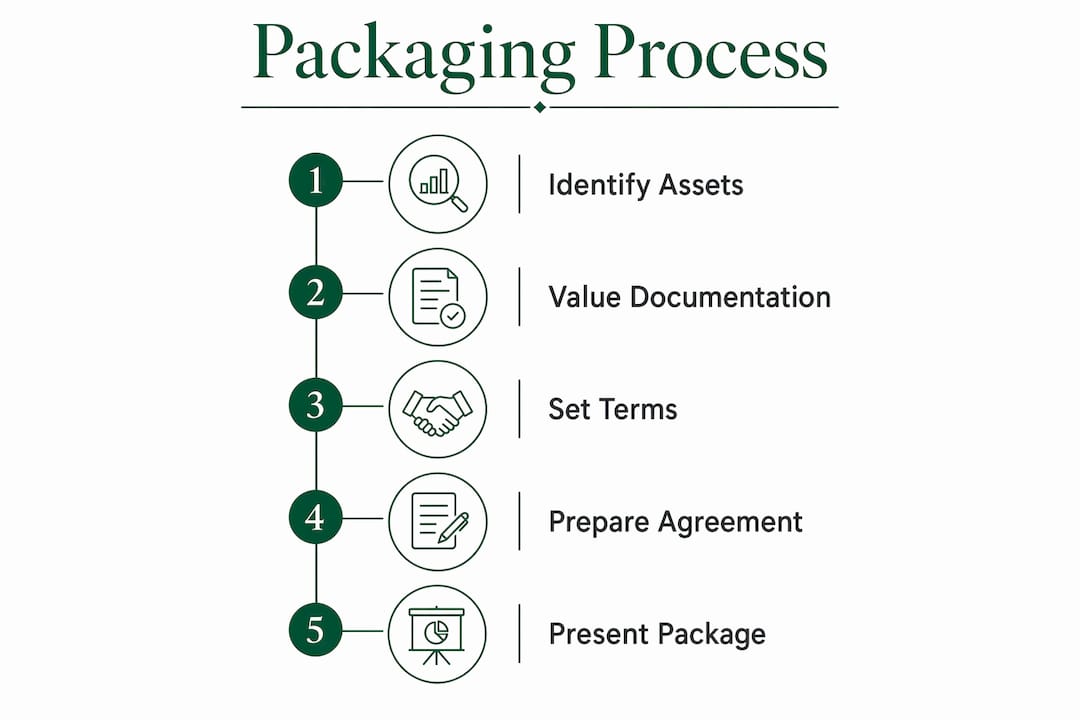
The first step is identifying every asset category your business holds. Typical business assets for sale include equipment, vehicles, inventory, furniture, intellectual property, digital assets, goodwill, customer data, and marketing collateral. Grouping them clearly helps buyers assess value quickly and reduces back-and-forth during due diligence.
The table below organizes the most common asset categories with examples of what each includes.
| Asset Category | Example Items |
|---|---|
| Physical equipment | Machinery, vehicles, POS systems, computers |
| Inventory | Raw materials, finished goods, consumables |
| Intellectual property | Trademarks, patents, proprietary software, domain names |
| Goodwill | Brand reputation, customer relationships, supplier agreements |
| Digital assets | Website, social media accounts, email lists, online content |
| Contracts and licenses | Lease agreements, supplier contracts, business licenses |
Not every category applies to every business. A service firm may have minimal inventory but substantial goodwill and client contracts. A retail operation may carry significant physical stock and equipment. Audit each category honestly and exclude items you plan to retain or that carry liabilities you do not want to transfer.
Pro Tip: Create a master asset register in a spreadsheet before drafting any sale documents. List every item, its estimated value, and its current condition. This single document becomes the foundation for everything else in your asset package.
How do you value and document your business assets?
Valuation methods differ for tangible and intangible assets. Proper documentation improves buyer confidence and smooths negotiations by removing guesswork about what an asset is worth and who owns it. Tangible assets like equipment are typically valued at replacement cost, depreciated book value, or fair market value based on comparable sales. Intangible assets like goodwill and intellectual property require a different approach, often involving earnings multiples or independent appraisals.
Documentation is not optional. Every asset in your package needs supporting evidence. The core documents for a complete asset package include:
- Proof of ownership: Title documents, purchase receipts, registration certificates
- Financial records: Three years of profit and loss statements, tax returns, and balance sheets
- Condition reports: Recent inspection or maintenance records for equipment and vehicles
- IP registrations: Trademark certificates, patent filings, domain registration records
- Contracts: Copies of active supplier, customer, and lease agreements
- Inventory count: A current, dated stocktake with unit costs
Goodwill and intellectual property are often sold together and need clear terms for ownership transfer and restrictions such as non-compete clauses. Without those terms in writing, a buyer has no legal protection against the seller competing directly after the sale closes.
Pro Tip: Consolidate all documents into a single secure digital folder organized by category. Use a naming convention like “Category_AssetName_Date” so buyers can locate any document in seconds. Disorganized files signal poor management and reduce buyer confidence.

How do you set clear sale terms and prepare the agreement?
Sale terms define exactly what transfers, what stays, and how payment works. The sale price can include deposits, deferred payments, vendor finance, and adjustments, and each mechanism carries different risks for both parties. Defining these terms before entering negotiations prevents disputes after settlement.
A well-structured asset sale agreement covers these critical points:
- Inclusions and exclusions: Name every asset included and explicitly exclude anything that does not transfer
- Purchase price and payment schedule: State the total price, deposit amount, and any deferred or vendor-financed portions
- Liability allocation: Confirm which liabilities, if any, the buyer assumes
- Warranties and representations: Describe the condition of assets and any known defects
- Handover obligations: Define training periods, transition support, and key staff introductions
- Non-compete clauses: Restrict the seller from operating a competing business for a defined period and geography
A well-drafted asset sale agreement must address granular details like website hosting, social media accounts, customer lists, assignment of contracts, and warranties. Vague terms about digital assets are a leading cause of post-settlement disputes. Legal experts advise sellers to explicitly itemize website rights, hosting credentials, and social media account access in the agreement itself.
Pro Tip: Engage a commercial lawyer to draft or review the asset sale agreement before presenting it to any buyer. The cost of legal review is small compared to the cost of resolving a dispute after settlement.
Working with experienced brokers also reduces risk. Professionals who use brokers for better deal outcomes consistently report fewer post-sale complications and stronger final sale prices.
How do you assemble and present your asset package to buyers?
Presentation quality signals professionalism. Clear presentation of asset packages with organized documents, summaries, and visual aids facilitates buyer understanding and accelerates due diligence. A buyer who can find every answer quickly is a buyer who moves forward with confidence.
Follow these steps to assemble a buyer-ready package:
- Create an executive summary. Write a one-to-two page overview covering the business type, asset categories included, asking price, and key financial highlights. This is the first document a buyer reads.
- Compile the full asset list. Use your master asset register to produce a clean, formatted document with descriptions, conditions, and estimated values for every item.
- Attach supporting documentation. Organize financial records, ownership proofs, contracts, and condition reports by category. Reference each document in the asset list so buyers can cross-check easily.
- Add visual aids. Include photographs of physical equipment, screenshots of digital assets, and floor plans if real estate is involved. Visuals reduce buyer uncertainty about condition.
- Prepare a FAQ document. Anticipate the ten most common buyer questions and answer them in writing. Topics typically include reason for sale, staff retention, supplier relationships, and transition support.
- Set up a secure data room. Use a password-protected folder or a virtual data room service to share documents. Control access and track which buyers have reviewed which files.
- Plan your presentation format. Decide whether you will present in person, via video call, or through a broker-managed process. Prepare a short verbal summary of the business and its assets to open any meeting.
A well-prepared business sale prospectus ties all of these elements together into a single, professional document. Buyers who receive a complete package at first contact are far more likely to submit a serious offer than those who must chase documents over multiple weeks.
Small business owners benefit from professional guidance when preparing asset packages. Consulting experienced brokers or legal advisors increases transaction success and reduces the risk of compliance issues or post-sale disputes.
Key Takeaways
Sellers who document, categorize, and present their business assets clearly achieve faster sales and stronger prices than those who approach the process informally.
| Point | Details |
|---|---|
| Asset sales offer flexibility | You choose which assets and liabilities transfer, unlike a stock sale. |
| Categorize before you document | Group assets by type first, then gather supporting documents for each category. |
| Valuation needs evidence | Use invoices, condition reports, and appraisals to support every asset’s stated value. |
| Sale terms prevent disputes | Explicitly name inclusions, exclusions, digital assets, and payment terms in the agreement. |
| Presentation drives buyer confidence | Organized packages with visual aids and FAQs accelerate due diligence and offers. |
Why most sellers underestimate the packaging step
The sellers I see struggle most are not the ones with weak businesses. They are the ones with genuinely good businesses that are poorly documented. A buyer cannot pay full price for something they cannot verify. That is the core problem with rushed or informal asset packages.
The most common mistake is treating the asset list as an afterthought. Sellers often produce a rough inventory after a buyer expresses interest, under time pressure, with gaps and inconsistencies. That approach destroys negotiating leverage. A buyer who finds missing documents or unclear ownership mid-negotiation will either walk away or reduce their offer significantly.
Transparency is not just ethical. It is a financial strategy. Every document you provide upfront removes a reason for a buyer to discount their offer. I have seen sellers recover tens of thousands of dollars in final price simply by presenting clean, complete records from the first meeting.
The other underestimated factor is digital assets. Website credentials, social media accounts, and email lists are often worth more than the physical equipment in a modern small business. Yet sellers routinely forget to include them or fail to document ownership clearly. Explicitly itemizing these in your package and your agreement is one of the highest-return steps you can take.
Professional help is not a luxury for complex deals. It is a practical investment for any sale above a modest threshold. Brokers and advisors who specialize in asset sales know exactly what buyers expect and where sellers typically fall short.
— Sierra
How Compassbusinessacquisitions supports sellers preparing asset packages
Compassbusinessacquisitions works directly with small business owners to prepare, present, and sell their business assets at maximum value. The team provides professional valuations, targeted marketing to qualified buyers, and hands-on guidance through every stage of the sale process.
Whether you are packaging physical equipment, intellectual property, or a full operational business, Compassbusinessacquisitions connects you with buyers who are ready to act. The firm’s network and market knowledge mean your asset package reaches the right audience, not just the widest one. Sellers who work with Compassbusinessacquisitions report a clearer process, fewer delays, and stronger final outcomes. Start the selling process with a team that knows how to position your assets for the best possible result.
FAQ
What is the difference between an asset sale and a stock sale?
An asset sale transfers specific operational components like equipment, goodwill, and intellectual property, while a stock sale transfers the entire business entity including all liabilities. Asset sales give sellers more control over what transfers.
What documents do I need to package business assets for sale?
You need proof of ownership, financial records for at least three years, condition reports, IP registrations, active contracts, and a current inventory count. Each document supports the stated value of a specific asset.
How do I value intangible assets like goodwill?
Goodwill is typically valued using an earnings multiple based on the business’s historical profit. An independent appraiser or experienced business broker can provide a defensible valuation that buyers will accept.
What should an asset sale agreement include?
The agreement must name every included and excluded asset, state the purchase price and payment terms, allocate liabilities, define warranties, and explicitly address digital assets like website hosting and social media accounts.
How does professional guidance improve an asset sale outcome?
Consulting experienced brokers or legal advisors increases transaction success by reducing compliance risks and ensuring the asset package meets buyer expectations from the first point of contact.