
What Makes a Business Sellable: A Practical Guide
What Makes a Business Sellable: A Practical Guide
A business is sellable when it generates predictable profits, runs independently of its owner, and shows clear growth potential backed by clean financials and documented systems. These are not aspirational qualities. They are the specific criteria serious buyers use to evaluate every deal. In Q1 2025, small-business acquisitions in the U.S. grew 9% year over year, with over 2,300 businesses sold totaling $2 billion in value. That market activity reflects real buyer demand. Understanding what makes a business sellable, and building toward it deliberately, is the difference between a business that sells at full value and one that sits on the market for years.
What makes a business sellable to serious buyers?
Sellability, the industry term is “sale readiness,” means a buyer can step in and run the business without the seller holding their hand. Buyers price every deal around one central question: will this business keep earning after the founder leaves? Buyer confidence hinges on businesses that continue smoothly post-sale without founder involvement. That single factor shapes valuation, deal structure, and whether a deal closes at all.
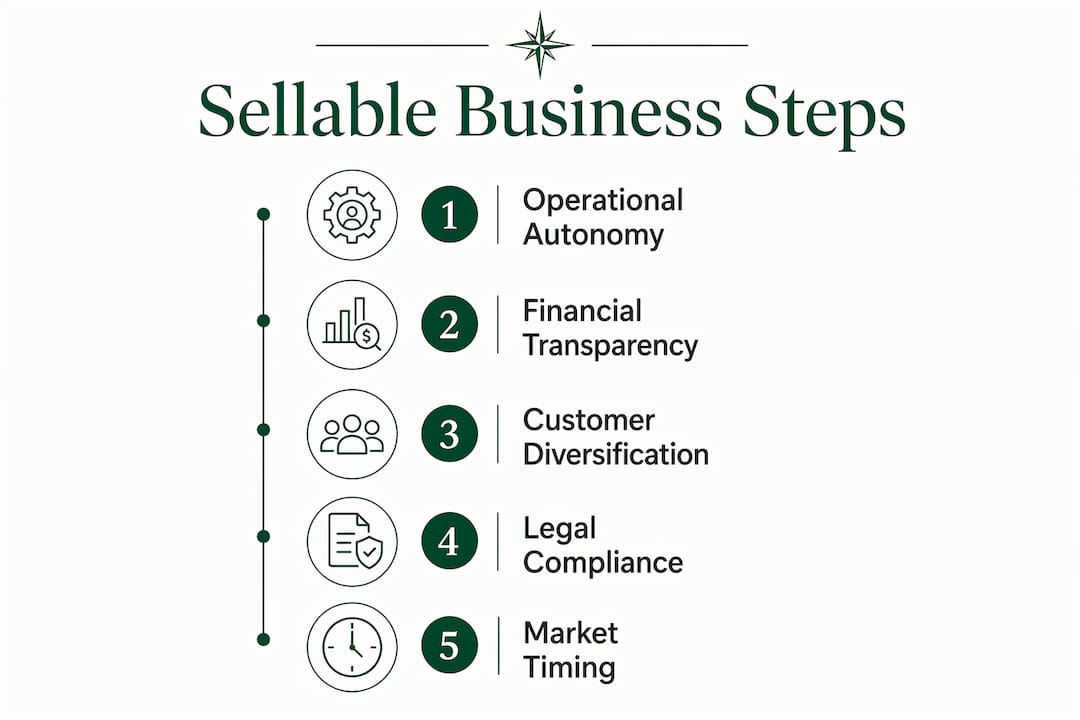
The core criteria buyers apply fall into four categories: operational autonomy, financial transparency, customer diversification, and legal clarity. A business that scores well across all four commands a premium. One that fails even one category faces either a valuation discount or a failed sale. Compassbusinessacquisitions works with sellers daily on exactly these factors, and the pattern is consistent. Businesses that prepare early sell faster and for more money.

How does owner dependency affect a business’s sellability?
Owner dependency is the most common factor that kills deals. When a business cannot function without its founder making daily decisions, answering client calls, or managing key relationships, buyers see a liability, not an asset.
Reducing owner dependency requires deliberate action across three areas:
- Staff delegation: Assign decision-making authority to team members for routine operations, client communication, and vendor management.
- Documented processes: Write standard operating procedures (SOPs) for every repeatable task. If it lives only in your head, it is a risk to the buyer.
- Bench strength: Build a management layer that can handle operations, sales, and customer issues without escalating to you.
Client relationships tied solely to the founder cause valuation discounts. Transferring those relationships to team members before listing raises buyer confidence and the final sale price.
Pro Tip: Test your operational independence by stepping away from the business for a full 90 days. A 90-day operational autonomy benchmark is the standard buyers use to confirm the business runs without you. If things break, fix them before you list.
The goal is a business that runs like a system, not a solo act. Buyers pay for systems. They discount for personalities.
What financial and legal factors make a business more attractive to buyers?
Clean financials are the foundation of any successful sale. Buyers and their advisors will scrutinize three years of records during due diligence. Gaps, inconsistencies, or mixed personal and business expenses create doubt and reduce offers.
The financial factors that matter most to buyers include:
- Accrual-based accounting: Cash-basis books are harder to verify and less trusted. Accrual accounting matches revenue to the period it was earned, giving buyers a clearer picture.
- Separated personal expenses: Personal costs run through the business inflate expenses and distort profit margins. Clean these up at least two years before listing.
- Consistent profitability: Buyers want to see stable or growing margins, not volatile swings. Erratic earnings signal operational risk.
- Margin quality: Businesses with EBITDA margins above 20% are valued at 8x EBITDA on average, while those below 15% average 5x. That gap is significant. A business generating $500,000 in EBITDA could be worth $2.5 million or $4 million depending on margin quality alone.
Legal clarity matters just as much. Buyers will not close on a business with unresolved legal exposure. Address these items before you list:
- Formalize all customer and vendor agreements with written contracts.
- Confirm your business owns all intellectual property, including trademarks, software, and content.
- Eliminate informal handshake agreements with key suppliers or partners.
- Resolve any outstanding disputes, liens, or compliance issues.
- Use NDAs to protect sensitive operational data during the sale process.
A business sale prospectus that presents clean financials and airtight legal documentation signals professionalism. Buyers who see organized records move faster and negotiate less aggressively on price. You can learn more about preparing that documentation in this guide on what a business sale prospectus requires.
Why is customer diversification critical for selling your business?
Revenue concentration is a structural risk that buyers price into every offer. When one client generates too large a share of your income, the buyer is not acquiring a business. They are acquiring a dependency.
Buyers flag businesses where a single customer accounts for 15% or more of total revenue as high risk. That threshold is the industry standard. Exceed it, and buyers either lower their offer or walk away.
Here is how to reduce concentration risk before you list:
- Audit your revenue by client. Identify any client above 10% of total revenue and treat them as a concentration risk, not just a good customer.
- Add new customer segments. Expand into adjacent markets, geographies, or buyer profiles to spread revenue across a wider base.
- Build recurring revenue. Recurring revenue models like subscriptions or long-term service contracts attract higher valuation multiples because they produce predictable cash flow.
- Lock in contracts. Convert month-to-month relationships to annual agreements wherever possible. Contracted revenue is worth more than verbal commitments.
Pro Tip: Start diversifying at least 18 months before your target sale date. Buyers want to see a trend, not a last-minute scramble. A diversified revenue base that has held for two years is far more credible than one assembled in the final quarter.
Recurring revenue is particularly powerful. A subscription-based business or one with long-term service agreements gives buyers a visible forward revenue stream. That visibility reduces perceived risk and supports a higher multiple.
How do documented processes and operational systems enhance business sellability?
A well-documented business conveys professionalism and reduces potential surprises, increasing buyer confidence. Documentation is not just an administrative task. It is a valuation tool.
Buyers evaluate operational systems across several key functions:
- Sales process: Is there a repeatable system for generating and closing new business, or does it depend on the owner’s personal network?
- Fulfillment and delivery: Are service or product delivery steps written down and followed consistently by staff?
- Customer support: Do team members handle complaints and escalations without founder involvement?
- Finance and reporting: Are monthly financial reports produced on a regular schedule without manual intervention from the owner?
The table below shows how documented versus undocumented operations affect buyer perception:
| Area | Documented | Undocumented |
|---|---|---|
| Sales process | Repeatable, trainable, transferable | Owner-dependent, high attrition risk |
| Fulfillment | Consistent quality, scalable | Variable quality, key-person risk |
| Customer support | Team-handled, low escalation | Founder-reliant, buyer concern |
| Financial reporting | Monthly, auditable | Irregular, raises due diligence flags |
A data room, a secure folder containing your org chart, contracts, IP documentation, financial statements, and SOPs, signals that you run a professional operation. Buyers who receive a complete data room spend less time on due diligence and more time on finalizing terms. Understanding market analysis in business investing also helps sellers position their documented systems within a broader market context.
What external market and timing factors impact a business’s sellability?
Internal preparation matters, but external conditions determine the ceiling on your sale price. Selling into a strong market amplifies every internal improvement you have made. Selling into a weak one discounts them.
Key external factors to monitor before listing include:
- Industry cycle: Businesses in growing sectors command higher multiples than those in contracting ones. Know where your industry sits in its cycle.
- Economic climate: Rising interest rates increase the cost of acquisition financing, which reduces what buyers can pay. Favorable credit conditions expand the buyer pool.
- Comparable sales: Recent transactions in your sector set buyer expectations for price and structure. Track what similar businesses sold for in the past 12 months.
- Your growth trajectory: Buyers pay for momentum. A business growing 15% year over year sells for more than a flat one, even if current earnings are identical.
- Personal readiness: Timing a sale around peak business performance, not personal fatigue, produces better outcomes. Sellers who list after a bad year leave money on the table.
Aligning your exit with favorable market conditions requires planning, often 12–24 months in advance. Reviewing how to conduct market analysis before listing gives you a data-backed view of where buyer demand is strongest.
Key takeaways
A business is sellable when it operates independently, shows clean financials, holds diversified revenue, and is supported by documented systems that any qualified buyer can step into and run.
| Point | Details |
|---|---|
| Operational autonomy | The business must run without the owner for at least 90 days to meet buyer standards. |
| Clean financials | Accrual-based books, separated personal expenses, and consistent EBITDA margins directly affect valuation multiples. |
| Customer diversification | No single client should exceed 15% of revenue; recurring revenue models attract higher multiples. |
| Documented systems | SOPs, data rooms, and written contracts reduce due diligence risk and increase buyer confidence. |
| Market timing | Selling during industry growth and favorable credit conditions maximizes the final sale price. |
What I have learned about building a sellable business
The sellers who get the best outcomes are not always the ones with the highest revenue. They are the ones who built their business as if a buyer were watching from day one.
The most underestimated step is owner independence testing. Most founders believe their business can run without them. Very few have actually tested it. Stepping away for 90 days, genuinely, not just being less visible, reveals every gap in your systems, your team, and your documentation. Fix those gaps before a buyer finds them.
I have also seen sellers underestimate how much documentation matters emotionally to buyers. A clean data room does not just reduce legal risk. It signals that the seller is serious, organized, and trustworthy. That perception carries real weight in negotiations.
The mindset shift that matters most: stop thinking about sellability as a pre-sale checklist. Build a sellable business continuously. The owners who do this find that their business performs better, attracts better staff, and commands a premium when they are ready to exit. Selling success depends more on buyer confidence in future earnings than on the seller’s past achievements. That framing changes everything about how you prepare.
— Sierra
How Compassbusinessacquisitions helps sellers maximize value
Compassbusinessacquisitions works with small business owners who want to sell at full value, not settle for the first offer that comes in.

Compassbusinessacquisitions provides professional valuations, targeted buyer marketing, and hands-on guidance through every stage of the sale process. The team connects sellers with qualified buyers who share their vision for the business, reducing the risk of deals falling apart after due diligence. Whether you are preparing to list now or planning an exit 18 months out, working with an experienced broker gives you a clear picture of where your business stands and what it will take to sell your business at its highest possible value. Explore how expert brokers improve deal outcomes and what that means for your specific situation.
FAQ
What is the most important factor in making a business sellable?
Operational autonomy is the single most critical factor. Buyers price deals assuming the founder may leave immediately after closing, so a business that runs without its owner commands the highest confidence and valuation.
How long does it take to prepare a business for sale?
Most advisors recommend 12–24 months of preparation. That window allows time to clean financials, reduce owner dependency, diversify customers, and document systems before listing.
What is a good EBITDA margin for selling a business?
Businesses with EBITDA margins above 20% are valued at approximately 8x EBITDA on average. Those below 15% average closer to 5x, making margin improvement one of the highest-return pre-sale activities.
Why does customer concentration hurt a business’s sale price?
Buyers treat any single customer above 15% of total revenue as a concentration risk. If that client leaves after the sale, the business loses a significant portion of its income, which buyers discount into their offer.
Do I need an NDA before sharing business information with buyers?
Yes. NDAs protect your sensitive operational and financial data during negotiations and prevent competitor interference while the sale is in progress.