
How to Build a Buyer Pipeline for a Small Business Sale
How to Build a Buyer Pipeline for a Small Business Sale
A confidential, broker-managed buyer pipeline built around fast qualification, a concise Confidential Information Memorandum (CIM), and staged outreach cadences reliably converts buyer interest into signed letters of intent. That is the direct answer. Owners who try to sell through scattered outreach, a listing here, a phone call there, tend to lose leverage, leak confidential information, and waste months on buyers who never had the capacity to close.
The reason a structured pipeline outperforms ad-hoc outreach comes down to three things: speed, qualification, and confidentiality. Buyers move fast when a process feels organized, and they lose interest when it doesn’t. A nondisclosure agreement filters out casual lookers before anyone sees financials. And a tightly run process keeps competitors, employees, and landlords from finding out the business is for sale before you’re ready.
You can start today. In the next 24 to 72 hours, put together a one-page buyer intake form and a standard NDA template. Those two documents are the gate that separates real buyers from tire kickers, and they’re the foundation everything else in this guide builds on.
Key Takeaways
A confidential, broker-managed pipeline built on fast qualification, a clean CIM, and staged buyer cadences turns interest into signed LOIs faster than ad-hoc outreach ever does.
| Point | Details |
|---|---|
| Build intake and NDA first | Create a one-page buyer intake form and standard NDA before any outreach begins. |
| Prepare CIM and data room | Organize financials, add-backs, and operational detail before buyers ever see them. |
| Bucket buyers into tiers | Sort every buyer into Tire Kicker, Active, or Pre-Approved to route broker time well. |
| Run a fast outreach cadence | Respond within minutes, not days, to keep qualified buyers engaged. |
| Track conversion at every stage | Watch inquiry to NDA, NDA to CIM, and CIM to LOI rates weekly. |
| Consider a managed process | Compass Business Acquisitions runs sourcing, qualification, and negotiation for owners who want this handled professionally. |
Table of Contents
- Building a Buyer Pipeline for Small Business Sales: The Stages That Matter
- Where Do Qualified Buyer Leads Actually Come From?
- What Do You Need to Prepare Before Marketing the Business?
- How Do You Qualify a Buyer Before Sharing Financials?
- How Should Outreach and Follow-Up Actually Work?
- What Does a Broker Actually Do to Run This Pipeline?
- Which Metrics Should You Track Every Week?
- How Long Does This Take, and What Does It Cost?
- How Do You Choose the Right Broker or Advisor?
- What Does a Real Buyer Pipeline Actually Produce?
- A Practical Perspective on Building the Pipeline
- Get a Managed Buyer Pipeline Built Around Your Business
- Frequently Asked Questions
- Sources
Building a Buyer Pipeline for Small Business Sales: The Stages That Matter
A buyer pipeline for a small business sale moves through seven stages: inquiry, NDA, CIM and data room access, structured Q&A, letter of intent (LOI), diligence, and close. Each stage has one job: filter out buyers who won’t close and keep momentum with the ones who will.
- Inquiry: A buyer reaches out about a blind teaser or listing, no financial detail shared yet.
- NDA: The buyer signs before receiving anything sensitive.
- CIM and data room: Full financials, add-back schedules, and operational detail become available.
- Structured Q&A: The broker manages a single channel for buyer questions instead of allowing scattered calls and emails.
- LOI: The buyer commits to terms in writing, subject to diligence.
- Diligence: Financial, legal, and operational verification.
- Close: Funds transfer and ownership changes hands.
Realistic funnel math helps set expectations early. Brokers should expect roughly 1.25% of initial seller inquiries to convert into a signed mandate, and only a minority of buyer registrants turn out to be genuinely fundable and pre-qualified. On the buyer side, conversion from CIM delivery to LOI is where most deals die.
| Stage Transition | Typical Range | What Moves It Forward |
|---|---|---|
| Inquiry to signed NDA | Varies by channel; direct outreach outperforms broad listings | A specific teaser and fast broker response |
| NDA to CIM/data room engagement | Most NDA signers request access | Clean, well-organized data room |
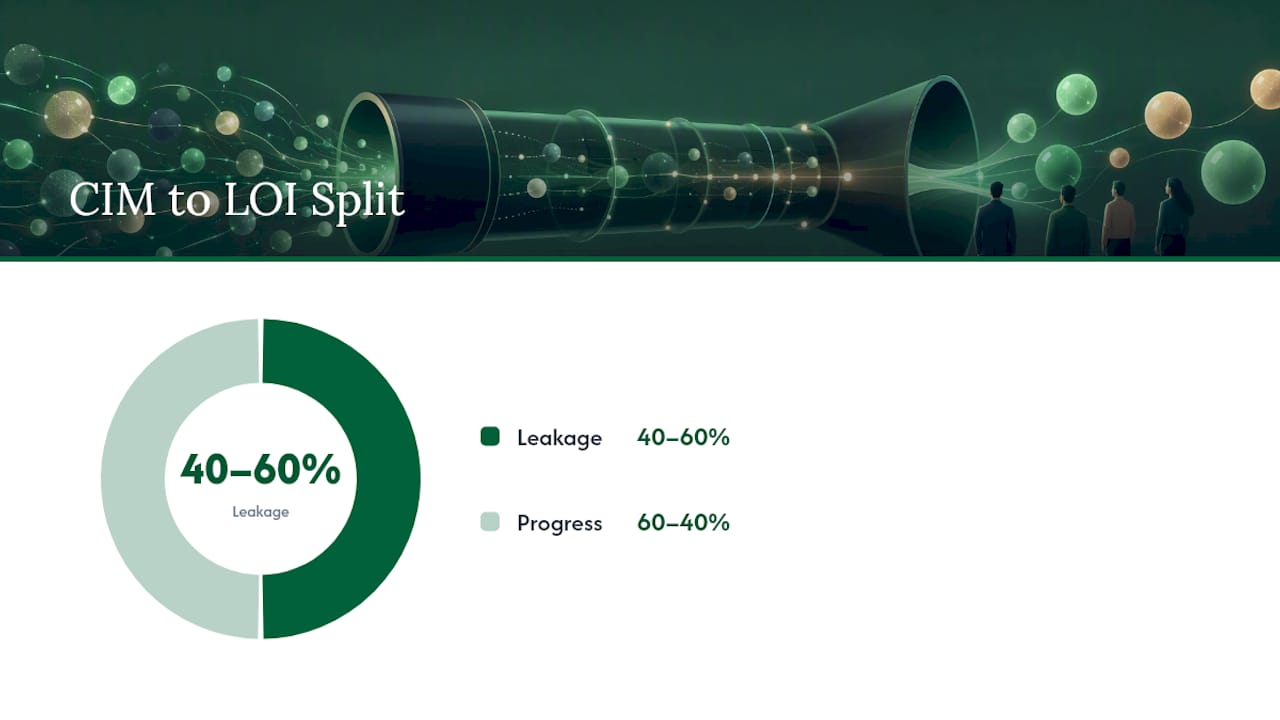
| CIM to LOI | High leakage historically | Structured single-channel Q&A cadence |
Pro Tip: Treat every stage transition as a decision point, not a formality. If a buyer stalls for more than a week at any stage, that’s a signal worth following up on directly rather than waiting it out.
The industry cites 40 to 60% deal leakage during the CIM to LOI phase, which is the single biggest reason pipelines stall. Standardizing each stage transition and running multiple buyers through the same cadence in parallel is what keeps a deal moving instead of drifting.
Where Do Qualified Buyer Leads Actually Come From?
The strongest buyer leads come from a mix of channels, and the right mix depends on how confidential the sale needs to stay and how large the business is.
- Broker network and referrals: Highest match quality, slowest volume, best for confidentiality-sensitive deals.
- Targeted direct outreach: Owner or broker-led contact with strategic acquirers or known industry players, high confidentiality control.
- Industry buyers and strategic acquirers: Fast to evaluate fit, but higher leak risk if approached carelessly.
- Search funds: Motivated, often well-capitalized individual buyers seeking an operating role.
- Private equity: Strong financial capacity, longer diligence timelines, more process-heavy.
- Business-for-sale marketplaces: Broadest exposure, lowest confidentiality, most tire kickers.
- Buyer registrants (site leads): Useful volume source when paired with strict pre-qualification.
For a high-confidentiality sale, especially where employees and customers don’t know it’s for sale, off-market outreach and broker referrals should come first. Marketplaces work better for smaller, lower-risk businesses where broad exposure matters more than discretion. Sourcing off-market deals tends to produce fewer but more serious inquiries.
Pro Tip: If your business has fewer than five employees who know nothing about the sale, skip marketplaces entirely for the first 60 days. One curious competitor browsing a listing can do real damage before you’ve even signed an NDA with anyone.
What Do You Need to Prepare Before Marketing the Business?
Sellers need a specific document set ready before a single buyer sees financials. Skipping this step is the most common cause of stalled deals and awkward re-trades later in the process.
- A one-page financial summary covering revenue, gross margin, and net cash flow trends.
- A Seller’s Discretionary Earnings (SDE) or EBITDA bridge with every add-back documented and defensible.
- Three years of tax returns and financial statements.
- A customer concentration summary, flagging any single account above 10 to 15% of revenue.
- A lease summary, including term length and any assignment or landlord consent requirements.
- A list of required third-party consents (franchisor, lender, key vendor contracts).
The teaser, the first thing a buyer sees, should stay blind: industry, general location, revenue range, and asking price range, with no identifying detail. The full CIM only goes out after the NDA is signed, and it should answer a buyer’s first 20 questions before they have to ask.
A well-organized data room saves weeks. Structure it in clear folders: financials, legal, operations, customer and vendor contracts, and property. Route all buyer questions through one Q&A log rather than letting five buyers email the owner directly.

Pro Tip: Design your NDA to protect identity and financials without being so restrictive that serious buyers walk away frustrated. An NDA that takes three rounds of legal redlining to finalize is often a sign the buyer isn’t serious, or your terms are too aggressive.
How Do You Qualify a Buyer Before Sharing Financials?
Buyer qualification runs across five dimensions, and skipping any one of them wastes broker time and risks a leak for nothing. Financial capacity, industry fit, timeline, post-close role, and track record together determine whether a buyer is worth pursuing.
- Financial capacity: Proof of funds or an SBA 7(a) pre-qualification letter.
- Industry or operational fit: Relevant experience or a credible plan to run the business.
- Timeline and motivation: A believable reason for buying now, not just browsing.
- Post-close role: Clarify whether the buyer plans to operate the business or install management.
- References and track record: Prior acquisitions or business ownership history.
Collect this information through a standardized intake form before the CIM goes out, not after. Buyers who volunteer an SBA pre-qualification letter and communicate promptly should move to the front of the line.
- No credible funding plan after two follow-ups.
- Timeline expectations that don’t match the business’s complexity.
- Excessive NDA renegotiation before ever seeing financials.
Score and bucket every buyer into three tiers: Tire Kicker, Active, and Pre-Approved. Pre-Approved buyers get priority scheduling and faster Q&A turnaround. Tire Kickers get a polite, standardized decline. Checking a buyer’s stated intentions against signs a business is genuinely worth acquiring also helps brokers spot buyers who haven’t done real homework.
How Should Outreach and Follow-Up Actually Work?
Speed separates a converting pipeline from a stalled one. An immediate automated response, followed by an SMS within minutes and a broker call shortly after, consistently improves qualification rates over next-day follow-up.
- Send an automated acknowledgment the moment an inquiry comes in.
- Follow with a personal text or call within the hour during business hours.
- Schedule a 15-minute qualification call within 48 hours.
- Send the NDA immediately after that call if the buyer clears initial screening.
- Deliver the CIM within 24 hours of a signed NDA.
Messaging should shift by buyer type. An operator buyer wants to hear about day-to-day workflows and staffing. A financial buyer wants clean multiples and cash flow stability. A strategic acquirer wants to know how the business fits their existing operations. One template does not fit all three.
- Touch 1: Blind teaser with a clear value proposition, no financial detail.
- Touch 2: NDA request with a short explanation of what the CIM will cover.
- Touch 3: CIM delivery plus an invitation to submit questions through the managed Q&A channel.
Structured content around the buyer’s own research timeline, not just cold outreach, tends to build trust faster; that principle shows up clearly in how B2B buying cycles map to content touchpoints.
What Does a Broker Actually Do to Run This Pipeline?
A broker’s job breaks into seven concrete responsibilities: sourcing buyers, running intake and qualification, managing the NDA and CIM process, running the Q&A cadence, drafting and negotiating the LOI, coordinating diligence, and shepherding the deal to close.
Brokers segment buyers into the same three tiers described earlier and allocate time accordingly, spending the bulk of hours on Pre-Approved and Active buyers while automating communication with Tire Kickers. That segmentation is what lets one broker run multiple live buyer conversations without any of them going cold.
Fee structures typically follow a commission tied to the final sale price, sometimes with a smaller upfront retainer for valuation and marketing prep. The expanded buyer coverage an advisor brings, often securing five to ten seriously interested buyers, is usually worth the commission compared to an owner running outreach solo.
| Point | Details |
|---|---|
| Time allocation | Brokers prioritize Pre-Approved and Active buyers over unqualified inquiries. |
| Process discipline | Templated intake forms and NDA cadences let one broker manage several buyers in parallel. |
| Advisor value | Working with an advisor typically expands the field to five to ten seriously interested buyers. |
Reviewing what a broker’s day-to-day role looks like for investors gives a fuller picture of how that time gets allocated across a live deal.
Which Metrics Should You Track Every Week?
Track leads sourced, inquiry-to-NDA rate, NDA-to-CIM open rate, CIM-to-LOI rate, LOI-to-close rate, average time in each stage, and the reasons deals leak out of the pipeline.
- Leads sourced by channel, so you know which source is actually producing serious buyers.
- Inquiry to NDA conversion, a first signal of buyer seriousness.
- CIM to LOI conversion, the stage most exposed to the 40 to 60% leak rate mentioned earlier.
- Time-in-stage averages, flagging any buyer stuck past the typical window.
A simple CRM with columns for buyer profile, funding evidence, stated timeline, and next scheduled action covers most of what a small brokerage needs. Pair that with e-signature software for NDAs, a secure data room, and shared calendaring. Techniques borrowed from traditional sales pipeline management translate directly here, since a buyer pipeline behaves like any other structured sales process.
How Long Does This Take, and What Does It Cost?
Inquiry to LOI typically runs several weeks to a few months depending on deal size and buyer pool depth, and LOI to close often takes another 60 to 120 days once financing and diligence enter the picture.
- Get an SBA 7(a) pre-qualification conversation started with buyers early, financing delays are the most common closing bottleneck.
- Prepare a Quality of Earnings review in advance if the deal size warrants it.
- Confirm landlord consent requirements before going to market, not after an LOI is signed.
- Consider a limited, exclusive buyer process instead of a wide auction when confidentiality and speed both matter.
Cost buckets typically include broker commission (a percentage of sale price), a valuation or reporting fee, data room and legal costs, and sometimes financing-related fees tied to SBA lending. Reviewing key terms to negotiate before an LOI arrives, working capital treatment, seller notes, earnouts, prevents last-minute renegotiation that can stall or kill a deal.
How Do You Choose the Right Broker or Advisor?
Ask direct questions before signing an engagement: What’s your track record on deals this size? What buyer types do you typically reach? Can you share a sample CIM and NDA template? What’s your average time from listing to LOI?
- Ask for two or three recent comparable transactions, not just a general resume.
- Request a sample CIM and NDA to judge process discipline firsthand.
- Ask how buyers are sourced, referral network, marketplaces, direct outreach, or all three.
- Confirm expected communication cadence during the active marketing period.
Red flags include vague answers about timeline, no willingness to share sample materials, and no clear qualification process for incoming buyers. A broker who can’t describe their own funnel probably doesn’t run one.
- Industry experience specific to your business type.
- Buyer network depth, not just listing volume.
- Data room and process discipline, evidenced by sample materials.
Choosing between an exclusive engagement, a limited process with a handful of invited buyers, or a broader auction depends on how much competitive tension you want versus how much confidentiality you need to protect.
What Does a Real Buyer Pipeline Actually Produce?
Two anonymized examples illustrate how process discipline changes outcomes.
A regional service business owner had been fielding inbound calls for months with no structure, mostly unqualified. After building a standardized intake form, requiring proof of funds before any financial disclosure, and running a single-channel Q&A cadence, the owner had three Pre-Approved buyers submitting LOIs within seven weeks, down from an open-ended process that had dragged on for over a year with no serious offers.
A small manufacturing business faced a different challenge: high customer concentration that scared off early inquiries once buyers saw the numbers. The fix was addressing concentration directly in the CIM upfront, rather than letting buyers discover it mid-diligence, paired with faster response times on every Q&A submission. The result was fewer re-trades after LOI and a cleaner path to close.
The pattern in both cases wasn’t a bigger buyer pool. It was tighter qualification upfront and faster response times at every stage, which kept serious buyers engaged instead of losing them to slower-moving competitors.
What changed operationally in both cases: faster initial response, stricter proof-of-funds requirements before CIM release, and a single point of contact for buyer questions instead of scattered communication.
A Practical Perspective on Building the Pipeline
The single biggest mistake I see owners make is treating buyer outreach as a marketing problem when it’s really a filtering problem. Wide exposure feels productive, more inquiries, more activity, but most of that volume is noise. What actually moves a deal toward close is qualifying hard and fast, protecting confidential information until a buyer has proven they’re serious, and keeping every buyer moving through the same disciplined cadence instead of letting momentum stall.
Owners who try to run this alone often underestimate how much time qualification and NDA management consume, and that’s exactly where a managed process pays for itself. For owners who want that discipline applied to their own sale, working with Compass Business Acquisitions to run the pipeline is the more reliable path than building one from scratch.
Get a Managed Buyer Pipeline Built Around Your Business
Compass Business Acquisitions runs the entire process described in this guide on your behalf, so you’re not building intake forms, NDA templates, and Q&A logs from a blank page while also running your business.
Compass handles professional valuation, targeted outreach to qualified buyer types, NDA and CIM management, structured Q&A cadences, and full transaction management through to close. Three things you get with this approach:
- A professional valuation that sets realistic pricing before any buyer sees a number.
- Access to a network of pre-screened operator, financial, and strategic buyers, not a public listing exposed to every competitor.
- Full negotiation and transaction support from first LOI through closing.
If you’re considering a sale and want to know what your business is worth before building a buyer pipeline, start with the business valuation calculator or go directly to the seller services page to talk with a broker about running your process.
Frequently Asked Questions
How long does it take to build a buyer pipeline for a small business? Most owners can have intake forms, an NDA template, and a teaser ready within a week. Generating a working pool of qualified buyers typically takes another four to eight weeks depending on the sourcing channels used.
What’s the difference between a teaser and a CIM? A teaser stays blind, industry, general location, and a revenue range with no identifying detail. The full CIM, released only after an NDA is signed, includes financials, add-backs, and operational specifics a buyer needs to make an offer.
How many buyers should be in a healthy pipeline? There’s no fixed number, but working with an advisor typically produces five to ten seriously interested buyers, enough to create real competitive tension without overwhelming the qualification process.
What causes most deals to fall apart before closing? Deal leakage between CIM delivery and LOI is the most common failure point, often tied to slow response times, poor Q&A management, or buyers who were never properly qualified for financial capacity.
Should a small business owner run this process alone or hire a broker? An owner can run a basic version alone, but qualification, confidentiality management, and buyer negotiation take real time and expertise. Firms like Compass Business Acquisitions exist specifically to manage that workload while protecting the sale’s value.
This article is general information, not a substitute for advice from a qualified financial advisor. Consult a qualified financial professional about your own circumstances before acting on anything here.
Sources
- How to Build a Buyer Pipeline | BizTrader
- Business Broker Lead Generation & Sales Funnel: The 2026 Deal Flow Engine
- OpenClaw for Business Brokers 2026: Buyer Qualification, NDA Cadence, Deal Pipeline
- How to Find a Buyer for Your Business: 5 Steps to Find Qualified Buyers