
How to Source Off-Market Acquisition Deals in 2026
How to Source Off-Market Acquisition Deals in 2026
Sourcing off-market acquisition deals is the process of identifying and securing business opportunities that are never publicly listed, giving buyers a direct competitive advantage and access to higher-value transactions. Unlike listed deals, off-market transactions avoid broker-imposed premiums and competitive auctions, allowing buyers to negotiate terms tailored to their acquisition criteria. Programmatic M&A frameworks, direct owner outreach, and proprietary databases are the three pillars of a repeatable off-market sourcing system. Firms like WGA Advisors and platforms like OffMarket Deck have formalized these methods into structured pipelines that generate consistent deal flow. Compassbusinessacquisitions applies the same principles to help investors and business professionals secure high-potential acquisitions before they reach the open market.
What tools do you need to source off-market acquisition deals?
A reliable off-market deal pipeline starts with the right infrastructure. Without organized data and relationship management systems, even the best outreach strategy produces inconsistent results.
CRM platforms built for deal tracking centralize target data, reduce lead loss, and give acquisition teams full pipeline visibility. Generic CRM tools work poorly here. Platforms configured for M&A or investment deal flow, such as DealCloud, Affinity, or Salesforce with custom deal objects, allow teams to segment targets by industry, geography, ownership profile, and deal readiness. That segmentation is what separates a managed pipeline from a contact list.
Beyond CRM, data sourcing tools define the quality of your target universe. The table below outlines the core tools and their specific roles:
| Tool Category | Example Platforms | Primary Benefit |
|---|---|---|
| CRM and Deal Tracking | DealCloud, Affinity, Salesforce | Centralizes pipeline and relationship history |
| Property and Business Data | OffMarket Deck, CoStar, BizBuySell | Identifies ownership and financial signals |
| Public Record Mining | PACER, county courthouse databases | Surfaces probate, tax liens, and distressed owners |
| Networking and Events | ACG conferences, local REIA meetups | Builds direct relationships with deal sources |
| M&A Advisory Partnerships | Buy-side advisors, business brokers | Provides curated deal flow beyond direct outreach |
Public records like probate and tax liens reveal motivated sellers before they ever consider listing. Courthouse data, absentee owner lists, and government lien records expose distress situations that are ideal for early outreach. Most competitors never mine these sources, which makes them a high-value, low-competition channel.
Pro Tip: Set up automated alerts in your county courthouse database or use a service like ATTOM Data Solutions to flag new probate filings and tax delinquencies in your target markets weekly. This keeps your pipeline fresh without manual research.

Investor meetups and wholesaler networks provide access to deals that never appear on MLS or public business listing platforms. Wholesalers assign contracts to investors for properties and businesses needing repositioning. These relationships take time to build but produce recurring deal flow once established.
How do you find off-market deals step by step?
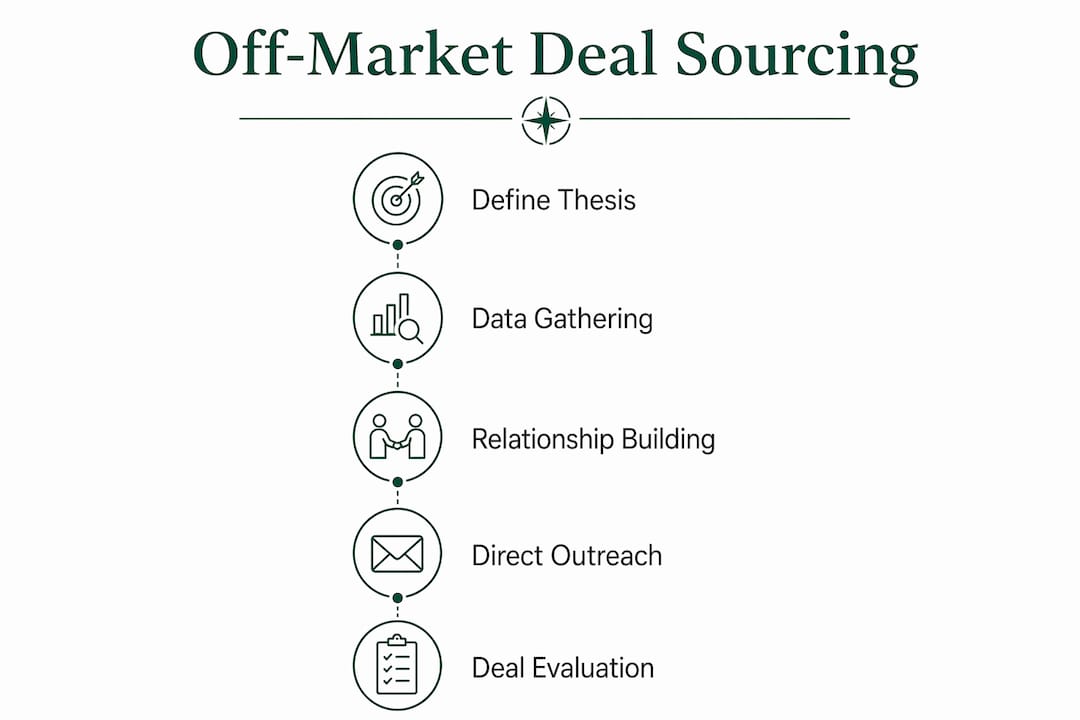
Consistent off-market deal sourcing follows a defined process. Improvised outreach produces occasional wins. A structured system produces compounding results.
-
Define your acquisition thesis. Specify the industry, revenue range, geography, ownership profile, and deal structure you will pursue. Vague criteria produce wasted outreach and misaligned conversations.
-
Build a segmented target list. Divide prospects into three tiers: near-term (actively considering a sale), mid-term (open to conversation in 12–24 months), and long-term (relationship-building phase). Each tier requires a different outreach approach and cadence.
-
Execute direct outreach campaigns. Direct mail to absentee owners and distressed business operators remains one of the most effective channels for generating seller leads outside public listings. Personalized letters referencing specific business attributes outperform generic templates by a significant margin.
-
Engage investor-friendly brokers and advisors. Buy-side M&A advisors provide curated off-market opportunities through proprietary networks that direct outreach cannot replicate. A qualified advisor brings market intelligence and pre-screened targets, compressing your sourcing timeline.
-
Maintain consistent follow-up. Most deals close after multiple touchpoints over months or years. A single outreach attempt rarely converts. Build follow-up sequences into your CRM so no prospect falls through the gaps.
-
Adjust based on data. Track response rates, conversion rates by outreach channel, and pipeline velocity. Shift resources toward the channels producing the highest quality conversations, not just the highest volume of responses.
The table below maps each step to its primary execution method:
| Step | Method | Expected Output |
|---|---|---|
| Define thesis | Internal strategy session | Written acquisition criteria document |
| Build target list | CRM segmentation and data sourcing | Tiered prospect database |
| Direct outreach | Mail, cold call, email sequences | Initial seller conversations |
| Advisory engagement | Broker and advisor partnerships | Curated deal introductions |
| Follow-up | CRM-automated sequences | Ongoing relationship development |
| Data review | Pipeline analytics | Optimized outreach allocation |
Pro Tip: When writing direct outreach letters, reference a specific and verifiable attribute of the target business, such as its tenure in the market or a recent expansion. Generic letters signal low intent. Specific letters signal serious buyers.
How does programmatic m&a turn sourcing into a growth engine?
Programmatic M&A is the practice of treating acquisitions as a continuous, governed business process rather than a series of one-off transactions. It is the most reliable method for generating repeatable off-market deal flow at scale.
Leading programmatic acquirers build proprietary databases segmented by strategic fit and assign dedicated relationship managers to each target tier. These teams engage targets 18–36 months before a deal becomes viable. At that stage, most targets do not consider themselves acquisition candidates. That early engagement is precisely what bypasses competitive auctions and broker processes later.
The governance structure behind programmatic M&A is what separates it from ad hoc deal hunting. Key organizational requirements include:
- A dedicated corporate development team with board-level authority and defined acquisition mandates
- A deal committee that reviews pipeline health, approves outreach escalations, and governs term sheet decisions
- A chief integration officer or equivalent role responsible for post-close execution planning
- Quarterly pipeline reviews tied to the company’s strategic planning calendar
- Clear accountability metrics: number of active relationships, pipeline conversion rates, and time-to-close benchmarks
Sustained relationship-building is the defining characteristic of top-performing acquirers. They cultivate connections that begin years before deal completion. This approach produces compounding advantages because each relationship deepens trust, surfaces new referrals, and reduces the friction of eventual negotiations.
“The primary failure in acquisitions is poor deal architecture, not execution. Building a continuous, relationship-based sourcing engine yields compounding advantages.” — WGA Advisors
Board-level accountability for acquisition programs is not optional in high-performing organizations. Deal committees and integration officers create the structure that prevents promising pipelines from stalling when key personnel change or market conditions shift.
What are the most common mistakes in off-market deal sourcing?
Most acquisition programs underperform not because of bad execution, but because of poor pipeline architecture. These are the mistakes that consistently derail off-market sourcing efforts.
-
Relying on sporadic leads instead of a system. Waiting for deals to appear through informal channels produces inconsistent results. A structured pipeline with defined outreach cadences is the only reliable alternative.
-
Skipping long-term relationship building. Deals that close quickly are rare. Most off-market acquisitions require months or years of relationship development before a seller is ready to transact. Investors who treat every conversation as a near-term close miss the majority of available opportunities.
-
Poor data hygiene. Outdated contact records, duplicate entries, and untracked follow-ups waste outreach budget and damage credibility with prospects. CRM discipline is not optional. It is the foundation of a functioning pipeline.
-
Generic outreach messaging. Sending identical letters or emails to every prospect signals low intent. Sellers respond to buyers who demonstrate specific knowledge of their business and a credible acquisition rationale.
-
No defined acquisition criteria. Without clear parameters on industry, size, geography, and deal structure, every conversation becomes exploratory rather than purposeful. This wastes time for both parties and reduces conversion rates.
-
Ignoring technology. Platforms like OffMarket Deck, ATTOM Data Solutions, and specialized CRM tools exist specifically to solve the data and workflow problems that manual sourcing cannot handle at scale.
Pro Tip: Prioritize your pipeline by deal readiness, not by recency of contact. A prospect who expressed interest 18 months ago and has since experienced a leadership change or revenue decline may be far more motivated than a cold contact you reached last week.
Key takeaways
Sourcing off-market acquisition deals requires a programmatic, relationship-driven system built on clean data, consistent outreach, and governance structures that sustain deal flow over time.
| Point | Details |
|---|---|
| Define your acquisition thesis first | Clear criteria for industry, size, and geography prevent wasted outreach and misaligned conversations. |
| Build a segmented, tiered pipeline | Separate near-term, mid-term, and long-term prospects to apply the right outreach cadence to each group. |
| Engage early with programmatic M&A | Target prospects 18–36 months before deal viability to bypass auctions and build trust before competition arrives. |
| Use data tools and CRM discipline | Platforms like DealCloud, OffMarket Deck, and ATTOM Data Solutions reduce lead loss and surface motivated sellers. |
| Governance drives consistency | Board-level accountability, deal committees, and integration officers are what separate repeatable programs from one-off wins. |
Why systematic sourcing beats opportunistic approaches every time
After working closely with acquisition-focused clients across multiple industries, one pattern stands out clearly. The investors and executives who consistently close high-quality off-market deals are not the ones with the best instincts. They are the ones with the best systems.
Opportunistic sourcing feels productive. You attend a conference, a contact mentions a business that might be for sale, and you follow up. That works occasionally. But it does not scale, and it does not compound. Every deal starts from zero.
Programmatic sourcing works differently. Each relationship you build adds to a network that generates referrals. Each data point you collect improves your targeting. Each follow-up sequence you run teaches you which messages resonate with which seller profiles. The pipeline gets better over time because the inputs are tracked and adjusted.
The governance piece is where most organizations fall short. Teams get excited about building a pipeline and then lose momentum when a key person leaves or a quarter gets busy. Without board-level accountability and a dedicated corporate development function, acquisition programs drift. The organizations that sustain deal flow treat acquisitions the way they treat sales: with defined targets, regular reviews, and clear ownership.
My honest recommendation is to start smaller than you think you need to. Define one target industry, one geography, and one outreach channel. Build the CRM discipline, the follow-up sequences, and the data hygiene before you expand. A tight, well-managed pipeline of 50 prospects outperforms a chaotic list of 500 every time.
— Sierra
How Compassbusinessacquisitions helps you find the right deal
Compassbusinessacquisitions specializes in connecting serious buyers with off-market business opportunities that align with their acquisition criteria and growth objectives.
Compassbusinessacquisitions provides professional valuations, targeted marketing, and direct access to a curated network of sellers who are not listed on public platforms. Their advisory team guides buyers through every stage of the acquisition process, from initial target identification to final negotiation and close. Whether you are pursuing your first acquisition or building a programmatic deal pipeline, Compassbusinessacquisitions delivers the market intelligence and deal access that serious buyers require. Explore available acquisition opportunities or connect with their advisory team to discuss your specific acquisition criteria and timeline.
FAQ
What is an off-market acquisition deal?
An off-market acquisition deal is a business or property transaction that occurs without public listing on exchanges, MLS platforms, or broker marketplaces. Buyers access these deals through direct outreach, proprietary networks, and advisory relationships.
How do you build an off-market deal pipeline?
Building an off-market pipeline requires a segmented CRM, a defined acquisition thesis, and consistent outreach through direct mail, cold calling, and M&A advisory partnerships. Top performers begin cultivating target relationships 18–36 months before a deal becomes viable.
What is programmatic m&a?
Programmatic M&A is a continuous, governed acquisition strategy in which companies build proprietary target databases, assign relationship managers, and maintain board-level oversight to generate repeatable deal flow. It replaces opportunistic deal hunting with a structured, scalable process.
How do direct mail campaigns help find off-market properties?
Direct mail campaigns targeted at absentee owners and distressed operators generate seller leads that never appear on public listing platforms. Personalized letters referencing specific business attributes produce significantly higher response rates than generic outreach.
Why do off-market deals offer better value for buyers?
Off-market deals bypass competitive bidding and broker-driven auction processes, allowing buyers to negotiate terms directly with sellers. This structure typically results in lower acquisition premiums and transaction terms that are custom-fit to the buyer’s strategic criteria.