
Benefits of Working with Business Brokers: Seller's Guide
Benefits of Working with Business Brokers: Seller’s Guide
For most small-business owners, working with a business broker is worth it. A broker delivers four concrete advantages from day one: confidentiality protection, a market-calibrated valuation, access to a qualified buyer pool, and end-to-end transaction management. The benefits of working with business brokers are most pronounced for deals in the $500K–$5M range, where selling is a full-time, specialized job that most owners cannot run alongside daily operations.
Core benefits at a glance:
- Confidentiality: Brokers use NDAs and blind teasers to shield your staff, customers, and supplier contracts from premature disclosure.
- Valuation: A third-party, market-supported valuation sets a defensible asking price.
- Buyer network: Brokers reach pre-vetted, financially qualified buyers that public listing sites rarely attract.
- Screening: Proofs of funds and lender readiness checks filter out tire-kickers before you spend a minute with them.
- Negotiation: Experienced representation protects your price, earnout terms, and seller-financing conditions.
- Transaction management: Brokers coordinate attorneys, CPAs, and due diligence timelines so the deal stays on track.
- Post-sale transition: Structured handover plans protect business value through ownership transfer.
One caveat: if you already have a known, qualified buyer and a straightforward deal, the commission cost may outweigh the benefit. For very small or simple transactions, a direct sale with attorney support can be sufficient.
Table of Contents
- The real benefits of working with a business broker, broken down
- What do brokers cost, and what are the trade-offs?
- How do you vet and choose the right business broker?
- Key Takeaways
- The broker advantage most sellers underestimate
- Compass Business Acquisitions: a proven partner for sellers
- Useful sources for further reading
The real benefits of working with a business broker, broken down
Confidentiality comes first
Premature disclosure kills deals. Employees start looking for new jobs, key customers get nervous, and competitors use the information against you. Brokers prevent this by marketing the business under a blind teaser, collecting NDAs before revealing any identifying details, and controlling exactly who sees the Confidential Business Review. You approve every disclosure step.
Valuation and pricing discipline
Overpriced businesses sit on the market and attract skepticism. Underpriced ones leave money on the table. A broker applies market comparables, earnings multiples, and asset-based methods to arrive at a price that attracts serious buyers without sacrificing value. This third-party discipline also removes the emotional bias that leads many owners to overprice what they built. For a deeper look at how market analysis supports accurate valuation, the methodology matters as much as the final number.
Access to a qualified buyer pool
Most owners do not know 50 financially qualified buyers. Brokers do. Active broker networks include SBA-financed buyers, private equity searchers, and industry consolidators who are actively looking. Co-broker relationships multiply that reach further. Public listing sites attract interest, but they also attract unqualified inquiries that consume your time.
A structured competitive process run by an experienced broker tends to produce faster closings and prices closer to the asking figure. Industry data tracked by BizBuySell showed median small-business sales closing at 94% of asking price, a result that unrepresented sellers rarely match when managing a single buyer with no competitive tension.
Screening and vetting buyers
Every hour you spend with an unqualified buyer is an hour away from your business. Brokers require proof of funds, verify lender pre-approval, and assess deal seriousness before you ever meet a prospect. That filter protects your time and keeps confidential information from reaching people who were never going to close.
Negotiation and deal structuring
Price is one variable. Earnouts, holdbacks, seller financing terms, non-compete scope, and transition obligations all affect what you actually walk away with. Experienced brokers know where buyers have flexibility and where they do not. They also know how to maintain competitive tension across multiple offers, which is the single most effective way to protect your asking price. Broker representation in negotiations gives sellers a professional counterpart to the buyer’s advisors.
Transaction management and closing
Due diligence is where deals collapse. Missing documents, slow responses, and uncoordinated advisors create delays that erode buyer confidence. A broker keeps the checklist moving, coordinates your attorney and CPA, and manages the timeline so small problems do not become deal-killers.
Post-sale transition support
A clean handover protects the purchase price. Buyers often tie earnout payments or holdbacks to business performance after closing. A broker who builds a structured transition plan, covering staff introductions, customer communication, and training schedules, protects both the seller’s proceeds and the buyer’s confidence.
Plan for a realistic timeline. Deals under $2M typically require several months of preparation, active marketing, and due diligence before closing. Sellers who prepare the business early consistently report smoother processes and stronger outcomes.
What do brokers cost, and what are the trade-offs?
Typical commission structure
Broker commissions for deals under $1M typically run in the 8–12% range, with minimum fees commonly $15,000–$25,000 regardless of sale price. Larger deals often carry more flexible percentage terms as deal size increases. Most brokers work on a success-only commission, meaning you pay nothing unless the deal closes. Some add a modest retainer for preparation work or valuation services.
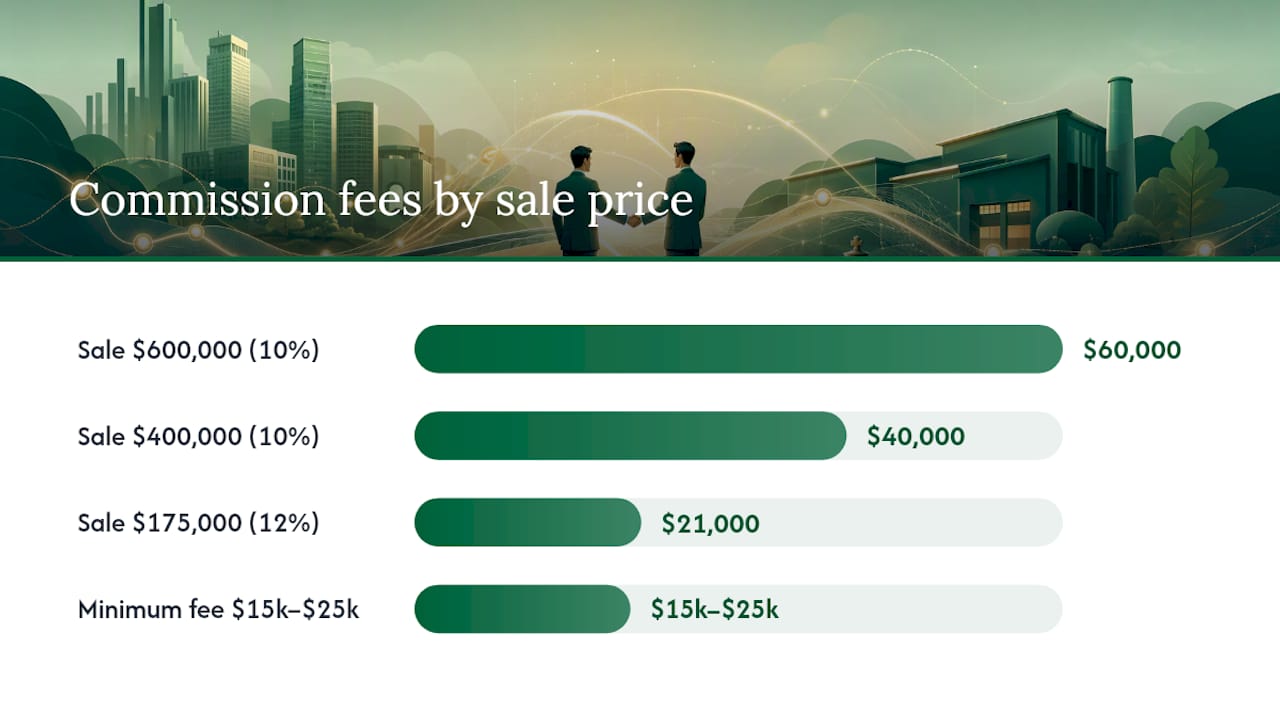
Fee examples (hypothetical, for illustration):
| Sale Price | Commission Rate | Estimated Fee |
|---|---|---|
| $600,000 | 10% | $60,000 |
| $400,000 | 10% | $40,000 (but may be subject to the minimum fee) |
| $175,000 | 12% (minimum applies) | $21,000 |
Most agreements also include an exclusivity window during which you cannot list with another broker or sell independently without owing a commission.
How do you vet and choose the right business broker?
Experts recommend interviewing at least three broker candidates and verifying closed-deal references before signing anything. Defaulting to the first referral you receive is one of the most common and costly mistakes sellers make.
Interview questions to ask
- How many deals have you closed in my industry in the past two years?
- What percentage of your listings are seller-only representation?
- Where does your buyer pipeline come from beyond listing sites?
- What is your average days-on-market for businesses in my value range?
- How do you handle confidentiality if a competitor inquires?
Red flags to watch for
- Reliance on listing sites as the primary or only marketing channel.
- No recent closed-deal references they can provide on request.
- Pressure to sign a long exclusivity agreement at the first meeting.
- Eagerness for a large upfront retainer without a clear marketing plan attached.
Pro Tip: Verify closed deals independently where possible. Ask for the business name and approximate sale date, then cross-reference with public records or BizBuySell transaction data. A broker who hesitates to provide verifiable references is a broker worth skipping.
Choosing a broker with relevant sector experience and an active buyer network is the single most reliable predictor of a strong sale outcome.
Key Takeaways
A business broker is worth the commission for most small-business sellers because the combination of confidentiality, valuation discipline, buyer access, and negotiation expertise consistently produces better outcomes than going solo.
| Point | Details |
|---|---|
| Confidentiality is the first priority | Brokers use NDAs and blind teasers to protect staff, customers, and contracts before any buyer knows your name. |
| Commission runs 8–12% under $1M | Minimum fees of $15,000–$25,000 are common; weigh this against the price premium a broker typically delivers. |
| Interview three brokers minimum | Verify closed-deal references, sector specialization, and deal-size experience before signing any exclusivity agreement. |
| Expect a multi-month timeline | Deals under $2M require preparation, active marketing, and due diligence; start the process well before you need to close. |
| Compassbusinessacquisitions covers the full process | Valuation, confidential marketing, buyer matching, negotiation, and closing support are all available through one engagement. |
The broker advantage most sellers underestimate
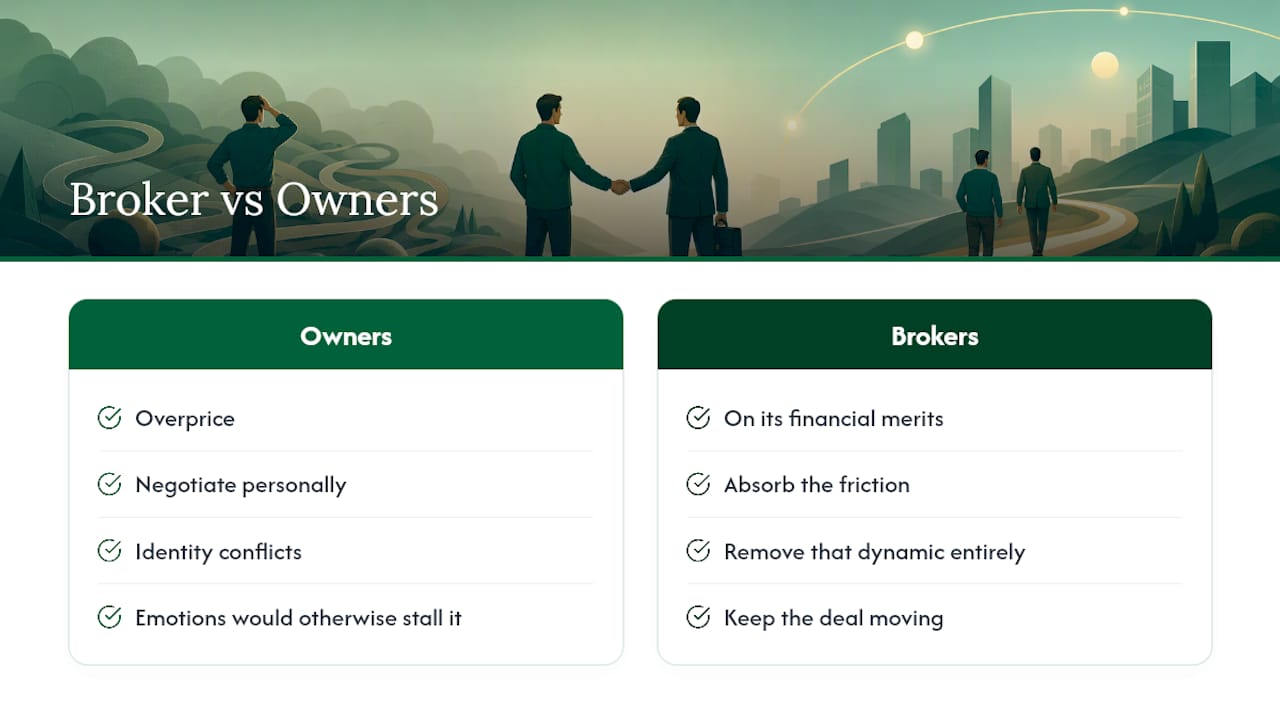
The conventional wisdom on business brokers focuses on access: they know buyers you do not. That is true, but it is not the most important thing they do. The real value is objectivity.
Selling a business you built is one of the most emotionally loaded financial decisions you will make. Owners routinely overprice based on what the business means to them, not what the market will pay. They also tend to negotiate personally, which turns price discussions into identity conflicts. A broker removes that dynamic entirely. They present your business on its financial merits, absorb the friction of difficult negotiations, and keep the deal moving when emotions would otherwise stall it.
There is also the issue of emotional pitfalls in the sale process that most sellers do not anticipate until they are in the middle of them. A broker who has run dozens of transactions has seen those patterns before and knows how to manage them without letting them derail the deal.
One more point worth stating plainly: seller control does not disappear when you hire a broker. You approve every offer, every disclosure, and every term. The broker executes your decisions with professional discipline. That combination, your authority and their expertise, is what produces the best outcomes.
Compass Business Acquisitions: a proven partner for sellers
Selling your business is a significant decision. Compassbusinessacquisitions gives sellers a structured, confidential path from valuation to closing, with professional representation at every stage.
Start with a business value estimate to establish a realistic asking price before you commit to anything. From there, Compassbusinessacquisitions provides:
- Negotiation representation — that protects your price and deal terms.
Explore the full seller process and request a confidential consultation. Your information stays private from the first conversation.
Useful sources for further reading
The following sources informed this article and are worth reviewing directly:
- 5 Key Steps To Find The Right Business Broker
- Business Broker, M&A Advisor, or Solo: Which Is Right for You? | The Owner’s Shortlist
- Expert Business Brokers | Maximize Your Sale & Find Opportunities
- Use Brokers for Better Deal Outcomes in 2026
- Role of Business Brokers for Investors: 2026 Guide
This article provides general information about business brokerage services and is not a substitute for legal, financial, or tax advice. Consult a qualified attorney, CPA, or licensed broker before making decisions about selling your business.