
Best mabusinessadvisors.com Alternatives for Small Business Owners
Best mabusinessadvisors.com Alternatives for Small Business Owners
For most U.S. small business owners seeking acquisition advice, professional valuations, and negotiation support, Compassbusinessacquisitions is the recommended full-service alternative, combining verified valuation capability, targeted buyer marketing, and hands-on transaction management. If your situation calls for a broader comparison, the four categories worth evaluating are:
- Full-service regional brokerages (e.g., Compassbusinessacquisitions): Best for sellers with businesses valued under $10M who need end-to-end support, from valuation through close.
- National full-service brokerages (Sunbelt, Transworld, Murphy): Best for owners who want brand-name reach and a large buyer database, typically for businesses in the $500K–$5M range.
- Boutique M&A advisory firms (Generational Equity and similar): Best for mid-market deals ($5M–$50M) where specialized industry expertise and institutional buyer access matter most.
- AI advisory platforms (Stack Network, Verdikt, Orca Advisor): Best as a low-cost first step for scoping, benchmarking, or preparing negotiation materials before engaging a paid broker.
M&A Business Advisors is an unfunded firm founded in 2017 and based in Calabasas, California. Its competitive context spans thousands of active advisory firms, which is exactly why knowing how to compare alternatives on the right dimensions saves time and money.
Table of Contents
- How do mabusinessadvisors.com alternatives compare on services and fees?
- How do you choose the right M&A advisor for your business?
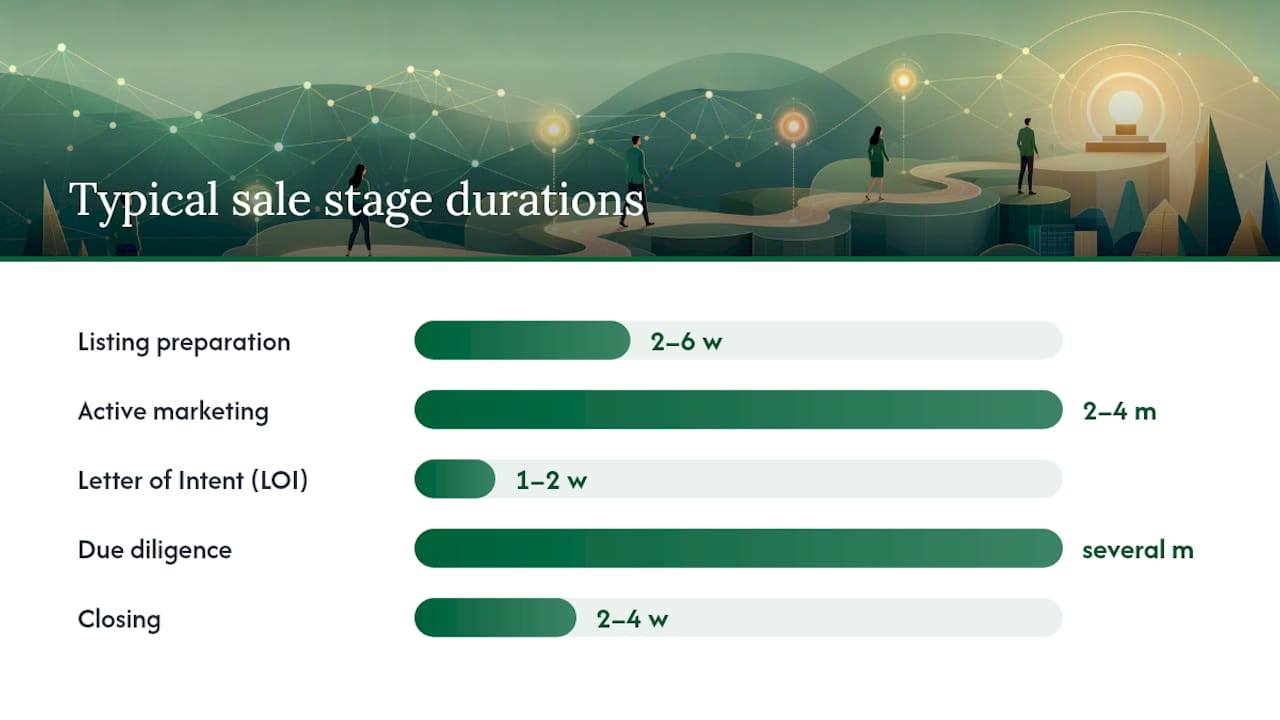
- What are the typical timelines and fees for selling a small business?
- Short profiles of each alternative category and Compassbusinessacquisitions
- Key Takeaways
- Compassbusinessacquisitions: full-service support from valuation to close
How do mabusinessadvisors.com alternatives compare on services and fees?
The table below compares the four alternative categories on the dimensions that most affect deal outcomes.
| Dimension | Regional Broker | National Brokerage | Boutique M&A Advisor | AI Advisory Platform |
|---|---|---|---|---|
| Primary services | Valuation, listing, buyer matching, negotiation, close | Valuation, listing, franchise network, buyer database | Strategic advisory, deal structuring, institutional buyer access | Scoping, benchmarking, vendor comparison, decision documents |
| Target deal size | $250K–$5M revenue | $500K–$5M revenue | $5M–$50M+ revenue | Any size (pre-engagement) |
| Typical fees | 8–12% success fee | 8–12% success fee + listing fee | Retainer + 3–7% success fee | $49/mo subscription or per-report |
| Industry focus | Generalist, local market depth | Generalist, franchise-heavy | Industry-specific (manufacturing, healthcare, tech) | Cross-vertical (tariffs, compliance, supply chain) |
| Geographic coverage | Local/regional | National (franchise network) | National/international | Online, no geography limit |
| Buyer network | Curated local/regional buyers | Large proprietary database | Institutional buyers, PE firms | No direct buyer outreach |
| Due diligence support | Full (in-house or partner) | Partial (varies by franchise) | Full (deal team) | Informational only |
Key trade-offs to weigh:
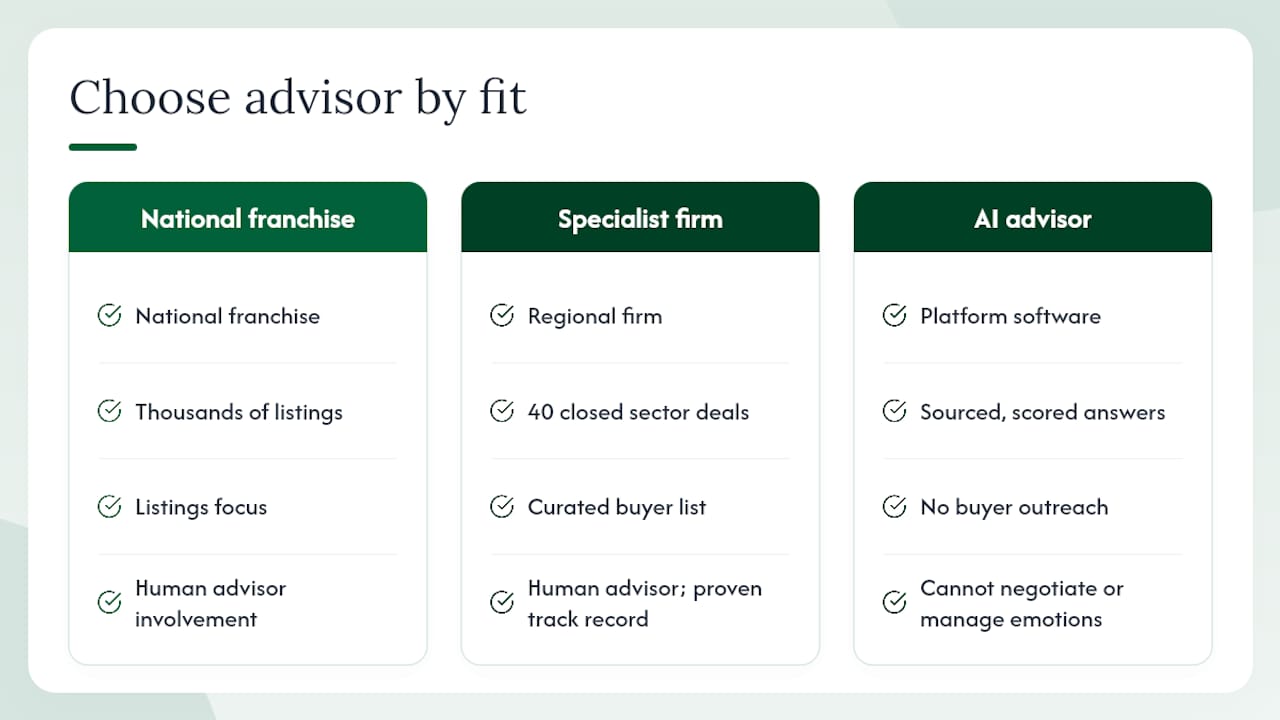
- Regional brokers offer the deepest local market knowledge and the most personalized seller support, but buyer reach is narrower than national networks.
- National brokerages provide volume and brand recognition; quality varies significantly by individual franchise location.
- Boutique M&A advisors bring institutional relationships and deal-structuring depth, but retainer costs make them impractical for deals under $5M.
- AI advisory platforms deliver fast, sourced answers on regulatory and competitive questions, yet they cannot replace relationship-driven buyer outreach or negotiation on your behalf.
Large consultancies such as McKinsey, BCG, and Kearney operate at enterprise scale, counseling Fortune 500 companies on transformational M&A. Their fee structures and minimum deal thresholds place them well outside the range relevant to most small business owners.
How do you choose the right M&A advisor for your business?
Fit on three dimensions beats brand recognition every time: deal size, industry, and your role (seller vs. buyer). Start there, then work through this checklist before signing any engagement letter.
- Define your seller goals. Know your target price, preferred timeline, and whether you want a clean exit or a transition role post-sale.
- Confirm the valuation method. Ask whether the firm uses asset-based, income-based (EBITDA multiple), or market-comparable approaches, and whether a certified appraiser signs off.
- Assess buyer access. Request a concrete description of their buyer database: how many active buyers, what industries, and how they qualify prospects.
- Verify confidentiality protocols. A signed NDA before any buyer receives your financials is non-negotiable.
- Clarify post-sale transition support. Some brokers exit at closing; others support the transition period. Know which you are getting.
- Request references. Ask for two or three sellers in your revenue range who closed within the past 18 months.
- Check credentials. IBBA membership and M&A Source certification signal professional standards and ongoing education.
- Read the fee schedule in full. Understand whether the success fee is calculated on total deal value or adjusted enterprise value.
Questions to ask on the first call:
- What is your average time from listing to close for businesses in my revenue range?
- How many transactions did you close in the past 12 months?
- Do you have in-house valuation capability, or do you refer out?
- How do you market listings, and which buyer channels do you use?
- What is your policy on dual representation (buyer and seller)?
- Can you provide a sample engagement letter before I commit?
Pro Tip: The single most telling red flag is an advisor who cannot produce verified transaction case studies. Published deal histories, even anonymized ones, demonstrate real execution capability. An advisor who deflects this request with vague assurances about “confidentiality” without offering any evidence of closed deals is worth passing on.
Understanding business model fit before you engage an advisor also sharpens your negotiating position from day one.
What are the typical timelines and fees for selling a small business?
The honest answer: most U.S. small business sales take several months from listing to close, and total advisory fees typically constitute a percentage of the final sale price for businesses under $5M in revenue.
| Stage | Typical Duration | Notes |
|---|---|---|
| Listing preparation & valuation | 2–6 weeks | Includes financial recast, CIM preparation |
| Active marketing | 2–4 months | Buyer outreach, NDA execution, initial offers |
| Letter of Intent (LOI) | 1–2 weeks | Negotiation of price and terms |
| Due diligence | several months | Buyer verification of financials, contracts, operations |
| Closing | 2–4 weeks | Legal docs, escrow, final transfer |
Sample fee scenarios:
- Broker commissions and valuation fees vary depending on deal size and complexity, with higher-priced transactions typically yielding larger fees, and standalone valuation fees depending on business complexity and the involvement of certified appraisers.
Buyer-side costs are usually lower. Buyers rarely pay a direct commission to the listing broker, but they may engage their own advisor on a retainer or flat-fee basis for due diligence support. Using a broker consistently produces better deal outcomes than going direct, particularly when it comes to pricing accuracy and buyer qualification.
Short profiles of each alternative category and Compassbusinessacquisitions
AI advisory platforms
Verdikt offers structured multi-persona advisory panels for small business owners, with tiered pricing starting at $49/month, useful for preparing negotiation materials or vendor comparisons before hiring a broker. Orca Advisor provides subscription-based business intelligence at $200/month, suited for founders who want ongoing strategic insight rather than transactional support. Both platforms are informational tools, not transaction executors.
Pro Tip: Use an AI advisory platform to scope your regulatory exposure, benchmark your financials, and stress-test your asking price before your first broker meeting. It costs a fraction of a retainer and sharpens every conversation that follows.
PwC’s research shows that only 20% of companies capture 74% of AI-driven value, a gap that applies directly to advisory: firms that integrate AI for data sourcing and analysis deliver faster, more accurate scoping than those relying on manual research alone.
How this shortlist was selected
The categories and providers featured here were selected based on four criteria: demonstrated fit for U.S. small business deal sizes, transparent fee structures, verifiable valuation capability, and published or verifiable transaction track records.
Primary data sources included industry association profiles (IBBA, M&A Source), public firm profiles, AI advisory product pages, and market-intelligence platforms. Direct competitor firms were evaluated but not named individually to keep the comparison category-level and free of vendor bias.
Key trust signals applied:
- Transaction history: closed deals in the relevant revenue range, with references available.
- Professional credentials: IBBA membership, M&A Source certification, or equivalent.
- Published case studies: anonymized or named deal summaries demonstrating execution.
- Clear fee schedules: written engagement letters with no hidden success-fee adjustments.
| Signal | Why it matters |
|---|---|
| IBBA / M&A Source membership | Signals professional standards and peer accountability |
| Verified transaction history | Confirms execution capability, not just advisory positioning |
| In-house valuation capability | Reduces reliance on third-party appraisers and speeds the listing process |
| Published fee schedule | Allows direct comparison and eliminates surprise deductions at close |
Key Takeaways
For U.S. small business owners, the right advisory alternative depends on deal size, industry fit, and how much hands-on support you need from valuation through close.
| Point | Details |
|---|---|
| Match advisor to deal size | Regional brokers fit deals under $5M; boutique M&A advisors serve $5M+ transactions. |
| Verify credentials and track record | Ask for IBBA/M&A Source membership and closed transaction references before signing. |
| Budget 8–12% for success fees | Most U.S. small business sales carry an 8–12% commission on the final sale price. |
| Use AI tools as prep, not replacement | AI advisory platforms scope and benchmark effectively but cannot execute buyer outreach or negotiate on your behalf. |
| Compassbusinessacquisitions | Offers full-service valuation, targeted marketing, buyer matching, and transaction management for small to mid-sized U.S. businesses. |
The case for choosing your advisor on fit, not familiarity
The most common mistake sellers make when evaluating business advisors alternatives is choosing on name recognition rather than demonstrated fit. A national brokerage franchise with thousands of listings is not automatically better for your $1.2M manufacturing business than a regional firm with 40 closed transactions in your sector and a curated buyer list. Volume and brand do not close deals. Relationships, accurate pricing, and targeted marketing do.
The rise of AI advisory tools adds a genuinely useful layer to this process. Platforms like Stack Network’s AI Business Advisor return sourced, confidence-scored answers on compliance, tariffs, and competitive positioning, which is real value at the scoping stage. But AI cannot call a qualified buyer, negotiate earnest money terms, or manage the emotional complexity of a seller who is handing over a business they built over 20 years. That work requires a human advisor with a proven track record and skin in the game.
The business advisory services comparison that actually matters is not which firm has the biggest website or the most Google reviews. It is which advisor has closed deals like yours, can name the buyers they would call on day one, and will put their fee structure in writing before you sign anything.
Compassbusinessacquisitions: full-service support from valuation to close
Sellers who want one firm to handle every stage of a transaction, from a professional valuation through targeted buyer marketing, negotiation, and final close, will find that Compassbusinessacquisitions delivers exactly that for small and mid-sized U.S. businesses.
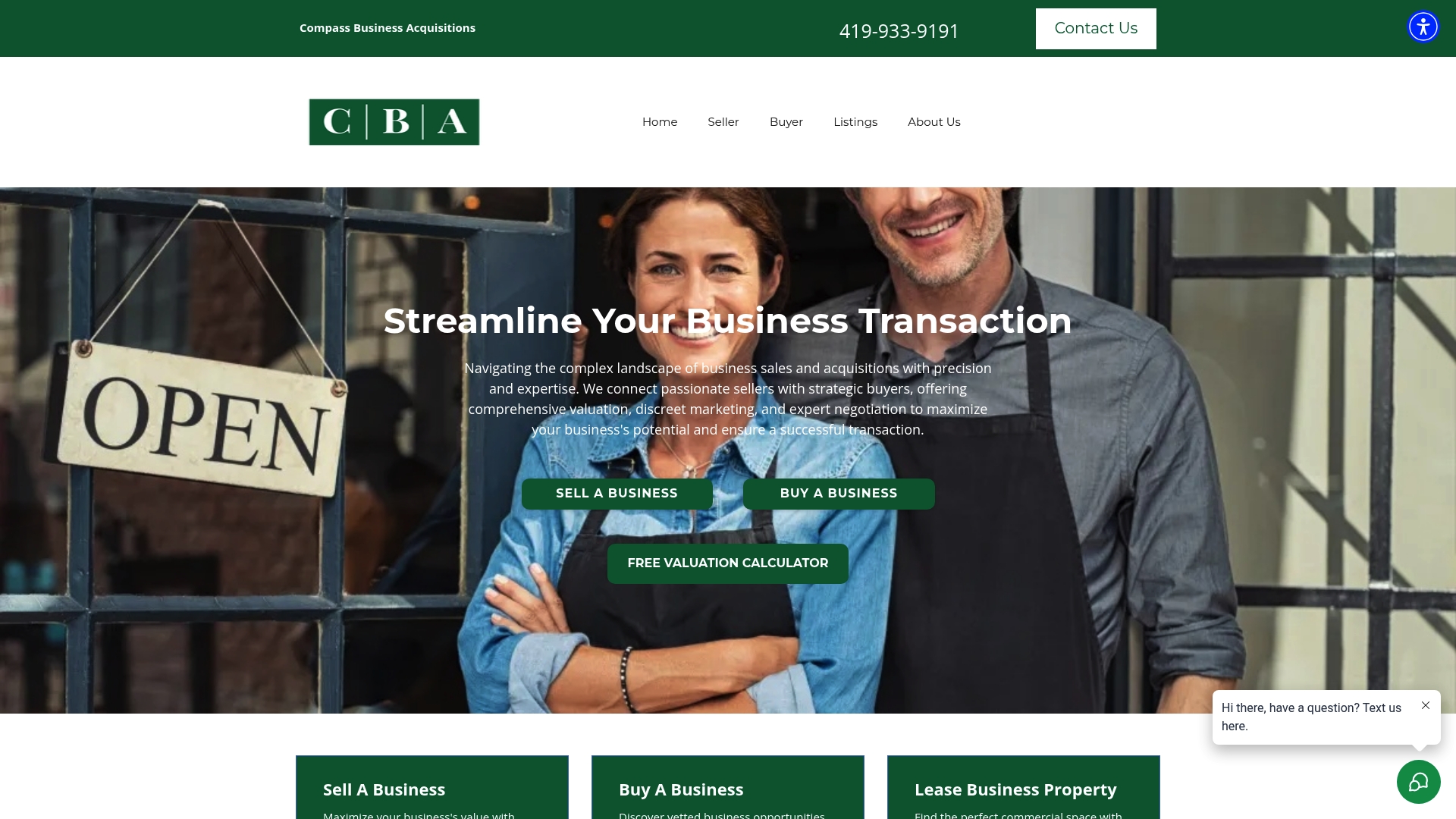
The process starts with a verified business valuation, giving you a defensible asking price before a single buyer sees your listing. From there, Compassbusinessacquisitions markets your business to qualified buyers, manages confidentiality, coordinates due diligence, and negotiates on your behalf through to close. Commercial property leasing is also available for owners who need to address real estate alongside the business transaction.
Fees are transparent and commission-based, so Compassbusinessacquisitions’s incentives align directly with maximizing your sale price. To get a market-aligned estimate of your business’s value, use the free valuation calculator or visit the seller services page to request a consultation and learn what to expect on the first call.
Useful sources and tools
- M&A Business Advisors - 2026 Company Profile & Competitors - Tracxn
- AI Business Advisor — Cross-Industry Analysis from Verified Data | Stack Network
- Verdikt | AI Advisory Board for Small Business Owners
- Orca Advisor | AI Business Intelligence for Small Business Owners
- Global management consulting | McKinsey & Company
- Seize tomorrow’s tech to reinvent your business | PwC
- Kearney
- Strategic Management Consulting | Boston Consulting Group