
What Is Key Person Risk and How Do You Fix It?
What Is Key Person Risk and How Do You Fix It?
Key person risk is the exposure a business carries when critical knowledge, relationships, or decision-making authority sit with one individual instead of the company itself. If that person leaves, gets sick, or dies, operations, revenue, or a pending sale can stall overnight.
The fastest way to size your exposure: list your top three people, write down the three processes or relationships each one solely controls, then estimate the revenue tied to each. Do this today, not after a resignation letter forces the question.
Rapid check checklist:
- Name the three people whose absence would stop work within a week.
- List what only they know: passwords, client contacts, vendor terms.
- Estimate the dollar revenue or contracts tied directly to each person.
Buyer commentary on business sales confirms that concentrated dependence on an owner or a single specialist actively reduces business value during due diligence.
Key Takeaways
Reducing key person risk requires documenting processes, cross-training backups, and pairing operational fixes with targeted insurance before a departure forces the issue.
| Point | Details |
|---|---|
| Run the rapid check first | List your top three key people, their sole-owned processes, and the revenue tied to each. |
| Document before you cross-train | Capture process steps, credentials, and relationship maps so knowledge outlives any one employee. |
| Track KRIs continuously | Monitor revenue concentration, single-signature approvals, and undocumented processes on a recurring basis. |
| Insurance backs up, not replaces, operations | Key person insurance covers short-term cash gaps; it doesn’t recreate lost knowledge or relationships. |
| Buyers test this directly | Compass Business Acquisitions factors key person exposure into valuations and helps sellers close gaps before going to market. |
Table of Contents
- The Operational and Financial Cost of Key Person Dependence
- Identifying Your Key People and Measurable Risk Indicators
- Cutting Key Personnel Dependence Through Documentation and Cross-Training
- Key Person Insurance and When You Actually Need It
- Prioritizing Fixes With a People-Focused Business Impact Analysis
- A 90-Day Plan to Reduce Key Person Exposure
- Why This Matters to Compass Business Acquisitions
- Legal and Contractual Ways to Reduce Key Person Exposure
- Talking to Employees, Lenders, and Buyers About This Risk
- Reduce Key Person Risk Before You List Your Business
- Sources
The Operational and Financial Cost of Key Person Dependence
When a key employee walks out, the damage rarely stops at an empty desk. Undocumented processes, known as shadow systems, vanish with the person who built them. Consultants who audit these situations regularly find fragmented files, personal cloud storage, and workflows that exist only in one person’s head.
Expect costs to stack across several categories:
- Recruiting and onboarding a replacement, often for months.
- Lost revenue while clients wait, hesitate, or leave.
- Interim consultants or overtime pay to cover the gap.
- Time spent recreating knowledge that used to exist in one person’s routine.
Lenders and buyers price this risk in. Business continuity experts warn that treating a high performer as interchangeable with everyone else is the common mistake. A true key person represents a single point of failure, and that distinction shows up directly in loan covenants, earnout structures, and valuation multiples during a sale.
Identifying Your Key People and Measurable Risk Indicators
Not every strong employee is a key person. The test is dependency, not talent. Ask these screening questions across your team:
- Who is the only person who can approve a payment, contract, or hire?
- Who holds passwords, credentials, or vendor logins that nobody else has access to?
- Which client relationships exist because of a personal connection rather than a company process?
- Who has specialized licensing, certification, or technical knowledge nobody else on staff holds?
Common key-person types include the founder-owner who still signs every deal, the sales rainmaker who owns the client Rolodex, the licensed specialist (an accountant, engineer, or pharmacist), and the IT lead who built your systems from scratch.
Once you’ve named them, track a few key risk indicators (KRIs): the percentage of revenue tied to one person, the number of approvals that require a single signature, and the count of processes with zero written documentation.
Pro Tip: Audit personal devices and private cloud accounts during your review. Shadow systems hide there more often than in any shared company drive.

Cutting Key Personnel Dependence Through Documentation and Cross-Training
Reducing dependency is a sequencing problem, not a mystery. Start where the exposure is highest and work down.
Documentation comes first. Build simple templates that capture process steps, system credentials, and a map of who knows which client or vendor relationship. This alone converts tribal knowledge into a company asset, which is exactly what industry guidance on key person risk recommends as step one.
Cross-training turns single points of failure into shared capability. A practical rollout looks like this:
- Pair every key role with a designated backup within 30 days.
- Test the pairing by having the backup run the role during a real vacation, not a drill.
- Rotate responsibilities quarterly so skills don’t atrophy between tests.
Role redesign matters as much as training. Move client relationships and vendor contracts onto company-owned systems, shared inboxes, and CRM records instead of a personal phone or email account. Compass Business Acquisitions has seen how transferring relationships to the business rather than the individual materially changes how a buyer views risk.
Retention plays a supporting role here too. Competitive pay, clear incentive structures, and reasonable notice terms in employment agreements won’t eliminate key person risk, but they buy you the time to execute the documentation and cross-training work before a departure becomes a crisis.
- Documentation: templates for processes, credentials, and relationship maps.
- Cross-training: backup pairs tested through real absences, not simulations.
- Role redesign: relationships owned by the company, not the individual.
- Retention: market pay and clear notice terms to buy transition time.
Key Person Insurance and When You Actually Need It
Operational fixes reduce the chance of disruption. Key person insurance (sometimes called key man insurance) covers the financial gap if disruption happens anyway. The policy pays the company a lump sum if a named individual dies or becomes disabled, and that cash typically funds recruiting costs, covers lost revenue during the transition, or buys out a deceased partner’s ownership stake.
It has real limits. It doesn’t replace lost client relationships, recreate undocumented processes, or retrain a replacement. It’s cash, not continuity.
- Lenders financing a small business often require key person coverage on the founder as a loan condition.
- Buyers negotiating an acquisition may request an escrow or holdback tied to owner transition risk.
- Sizing the policy should reflect short-term cash needs, not a company’s entire valuation.
A blended approach works best: documentation and cross-training reduce operational disruption long-term, while insurance provides short-term cash during the gap. Treat insurance as a backstop, never the whole strategy.
Prioritizing Fixes With a People-Focused Business Impact Analysis
You can’t fix everything at once, so prioritize using the same logic a business impact analysis applies to systems. NIST Interagency Report 8286D recommends this approach for mission-critical assets, and it works just as well applied to people.
- Identify mission-essential functions and name the person who currently owns each one.
- Score each function on impact (how much revenue or operations depend on it) and likelihood (how likely that person is to leave soon).
- Set a recovery time objective for each role: how many days can it stay uncovered before real damage starts?
| KRI | Example threshold |
|---|---|
| Revenue tied to one person | Flag anything above 20% of total revenue |
| Single-signature approvals | Flag any approval process with zero backup signer |
| Undocumented core processes | Flag any process with no written procedure |
Mature organizations track these KRIs on an ongoing dashboard rather than reviewing them once a year.
A 90-Day Plan to Reduce Key Person Exposure
Turning this into action means giving it a deadline. Here’s a sequence that fits inside one quarter.
- Weeks 0 to 2: Run the rapid audit. List your top exposures and score each on impact and likelihood.
- Weeks 3 to 8: Document the highest-risk processes and assign a named backup to each key role. Start hands-on cross-training immediately, not after documentation is “finished.”
- Weeks 9 to 10: Review your key person insurance coverage and any cash protections against what the audit revealed.
- Weeks 11 to 12: Formalize your KRIs into a recurring report and set a review cadence, monthly or quarterly.
Ninety days won’t eliminate dependency in a complex organization, but it will move you from unknown exposure to a measured, tracked risk. That shift alone changes how lenders and buyers view your business.
Why This Matters to Compass Business Acquisitions
Compass Business Acquisitions works with owners preparing to sell, and key person risk is one of the first things buyers probe during due diligence. Professional valuations, targeted marketing, and buyer-seller matching only produce a strong outcome when the underlying business can survive a leadership transition.
Buyers actively test whether client relationships and operational knowledge belong to the company or to an individual. Businesses that can demonstrate company-owned processes and documented relationships consistently negotiate from a stronger position.
Sierra, contributing to Compass Business Acquisitions’ advisory content, draws on the firm’s experience preparing sellers for the scrutiny that comes with a transaction.
Legal and Contractual Ways to Reduce Key Person Exposure
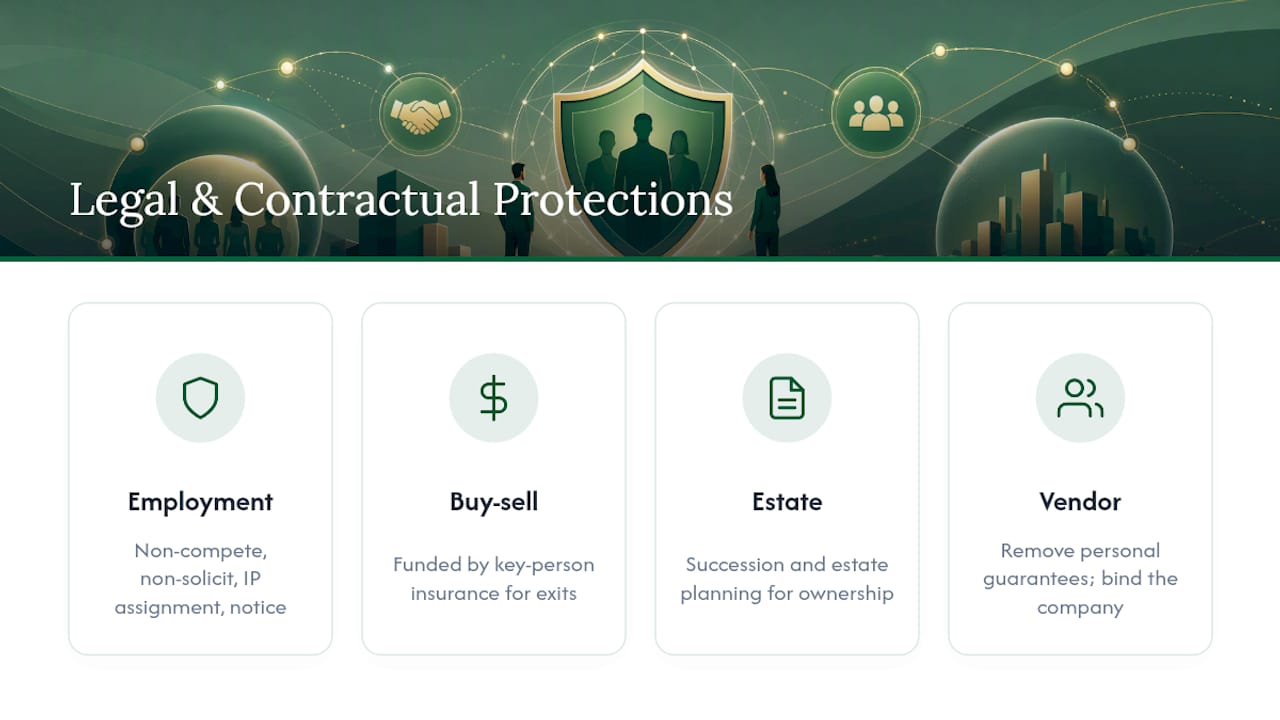
Contracts are where key person risk either gets contained or quietly compounds. Employment agreements for critical staff should include non-compete and non-solicitation clauses where enforceable, reasonable notice periods, and clear intellectual property assignment so that processes, client lists, and proprietary tools belong to the company, not the employee’s personal files.
Buy-sell agreements matter just as much for owner-level risk. If your business has multiple partners, a buy-sell agreement funded by key person insurance determines what happens to an owner’s equity stake if they die, become disabled, or want to exit. Without one, surviving partners can end up negotiating with a grieving spouse or an estate attorney under pressure, often at a worse price than a pre-agreed formula would have set.
Succession and estate planning intersect here too. Business owners frequently delay personal estate planning even after building strong company processes, which leaves ownership transfer exposed even when operations are covered. General guidance on succession and estate planning for business owners is a useful starting point, though owners should confirm specifics with a licensed attorney in their own jurisdiction.
Vendor and client contracts deserve a review too. Check whether key agreements are personally guaranteed by an owner or tied to a named employee’s continued involvement. Contracts written around a person rather than the company create exactly the kind of dependency a buyer will flag, and the terms you negotiate now can affect what a buyer will accept later in a sale.
Talking to Employees, Lenders, and Buyers About This Risk
How you communicate key person risk depends entirely on the audience, and getting the tone wrong with any one of them creates a new problem.
With employees, frame cross-training and documentation as career development and operational resilience, not as a signal that someone is replaceable or on their way out. Nobody responds well to feeling like a liability being managed down. Position it instead as building a team that can support each other during vacations, illness, or growth.
With lenders, transparency works in your favor. If a loan covenant requires key person insurance, provide it proactively rather than waiting to be asked. Lenders read voluntary disclosure as a sign of a well-run operation, not a red flag.
With buyers, the conversation shifts to evidence. Buyers don’t want reassurance that “everything will be fine.” They want documentation, backup personnel already in place, and client relationships managed through company systems rather than personal cell phones. Bring the audit results, the cross-training log, and the insurance policy to the table before they ask for it.
With partners and co-owners, the buy-sell agreement conversation is easiest to have early, before anyone is sick, retiring, or in conflict. Revisit it annually alongside your KRI review so it stays current with the business’s actual value and structure.
Absence isn’t always dramatic. Illness, extended leave, and ordinary attrition are far more common triggers than a dramatic departure, and continuity planning literature treats these everyday causes as the real, recurring threat.
What buyer readiness looks like in practice
A brief note tying this back to the sale process: buyers pay closer attention to key person exposure than most sellers expect, and that scrutiny only grows as deal size increases. Owners who run this audit and document their fixes before going to market consistently negotiate stronger terms.
Run the 90-day checklist above, then reach out to Compass Business Acquisitions for a valuation conversation once you’ve closed the biggest gaps.
— Sierra
Reduce Key Person Risk Before You List Your Business
Compass Business Acquisitions gives sellers something most business owners can’t build alone: an outside view of exactly where buyers will push during due diligence, before that scrutiny costs you leverage at the negotiating table.

Compass’s professional valuation process factors in operational dependency the same way a buyer will, so you see the discount coming rather than discovering it mid negotiation. The team’s targeted marketing and buyer matching then position your business to buyers who understand its real value, not just the surface numbers. If you’ve already started documenting processes and building backups using the 90-day plan above, that work directly strengthens your negotiating position.
Start with a free Business Evaluation Calculator to see where your business stands today, then visit the seller services page to schedule a valuation conversation with the Compass team.
Sources
- NIST Interagency Report 8286D
- Key person risk — Prialto blog
- Key Person Risk: What Is It Costing Your Business? — Forbes
- Navigating key person risks — Nationwide
- Key Person Dependency: The $1M Risk Hiding in Your Org Chart — Privagent