
Why Business Relationships Transfer in Sales
Why Business Relationships Transfer in Sales
Business relationship transfer in sales is the process of passing personal trust, communication context, and client-specific knowledge from one sales professional or owner to another, preserving revenue continuity. This transfer is the core challenge in any sales handoff, whether triggered by a rep change, territory rebalancing, or a full business acquisition. Meaningful trust takes 3–6 months to build in B2B environments. That timeline makes understanding why business relationships transfer in sales a critical priority for any professional managing a transition. Poorly managed handoffs stall deals, erode client confidence, and directly threaten pipeline value.
Why do business relationships transfer in sales?
Business relationships transfer in sales because the value embedded in those relationships is not purely personal. It lives in documented context, shared history, and consistent communication patterns that can be captured and handed off deliberately. When a sales rep or business owner changes, the client does not lose their need for the product or service. What they lose is the person who understood their preferences, their internal politics, and their negotiation history. That loss is recoverable, but only if the transfer is managed with intention.
Relationship-led selling generates more referrals, higher retention, and shorter sales cycles on repeat business. This means the relationship itself carries measurable financial value. When that value transfers successfully, the incoming rep or new owner inherits not just a contact name but a revenue-producing asset. The importance of business relationships becomes clearest at the moment of transition, when their absence is most costly.

Transfer works because trust, while personal, is also institutional. Clients trust the company behind the rep as much as the rep themselves, provided the company demonstrates continuity. A structured handoff signals to the client that the organization values the relationship, not just the transaction.
What are the key components that make business relationships transferable?
Several specific elements determine whether a sales relationship can transfer successfully. Each one must be actively preserved during any handoff.
- Trust and rapport. The outgoing rep’s credibility is the foundation. Clients extend initial goodwill to a new rep based on how the transition is introduced and managed.
- Contextual knowledge. Buyer preferences, internal decision-making structures, past negotiation outcomes, and communication styles are rarely captured in a CRM. This “soft” knowledge is the most fragile element of any transfer.
- Ongoing engagement habits. Clients expect contact at specific intervals and through specific channels. A new rep who changes that cadence without explanation signals disruption.
- Multi-threaded relationships. A relationship tied to one contact is fragile. 86% of sellers lose or stall deals when a single buyer contact changes roles. Building relationships across multiple stakeholders at the client organization reduces this risk significantly.
- Contract and legal context. Active agreements, renewal dates, and pricing commitments must transfer with full documentation to avoid credibility-damaging errors in early conversations.
Pro Tip: Before any handoff, have the outgoing rep record a 10-minute audio or video brief covering the client’s communication preferences, key internal champions, and any sensitive topics to avoid. This captures tone and nuance that written notes miss.
The importance of business relationships shows up directly in pipeline progression. Relationship-building proficiency influences buyer openness, earlier involvement of decision makers, and sustained engagement in longer buying cycles. These qualities do not disappear when a rep leaves. They transfer when the incoming rep receives the right context.
How does improper transfer of business relationships affect sales outcomes?
Clumsy handoffs carry a concrete cost. Improper territory or rep transfers stall deal momentum for 4–6 weeks across 3–5 high-value accounts per transition. That is not a minor inconvenience. For a business with deals averaging $50,000 or more, a six-week stall on five accounts represents a material revenue delay or loss.
The risks compound across several dimensions:
- Lost deal context. Late-stage negotiations depend on knowing exactly where the buyer stands emotionally and commercially. An incoming rep without that context restarts conversations the client thought were finished.
- Credibility gap. The new rep must earn access to senior decision makers from scratch. Buyers who were close to signing become cautious when they sense the relationship has been reset.
- Post-sale decay. Sales professionals frequently abandon the relationship immediately after closing. Post-sale relationship-building yields referrals worth three times the original contract value. Abandoning that relationship after the close eliminates this return entirely.
- Single-thread collapse. When a relationship exists only with one contact and that contact leaves, the entire account is at risk. This is the most common and most preventable form of relationship loss.
The financial impact of poor handoffs extends beyond the immediate deal. Clients who experience a disjointed transition are less likely to expand their contracts, provide referrals, or renew at full value. The benefits of strong sales connections accumulate over time, and a single poor handoff can erase years of relationship equity.
What best practices ensure effective transfer of business relationships?
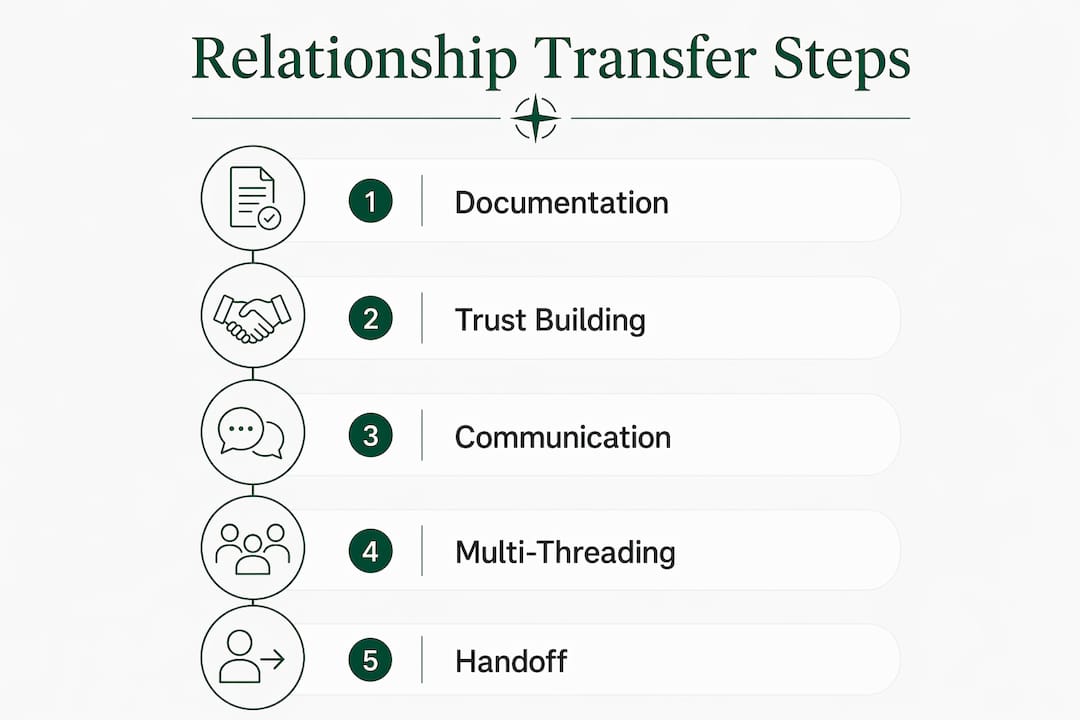
A structured approach to handoffs protects both the client relationship and the pipeline. The following steps apply across rep changes, territory shifts, and ownership transitions.
- Create a structured account brief. Effective account transfers require documented soft knowledge: buyer communication preferences, internal politics, and negotiation history that never appears in a CRM. This brief is the single most important transfer document.
- Introduce the transition directly. The outgoing rep should communicate the change to the client personally, by phone or in person, before the new rep makes contact. This preserves trust and frames the change positively.
- Run a joint meeting. A three-way call or meeting with the outgoing rep, incoming rep, and client signals continuity. The client sees the relationship as a company asset, not a personal one.
- Build company-level relationships. Introduce clients to account managers, support leads, and executives. This multi-threading reduces dependence on any single point of contact.
- Maintain post-handoff engagement. The outgoing rep should remain available for questions for at least 30 days. This continuity period prevents the credibility gap from widening.
Pro Tip: Tier your transfer approach by account value and deal stage. High-value accounts in late-stage negotiations need a full joint meeting and a 60-day continuity plan. Early-stage accounts may need only a warm email introduction and a detailed brief.
The table below shows how transfer depth should vary by account type.
| Account type | Transfer method | Continuity period |
|---|---|---|
| High-value, late-stage deal | Joint meeting plus full account brief | 60 days |
| Mid-value, active relationship | Warm introduction call plus written brief | 30 days |
| Early-stage or low-value | Email introduction plus CRM notes | 14 days |
Negotiation tactics that preserve relationship continuity during transitions consistently produce better close rates than those that treat the handoff as an administrative task.
How do business relationship transfers evolve across different sales contexts?
The factors influencing relationship transfers shift significantly depending on the type of change involved. A rep promotion within a company carries different risks than a full business acquisition.
- Territory transfers. These are the most common and most underestimated. Territory rebalancing and team restructuring frequently cause the loss of institutional knowledge when soft context goes undocumented. The incoming rep inherits accounts but not the relationship depth behind them.
- Rep transitions due to attrition. When a rep leaves unexpectedly, there is no planned handoff. The company must reconstruct relationship context from CRM data, email history, and colleagues. This is the highest-risk scenario.
- Business acquisitions. Buyers analyze customer transferability to assess whether revenue streams will continue after an ownership change. Contractual stability, account relationships, and team continuity are the three primary factors in this evaluation. A business where revenue depends on the personal relationships of the departing owner carries a measurable valuation discount.
- Management continuity. Keeping key account managers in place post-acquisition is one of the most effective ways to preserve client relationships. Buyers who commit to retaining the existing team signal stability to clients.
How sales relationships evolve in complex B2B environments depends heavily on relationship depth at the time of transfer. A client with a five-year history and multiple internal champions transfers far more reliably than a client with a single contact and a one-year relationship. Conducting market analysis before acquiring a business should include a direct assessment of client relationship depth and concentration risk.
Key Takeaways
Business relationships transfer successfully in sales only when trust, contextual knowledge, and multi-threaded connections are deliberately preserved and handed off through structured processes.
| Point | Details |
|---|---|
| Trust takes time to build | Building meaningful B2B trust requires 3–6 months of consistent engagement, making early handoff planning critical. |
| Soft knowledge is the most fragile asset | Buyer preferences and internal politics rarely appear in CRM systems and must be captured in structured account briefs. |
| Poor handoffs carry a direct cost | Improper transfers stall 3–5 high-value deals for 4–6 weeks, creating measurable revenue delays. |
| Multi-threading reduces transfer risk | Relationships built across multiple client stakeholders survive personnel changes far better than single-contact accounts. |
| Acquisition buyers assess transferability | Customer relationship stability directly influences business valuation and acquisition risk assessment. |
What I’ve learned about relationship transfers that most professionals get wrong
The most common mistake I see is treating a sales handoff as an administrative event rather than a relationship event. A rep change or ownership transition is, from the client’s perspective, a test of whether the company they trusted is still the same company. Most professionals focus entirely on the paperwork and miss that test entirely.
Single-threaded relationships are the silent killer in any transition. A seller who has been the sole point of contact for a major account for three years has not built a business asset. They have built a personal asset that walks out the door with them. The remedy is not complicated. It requires introducing clients to at least two other people in the organization before any transition occurs. Most professionals wait until the transition is announced to start that process, which is already too late.
Relationship building in negotiation requires ongoing management even after contracts are signed. This is the insight that separates high-retention sales organizations from average ones. The relationship does not end at the close. It continues through renewals, expansions, and referrals. Post-sale decay, the habit of abandoning a client after closing, destroys the compounding value that makes strong client relationships worth preserving in the first place.
Document the tacit knowledge. Record the brief. Make the introduction call. These are not optional steps in a good handoff. They are the difference between a client who stays and one who quietly evaluates alternatives.
— Sierra
How Compassbusinessacquisitions supports relationship continuity in business sales
Relationship continuity is one of the most undervalued factors in a successful business sale. When client relationships are strong and transferable, the business commands a higher valuation and attracts more qualified buyers.

Compassbusinessacquisitions specializes in connecting sellers with buyers who are aligned with the business’s existing client base and operational culture. Their professional valuations account for relationship depth and customer concentration risk, two factors that directly affect what a buyer will pay. For sellers preparing to exit, Compassbusinessacquisitions provides the guidance needed to document and present client relationships as transferable assets. Sell your business with a team that understands the full value of what you have built, including the relationships that drive your revenue.
FAQ
Why do business relationships transfer in sales?
Business relationships transfer in sales because trust and contextual knowledge can be documented and handed off deliberately. When the incoming rep or new owner receives a structured account brief and a warm introduction, clients extend their existing goodwill to the new relationship.
How long does it take to rebuild a transferred sales relationship?
Rebuilding trust after a poor handoff can take as long as the original relationship took to form, typically 3–6 months. A well-managed transfer with a joint introduction and continuity period significantly shortens that timeline.
What is the biggest risk in a sales relationship transfer?
The biggest risk is a single-threaded relationship where only one contact knows the client well. When that contact leaves without a handoff plan, the account loses its relationship foundation and becomes vulnerable to churn.
How does customer transferability affect a business acquisition?
Buyers evaluate customer transferability as a direct measure of revenue risk. Businesses where revenue depends on the personal relationships of the departing owner carry a valuation discount because those relationships may not survive the ownership change.
What should a sales account brief include?
A strong account brief covers buyer communication preferences, internal decision-making structure, negotiation history, key champions, sensitive topics, and active contract terms. This soft knowledge is rarely captured in CRM systems and must be recorded explicitly before any handoff.