
The Role of Timing in Deal Negotiation: 2026 Guide
The Role of Timing in Deal Negotiation: 2026 Guide
Timing in deal negotiation is defined as the deliberate control of when offers are made, how quickly responses arrive, and how deadlines are managed to shift leverage and influence outcomes. The role of timing in deal negotiation goes far beyond scheduling. It shapes the psychological dynamics between buyers and sellers, determines who holds power at each stage, and directly affects whether a deal closes at all. Research from the Harvard Program on Negotiation, Duke University’s Fuqua School of Business, and the Kellogg School of Management confirms that timing decisions, including when to anchor, when to pause, and when to push back on deadlines, produce measurable differences in final prices and closure rates.
How does timing affect anchoring and first offers?
The anchoring effect is the tendency for the first number introduced in a negotiation to disproportionately shape all subsequent offers. Timing determines whether that anchor works for you or against you.
Delaying initial offers in multi-issue negotiations produces better joint outcomes. Early anchors lock the conversation onto a single number before both parties have shared enough information to find creative value. In complex business deals involving price, payment terms, transition support, and non-competes, rushing to anchor can eliminate options that neither side has even considered yet.
The decision to anchor early or late depends on one key variable: how well you understand the Zone of Possible Agreement, or ZOPA. The ZOPA is the range where both parties could theoretically agree. Better informed parties benefit from anchoring early because their number is grounded in real data. Less informed parties should delay their first offer to gather more information and avoid setting an anchor that undersells or overreaches.
- You know the market well: Make the first offer. Your anchor reflects real value and pulls the negotiation in your favor.
- You lack full information: Ask questions first. Understand the other party’s priorities before committing to a number.
- The deal has multiple issues: Delay the anchor. Share information on each issue before pricing anything.
- The counterpart is clearly better informed: Invite them to go first. Their anchor reveals their expectations and your ZOPA.
Pro Tip: Before deciding whether to anchor, ask yourself one question: do I know more about the fair value of this deal than the person across the table? If yes, anchor early. If not, ask questions until you do.
What is the impact of response timing on deal outcomes?
Response speed sends a signal. A fast reply communicates eagerness. A slow reply communicates confidence, or disinterest. Both affect how the other party values the deal.

Research on counteroffer timing in price negotiations shows that sellers who take twice the average time to respond reduce the buyer’s likelihood to counteroffer by 6.3% and decrease deal closure probability by 4.4%. That is a significant cost for simply taking too long. Slow responses erode momentum and signal that the seller may not be serious.
The data also shows a nuance worth understanding. When a sale does occur after a delayed seller response, the final sale price rises by $0.74 relative to the buyer’s initial offer. That means a deliberate, controlled delay can extract slightly better terms, but only if the deal survives the wait.
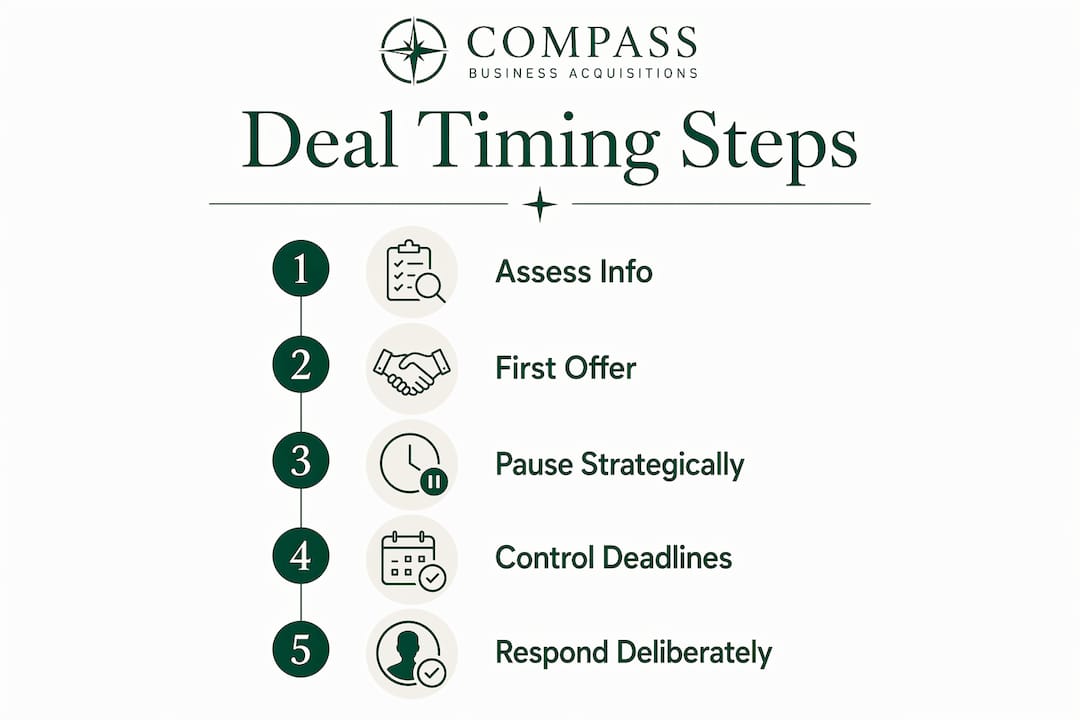
Unexpected pauses produce a different effect entirely. Duke University research found that a brief, unanticipated pause of roughly 90 seconds during bargaining raised purchase likelihood from 64% to 87%. The buyer, not expecting the pause, interpreted it as the seller reconsidering, which increased perceived value. Critically, this effect disappears when the buyer anticipates the delay.
| Timing scenario | Effect on buyer behavior | Effect on deal outcome |
|---|---|---|
| Seller responds twice as slow | Buyer 6.3% less likely to counteroffer | Closure probability drops 4.4% |
| Unexpected 90-second pause | Buyer interprets pause as reconsideration | Purchase likelihood rises from 64% to 87% |
| Anticipated delay | Buyer adjusts expectations in advance | Surprise effect is eliminated |
| Fast seller response | Buyer perceives eagerness | May reduce perceived seller leverage |
Pro Tip: Use a brief, unannounced pause after receiving an offer before responding. Say you need a moment to review. That single pause can shift perceived value without any change to your actual terms.
How should you manage deadlines and negotiation pacing?
Deadlines are not fixed facts. They are variables, and treating them as tradable assets is one of the most underused timing tactics for deals.
Experienced negotiators treat time as traded capital, demanding concessions in exchange for compressed schedules or faster closings. If a buyer wants to close in 30 days instead of 60, that acceleration has value. You can trade it for a higher price, fewer contingencies, or a cleaner contract. Giving away speed for free leaves real money on the table.
Before accepting any deadline as real, verify it. Deadlines can be tactical bluffs, and negotiators who concede to artificial time pressure give up leverage without cause. Ask three questions: Who benefits from this deadline? What actually happens if it is missed? Is there a realistic alternative timeline? The answers reveal whether the deadline is a genuine constraint or a pressure tactic.
Pacing matters just as much as deadlines. Long delays cause deal fatigue, which pushes both parties toward rushed concessions near the close. Controlling the pace means setting a deliberate rhythm: advance on key issues, pause on others, and never let the other party dictate the speed of every exchange.
- Identify who owns the deadline. Determine whether the timeline serves the other party’s interests more than yours.
- Test the deadline’s authenticity. Ask what changes if the date moves. A real deadline has clear consequences.
- Trade time for value. If you agree to accelerate, ask for something concrete in return.
- Segment the timeline. Break the deal into phases with separate milestones. This gives you natural pause points to reassess.
- Pair any extension request with progress. Deadline extension requests must come with a revised timeline and evidence of progress to avoid appearing desperate.
Treating a deadline as a constraint rather than a variable is one of the most common and costly mistakes in business negotiation. Time is a commodity. The party who controls it controls the deal.
What timing mistakes do small business owners make most often?
Small business owners face a specific set of timing pressures that larger organizations do not. They often negotiate without a team, under real financial pressure, and with less experience reading the other party’s signals. These conditions create predictable timing errors.
The most common mistake is accepting the first deadline offered without question. A buyer says, “We need an answer by Friday.” The seller, anxious to close, agrees. That Friday deadline may have no basis in reality. It exists to compress the seller’s thinking time and reduce the quality of their response. Negotiators who manage timing variables strategically maintain leverage and avoid panic-induced weak concessions.
- Responding too fast: Instant replies signal desperation. Wait before responding to any significant offer, even if you already know your answer.
- Accepting artificial urgency: Phrases like “this offer expires tonight” are pressure tactics. Verify the claim before reacting.
- Ignoring the other party’s timing pressures: If a buyer needs to close before their fiscal year ends, that pressure is your leverage. Use it.
- Rushing multi-issue deals: Settling price before discussing terms, transition support, or training compresses your total value. Sequence issues deliberately.
- Skipping preparation on ZOPA: Entering a negotiation without understanding the realistic range of outcomes forces you to react rather than lead.
Understanding the market conditions before acquiring or selling a business gives you the informational foundation to time your offers and responses with confidence. Preparation is what separates reactive negotiators from deliberate ones.
Small business owners who treat timing as a passive element, something that just happens, consistently underperform those who treat it as a tool. The good news is that timing awareness is a learnable skill. It requires observation, preparation, and the discipline to pause before reacting.
Key Takeaways
Timing in deal negotiation is a controllable variable that directly affects leverage, closure rates, and final price at every stage of a deal.
| Point | Details |
|---|---|
| Anchor timing depends on information | Better informed parties should anchor early; less informed parties should delay and ask questions first. |
| Unexpected pauses increase deal value | A brief, unanticipated pause can raise purchase likelihood significantly, but only when the counterpart does not expect it. |
| Deadlines are negotiable assets | Test every deadline for authenticity and trade accelerated timelines for concrete concessions. |
| Slow responses carry real costs | Sellers who respond too slowly reduce closure probability, even when a slight price gain is possible. |
| Preparation enables timing control | Knowing your ZOPA and the counterpart’s pressures lets you set the pace instead of reacting to it. |
Timing is the negotiation variable most entrepreneurs ignore
I have watched entrepreneurs spend weeks preparing financial models, legal terms, and valuation arguments, then walk into a negotiation and respond to every offer within minutes. All that preparation, and they handed over their leverage in the first exchange.
The uncomfortable truth is that most negotiators treat timing as a byproduct of the deal rather than a driver of it. They respond when they feel ready, accept deadlines because they sound official, and rush to close because silence feels like failure. Every one of those instincts costs money.
What I have found actually works is treating time the same way you treat price: as something you give up only when you get something back. If a buyer wants a faster close, that speed has a dollar value. If a seller goes quiet for 48 hours, that silence has a psychological effect. Neither of those moves requires a lawyer or a financial model. They require awareness and the confidence to pause.
The use of experienced brokers in complex deals matters here more than most entrepreneurs realize. A broker who has closed hundreds of transactions knows exactly when a deadline is real and when it is theater. That pattern recognition is worth more than any single tactic in this article.
Timing mastery is not about being slow or playing games. It is about knowing when speed serves you and when patience does. The entrepreneurs who close the best deals are not the fastest or the most aggressive. They are the most deliberate.
— Sierra
How Compassbusinessacquisitions supports your deal timing strategy
Negotiation timing is one of the most consequential variables in any business sale or acquisition, and it is also one of the hardest to manage alone.

Compassbusinessacquisitions brings deep market knowledge and transaction experience to every deal, helping business owners time their offers, manage counterpart pressure, and negotiate from a position of strength. Whether you are preparing to sell or evaluating an acquisition, the team at Compassbusinessacquisitions understands how pacing, deadlines, and response strategy affect your final outcome. Explore how their seller services can help you maximize value through expert negotiation guidance. For buyers, their acquisition support provides the market insight needed to time your approach effectively and close with confidence.
FAQ
What is the role of timing in deal negotiation?
Timing in deal negotiation controls when offers are made, how quickly parties respond, and how deadlines are managed. These decisions directly affect leverage, perceived value, and the probability that a deal closes.
When should you make the first offer in a negotiation?
Make the first offer when you have a strong understanding of the ZOPA and the other party’s position. Less informed negotiators should delay their first offer and gather information through questions first.
How do unexpected delays affect negotiation outcomes?
Duke University research found that an unanticipated pause of roughly 90 seconds raised purchase likelihood from 64% to 87%. The effect only works when the counterpart does not expect the delay.
Are negotiation deadlines always real?
Deadlines are frequently used as pressure tactics rather than genuine constraints. Verify any deadline by asking who benefits from it and what actually happens if it is missed before adjusting your position.
How does response speed affect deal closure?
Sellers who take twice the average response time reduce deal closure probability by 4.4%, according to Kellogg research. Controlled delays can slightly raise final prices, but excessive slowness risks losing the deal entirely.