
Before Diligence: Sellers and Buyers on IOIs in M&A and Securities
Before Diligence: Sellers and Buyers on IOIs in M&A and Securities
An indication of interest (IOI) is a preliminary, non-binding statement from a buyer signaling intent to pursue a deal, typically with a proposed valuation range. It appears in merger and acquisition negotiations and in securities offerings like IPOs. Its purpose is narrow: it lets sellers or underwriters screen serious bidders before committing time to deeper diligence.
TL;DR:
- Most IOIs propose a valuation range and transaction structure without committing to a final price or terms, serving only as a filter for serious bidders.
- An IOI is non-binding but can contain enforceable clauses like exclusivity or confidentiality, making legal review essential before responding.
- Buyers should be expected to provide proof of funding and a financing plan, as detailed interest indicates higher transaction readiness.
- Mistakenly treating an IOI as a final offer or binding number can lead to disappointment when the LOI reflects a lower valuation after due diligence.
- Sellers benefit from establishing a strong valuation range upfront and vetting buyers’ seriousness early to maintain leverage in negotiations.
Table of Contents
- What does an indication of interest look like in practice?
- IOI vs LOI: what actually changes between the two
- What should a well-built IOI actually include?
- How sellers and underwriters actually use IOIs
- Legal red flags to check before responding to an IOI
- How Compass Business Acquisitions approaches the IOI stage
- A practical read on how sellers get this wrong
- Get your valuation range right before the first IOI arrives
- Primary sources and further reading
- Sources
What does an indication of interest look like in practice?
An IOI functions differently depending on where it surfaces, but the underlying purpose stays the same: signal serious interest without locking anyone into terms. In an M&A deal, a buyer usually submits an IOI after reviewing a confidential information memorandum or completing an initial management call. The document proposes a valuation range and gives the seller a first read on whether the buyer’s numbers are realistic, according to Investopedia’s definition of an IOI.
In securities offerings, the IOI shows up during the registration process, before the SEC declares an offering effective. Underwriters collect IOIs from institutional investors during the roadshow to gauge demand and inform pricing. Brokers handling these IOIs are required to provide a preliminary prospectus to any investor considering one, a detail Quantopia’s overview of IOIs lays out clearly.
What ties both contexts together:
- Neither version commits the buyer or investor to a final price or allocation.
- Both function as filters, narrowing a field of prospects before real negotiation begins.
- Both are the seller’s or underwriter’s first real signal of market appetite.
IOI vs LOI: what actually changes between the two
Confusing an indication of interest with a letter of intent (LOI) is one of the most common and costly mistakes a seller can make during a sale process. The two documents look similar on paper. Their legal weight is not close.
- Timing. An IOI arrives early, often before a buyer has seen detailed financials. An LOI comes after due diligence has started, once the buyer has real numbers to work from.
- Detail. IOIs propose a valuation range and a rough structure. LOIs specify a fixed price, defined terms, and often a closing timeline.
- Binding provisions. IOIs are almost always non-binding on price, but they can still contain enforceable clauses. LOIs frequently include binding exclusivity periods, confidentiality obligations, and expense allocation terms, a distinction LegalClarity’s comparison of IOI and LOI spells out in detail.
The most expensive mistake sellers make is anchoring emotionally to an IOI’s valuation range and then feeling blindsided when the LOI comes in lower. This is retrade, and it happens because early ranges are built on incomplete information. Practitioners at Glacier Lake Partners note that sellers who misread an IOI as a locked number are far more vulnerable to it.
Pro Tip: Treat every number in an IOI as a hypothesis, not a promise. The real price gets set after diligence, not before it.
What should a well-built IOI actually include?
A buyer’s IOI tells you a lot about how prepared they are before you ever grant diligence access. A thin, vague IOI is often a warning sign; a detailed one suggests the buyer has done homework and has financing lined up.
Sellers should expect to see:
- A valuation range, usually expressed in dollars or as an EBITDA multiple, along with an acceptable variance.
- A proposed transaction structure: asset sale versus stock sale, and the consideration mix (cash, seller financing, earnout, or a combination).
- A high-level statement of financing, such as whether the buyer has committed capital, a lender relationship, or is still assembling funds.
- A proposed timeline for diligence and closing, plus a short background on the buyer and what information or access they need next.
Elements like these give sellers something concrete to compare across multiple bidders, according to Glacier Lake Partners’ breakdown of IOI content. A buyer unwilling to commit to even a range at this stage usually isn’t ready to transact.
How sellers and underwriters actually use IOIs
An IOI is a filtering mechanism, not a formality. Sellers and underwriters use it to make real decisions about who gets more of their time and information.
- Sellers compare price range, financing credibility, and strategic fit across every IOI received, then rank buyers before granting deeper access to financials.
- Underwriters use IOIs as a live demand gauge during an IPO roadshow, feeding directly into pricing and share allocation decisions.
- Sellers can and should request proof, such as proof of funds or a financing commitment letter, before treating an IOI as credible. A vague verbal assurance is not evidence.
- The typical outcome narrows a field of bidders down to a shortlist, moving the strongest one or two toward a formal LOI, or in a securities context, finalizing share allocation.
Timing matters here too. An IOI stage that drags on for months without a shortlist forming is often a sign the seller’s asking range and market reality haven’t aligned yet.
Legal red flags to check before responding to an IOI
Non-binding does not mean risk-free. Some of the most common and expensive mistakes in deal-making come from treating an IOI as harmless paperwork when it actually contains enforceable language.
Watch for these before signing anything:
- Exclusivity clauses buried in what otherwise reads as a routine, non-binding letter.
- No-shop provisions that quietly restrict the seller from talking to other buyers.
- Expense allocation language that could obligate one party to cover legal or advisory fees regardless of outcome.
- Implicit good-faith negotiation clauses that create soft obligations even without a binding price.
LegalClarity’s guidance on IOI and LOI differences makes the point directly: IOIs are almost always non-binding overall, but hybrid provisions inside them can still be enforceable. That’s exactly why legal counsel should review any IOI before you sign or respond, not after. Ask counsel to confirm the scope of any confidentiality language, the exact duration of exclusivity if present, and what triggers termination. Understanding key terms to negotiate in a business sale before you’re mid-negotiation gives you leverage you won’t have later.
Pro Tip: If an IOI asks you to stop talking to other buyers, that’s an LOI wearing an IOI’s name. Push back or get counsel to redline it before you sign.
How Compass Business Acquisitions approaches the IOI stage
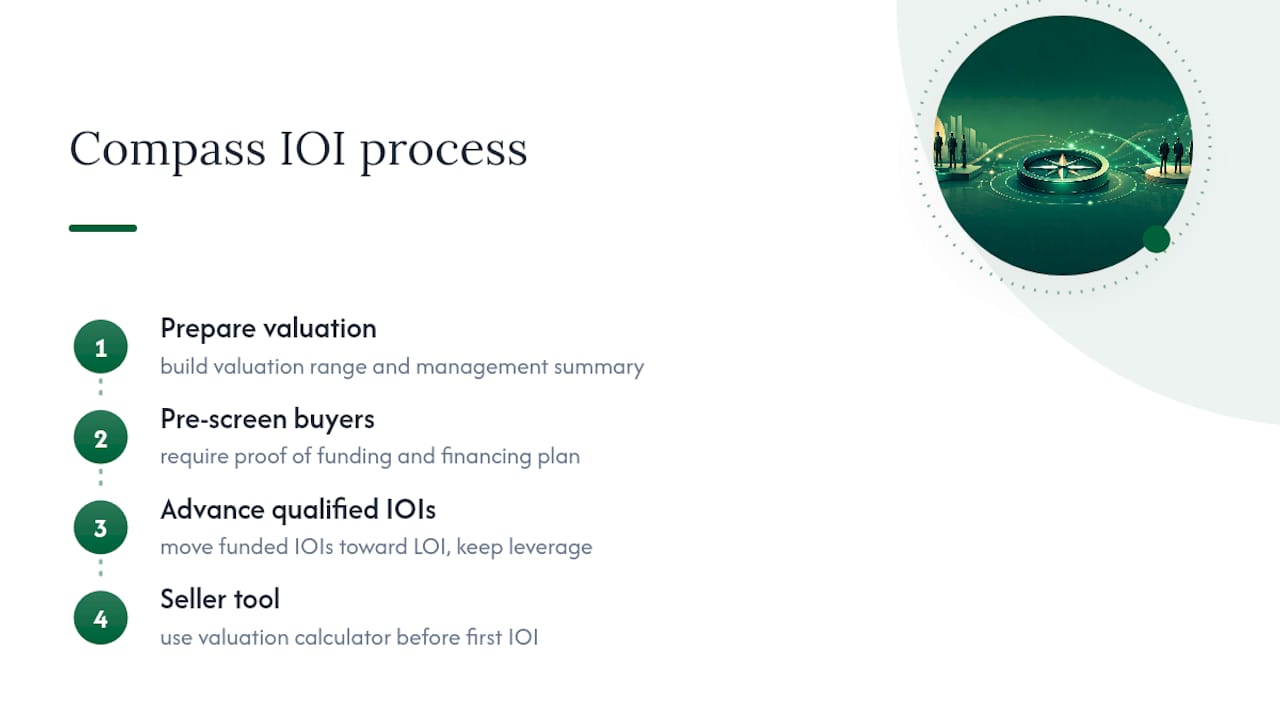
Compass Business Acquisitions builds valuation ranges and management summaries specifically to support a strong IOI round, giving sellers a realistic number before offers start arriving. Before granting diligence access, Compass requires buyers to show proof of funding and a high-level financing plan, filtering out unqualified interest early. When an IOI shows real financing and a workable structure, Compass moves that buyer toward an LOI while preserving the seller’s negotiating leverage. Sellers can start with Compass’s business valuation calculator to see where their range likely lands before the first IOI ever arrives.
A practical read on how sellers get this wrong
The biggest mistake I see sellers make with IOIs isn’t legal. It’s psychological. They read a strong valuation number in an early IOI and start planning around it, before diligence has even started. That number is a starting point, not a commitment, and treating it otherwise sets you up for disappointment when the LOI lands lower. My advice: get counsel involved before you respond to any IOI, not after a dispute starts. And measure buyer credibility early. Proof of funds and a real financing plan tell you more than any valuation number does. An IOI’s job is to screen interest, not to close a deal, and sellers who remember that negotiate from a stronger position throughout.
— Sierra
Get your valuation range right before the first IOI arrives
Compass Business Acquisitions gives sellers something most IOI conversations lack: a defensible number before buyers start proposing their own. Where a seller working alone has to guess whether an incoming valuation range is fair, Compass builds that range first, using professional valuation methods and targeted marketing designed to draw multiple credible buyers instead of one opportunistic offer.

That matters because leverage at the IOI stage comes from having options, not from reacting to whatever number lands in your inbox. Compass handles buyer screening, negotiation support, and marketing so sellers walk into IOI conversations already knowing their number and already vetting who’s serious. If you’re preparing to sell, start with a professional valuation and seller consultation to see where your business stands before the first offer comes in.
Primary sources and further reading
- Investopedia: IOI definition — foundational definition and context.
- LegalClarity: IOI vs LOI — legal distinctions and binding-clause nuance.
- FINRA Rule 5210 — regulatory treatment of IOIs.
- Quantopia: how IOIs work — securities-offering mechanics.
- Glacier Lake Partners: IOI vs LOI — practitioner view on content and risk.
Sources
- Understanding Indication of Interest (IOI): How They Work and Examples — Quantopia
- FINRA Rule 5210 — FINRA
- IOI vs. LOI — Glacier Lake Partners