
How to Negotiate Investor-Friendly Purchase Terms
How to Negotiate Investor-Friendly Purchase Terms
Investor-friendly purchase terms are defined as contract provisions that attract capital while protecting the seller’s ownership, payout, and post-closing rights. To negotiate investor-friendly purchase terms effectively, you must understand which clauses carry the most financial weight, where market benchmarks sit, and how to present your position without stalling the deal. The standard industry phrase for this process is “term sheet negotiation,” and it covers everything from liquidation preferences to board composition. Founders and business owners who master these provisions close better deals and keep more of what they built.
What are the critical purchase terms investors expect you to negotiate?
The terms that matter most in any investment deal are not always the ones with the biggest headlines. Liquidation preference impacts your ultimate payout more than pre-money valuation because it determines who gets paid first and how much when a company is sold or wound down. A 1x non-participating liquidation preference means investors get their money back before founders share proceeds, but they do not double-dip. A participating preferred structure lets investors take their preference and then share in remaining proceeds, which can dramatically reduce founder returns.

The market benchmark as of Q2 2026 is a 1x non-participating liquidation preference paired with broad-based weighted average anti-dilution. Any term that exceeds this standard, such as full ratchet anti-dilution, is considered aggressive and can significantly harm your ownership stake. Anti-dilution provisions protect investors when new shares are issued at a lower price, but full ratchet versions are punishing to founders compared to weighted average formulas.
Here are the other critical terms you must address in any investor agreement:
- Indemnification caps and baskets. Indemnification terms set the maximum post-closing liability for the seller. Caps limit total exposure; baskets set a minimum threshold before claims can be made. Negotiate both to avoid open-ended liability after the deal closes.
- Working capital adjustments. The working capital adjustment clause can swing the effective purchase price by 5–15%. Agreeing to an unrealistic working capital target means you could owe money back to the buyer at closing.
- Option pool size and timing. Negotiating option pools post-close preserves your equity better than pre-close expansion. Pre-close expansion dilutes founders before the investment even lands.
- Board composition. Founder-friendly deals avoid giving investors majority board seats at Seed or Series A. Losing board control early limits your ability to make key decisions.
Pro Tip: Run payout waterfall models for at least three exit scenarios before you sign anything. A term that looks minor at a $5 million exit can cost you hundreds of thousands at a $20 million exit.
How to prepare before entering negotiations with investors
Preparation is the single biggest factor separating founders who get favorable terms from those who accept whatever is offered. Before you sit down with any investor, you need to know your walk-away point on every major term. Without that clarity, you will make concessions under pressure that you will regret at closing.
- Define your non-negotiables. List the three or four terms where you will not move. These typically include liquidation preference structure, board seat allocation, and indemnification caps. Everything else is negotiable.
- Research market benchmarks. Use current market analysis resources to understand what investors in your sector and stage are actually accepting. Knowing the standard gives you a factual basis for pushback.
- Model your exit scenarios. Build financial models showing how different term combinations affect your payout at various exit valuations. This is where you will see the real cost of a participating preferred versus a non-participating structure.
- Assemble your team. You need an attorney experienced in M&A or venture transactions, not a generalist. Working with brokers who specialize in business acquisitions adds another layer of market knowledge and negotiation experience.
- Review all documents before the first meeting. Read the term sheet, the letter of intent, and any draft purchase agreement in full. Identify every clause that deviates from market standard before you respond.
Pro Tip: Prepare a one-page summary of your key term positions before the first negotiation session. Sharing it early signals confidence and sets the agenda on your terms.
Good preparation also means understanding your business’s verifiable financials inside and out. Investors will probe every number. If you know your working capital cycle, your EBITDA adjustments, and your customer concentration risks before they ask, you negotiate from a position of credibility.
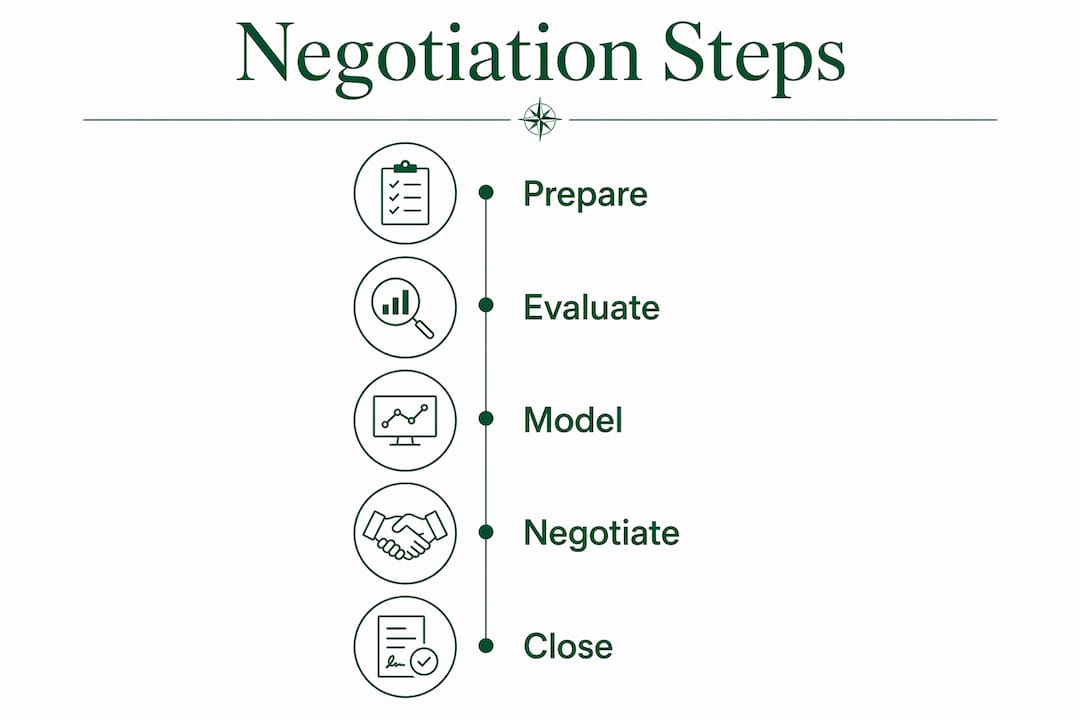
Step-by-step process to negotiate investor-friendly purchase terms
The most effective negotiation approach is focused, not exhaustive. Founders who focus on 4–5 high-leverage terms as a package are perceived as reasonable and collaborative, which leads to better outcomes than redlining every clause.
- Lead with your short list. Present three or four specific term changes you need, not a fully marked-up document. This signals that you understand market norms and are not trying to rewrite the deal from scratch.
- Negotiate terms as a package. Offer concessions on lower-priority items in exchange for wins on your critical terms. For example, accept standard indemnification baskets in exchange for a 1x non-participating liquidation preference.
- Manage the exclusivity period. Exclusivity periods should stay under 30 days during the letter of intent or term sheet phase. Diligence and legal negotiations typically run 4–8 weeks. A longer exclusivity window removes your leverage and risks deal fatigue.
- Watch for legal drift. Once you move from term sheet to definitive agreement, preventing legal drift is critical. Legal drift happens when attorneys introduce new language that quietly shifts rights or payouts away from what was agreed. Review every change line by line.
- Balance firmness with relationship. Investors are long-term partners, not adversaries. Push hard on the terms that matter, but stay professional and solution-oriented throughout.
The negotiation posture that works best is direct and data-driven. When you push back on a term, cite the market benchmark. “The current standard is a 1x non-participating preference” is a stronger position than “I don’t like this clause.”
Here are the behaviors that keep negotiations moving:
- Respond to redlines within 48 hours to maintain momentum.
- Confirm verbal agreements in writing before the next session.
- Avoid introducing new issues late in the process.
- Keep your attorney and broker aligned on your priorities before every session.
Common negotiation pitfalls and how to avoid them
The most damaging mistakes in investor negotiations are not dramatic blunders. They are quiet errors that compound over time and cost you money or control at closing.
- Over-negotiating every clause. Trying to renegotiate every clause slows the process and leads to worse outcomes. Investors lose patience, and you lose goodwill on the terms that actually matter.
- Ignoring market standards. Pushing for terms that deviate far from market benchmarks signals inexperience. Investors who see aggressive asks on standard terms often question whether you understand the deal at all.
- Signing long exclusivity periods. Accepting an exclusivity window beyond 30 days removes your ability to run a competitive process. Without alternatives, your negotiating position weakens every day.
- Accepting aggressive anti-dilution provisions. Full ratchet anti-dilution can wipe out significant founder equity in a down round. Always push for broad-based weighted average anti-dilution as the baseline.
- Failing to catch legal drift. Definitive agreements are the law of the land. A term that was agreed in the term sheet can be quietly altered in the final document. Your attorney must compare both documents clause by clause.
Changing term sheet terms in the final documents stage is perceived as bad faith and can cause deal collapse. Agreeing to terms early and thoroughly reviewing documents beforehand makes or breaks deals. The time to negotiate is before you sign the term sheet, not after.
Deal fatigue is also a real risk. Long negotiations wear down both sides, and exhausted founders make concessions they would never accept at the start. Set a clear timeline at the beginning and hold to it.
Key Takeaways
Successful investor-friendly contract negotiation requires focusing on a short list of high-leverage terms, understanding market benchmarks, and reviewing every document before signing.
| Point | Details |
|---|---|
| Prioritize 4–5 critical terms | Focus negotiation energy on liquidation preference, anti-dilution, board seats, indemnification, and working capital. |
| Know the market benchmark | The 2026 standard is a 1x non-participating liquidation preference with broad-based weighted average anti-dilution. |
| Model your exit scenarios | Run payout waterfalls at multiple exit valuations to see the real financial impact of each term. |
| Limit exclusivity periods | Keep no-shop clauses under 30 days to preserve competitive leverage during diligence. |
| Prevent legal drift | Review every clause in the definitive agreement against the signed term sheet before closing. |
Why I think most founders negotiate the wrong things
After working through dozens of acquisition and investment deals, the pattern I see most often is founders spending hours arguing over representations and warranties language while accepting a participating preferred structure without a second thought. The participating preferred is the term that will cost them the most money. The reps and warranties clause almost never triggers.
The uncomfortable truth is that legal boilerplate contains hidden traps, and most founders do not have the experience to spot them. They focus on what they understand, which is usually valuation, and ignore the structural terms that determine how that valuation actually translates into cash in their pocket.
My strongest advice is to hire an attorney who has closed at least 20 transactions in your deal type before you enter any negotiation. A generalist will miss things. The cost of specialized counsel is always less than the cost of a bad term that survives to closing.
The other lesson I have learned is that patience is a negotiation tool. Investors expect some back-and-forth. If you respond to every redline within hours and accept terms quickly, you signal that you are not reading carefully. Take the time you need. A 48-hour response window is professional, not slow.
Finally, do not underestimate the value of a business broker who knows your market. They have seen the same investor playbook many times and can tell you immediately when a term is out of market. That context is worth more than any negotiation tactic.
— Sierra
How Compassbusinessacquisitions helps you secure better purchase terms
Compassbusinessacquisitions works with business owners at every stage of the sale and acquisition process, from initial valuation through final closing. Their team brings market knowledge and transaction experience that helps sellers identify which terms to push on and which to accept without losing deal momentum.

Whether you are selling a business or evaluating an acquisition offer, Compassbusinessacquisitions provides professional valuations, targeted marketing, and direct support during term negotiations. Their network of buyers and advisors means you enter every negotiation with real market data behind you. If you are ready to maximize your sale value and negotiate from a position of strength, Compassbusinessacquisitions offers the guidance and connections to make that happen. Reach out to their team to discuss your specific deal structure and get tailored advice before you sign anything.
FAQ
What is a liquidation preference in a purchase agreement?
A liquidation preference is a clause that determines how proceeds are distributed when a company is sold. A 1x non-participating preference means investors recover their investment first, then founders share the remainder.
How do I set purchase conditions that protect my ownership?
Negotiate a 1x non-participating liquidation preference, broad-based weighted average anti-dilution, and post-close option pool expansion. These three terms protect founder equity more than any other provisions in a standard term sheet.
How long should an exclusivity period be in an investor agreement?
Exclusivity periods should stay under 30 days. Longer periods remove competitive leverage and increase the risk of deal fatigue before closing.
What is legal drift and why does it matter?
Legal drift occurs when attorneys introduce new language in the definitive agreement that quietly changes rights or payouts agreed in the term sheet. Catching it requires a line-by-line comparison of both documents before signing.
When should I bring in a business broker for investor negotiations?
Bring in a broker before you receive your first term sheet. Brokers with acquisition experience know current market benchmarks and can guide deal structure decisions before you are locked into a negotiating position.