
The Role of Competitive Offers in Negotiations
The Role of Competitive Offers in Negotiations
Competitive offers are defined as verifiable bids or proposals from third parties that a negotiator uses to shift leverage, anchor expectations, and improve final terms. The role of competitive offers in negotiations is to provide measurable leverage. A real, verifiable competing offer can shift base compensation by 15–30% in a single conversation. That magnitude applies equally to salary talks, business acquisitions, and competitive bidding scenarios. Understanding the anchoring effect and the Zone of Possible Agreement (ZOPA) turns a competing offer from a passive fact into an active negotiation tool.
How do competitive offers influence negotiation leverage and outcomes?
Competitive offers work primarily through anchoring bias. The first number introduced in a negotiation disproportionately pulls the final outcome toward it. When you present a credible competing offer early, you set the anchor, and every subsequent discussion orbits that number.
First movers achieve better terms roughly 60% of the time. Ambitious first offers lead to superior economic outcomes in approximately 75% of cases. Those figures confirm that timing and aggressiveness are not incidental. They are the mechanism.
Presenting an offer as a bolstering range amplifies this effect. A range like $7,000–$7,500 sets a high anchor while signaling flexibility. A bolstering range increases concessions while preserving relationship goodwill because it creates social pressure to counter within the range rather than below it. That is a measurable behavioral shift, not a soft tactic.
Credibility is the non-negotiable foundation of this approach. A competing offer only generates leverage if the counterpart believes it is real. Bluffing destroys that foundation instantly.
Key factors that determine how much leverage a competitive offer generates:
- Verifiability. The offer must be real and documentable. Vague references to “other interest” carry little weight.
- Timing. Introducing the offer before the counterpart anchors their own number is more effective than using it as a late-stage counter.
- Relevance. A competing offer from a directly comparable source carries more weight than one from a tangential market.
- ZOPA alignment. Knowing your Zone of Possible Agreement tells you how aggressively to anchor without collapsing the deal.
Pro Tip: Before entering any negotiation, map your ZOPA by estimating the counterpart’s reservation price. If your competing offer falls well within their ZOPA, anchor at the top of your range with confidence.
What are advanced negotiation tactics involving competitive offers, such as MESOs?
Multiple Equivalent Simultaneous Offers, known as MESOs, represent one of the most research-supported advances in negotiation practice. A MESO involves presenting two or three offers at the same time, each structured differently but valued equally from your perspective. MESOs increase the likelihood of a mutually beneficial agreement by signaling flexibility and revealing the counterpart’s true preferences.

The counterpart’s reaction to each option tells you what they value most. If they gravitate toward the option with a lower price but extended payment terms, you learn their cash flow is the constraint, not the total price. That information is worth more than any single concession.
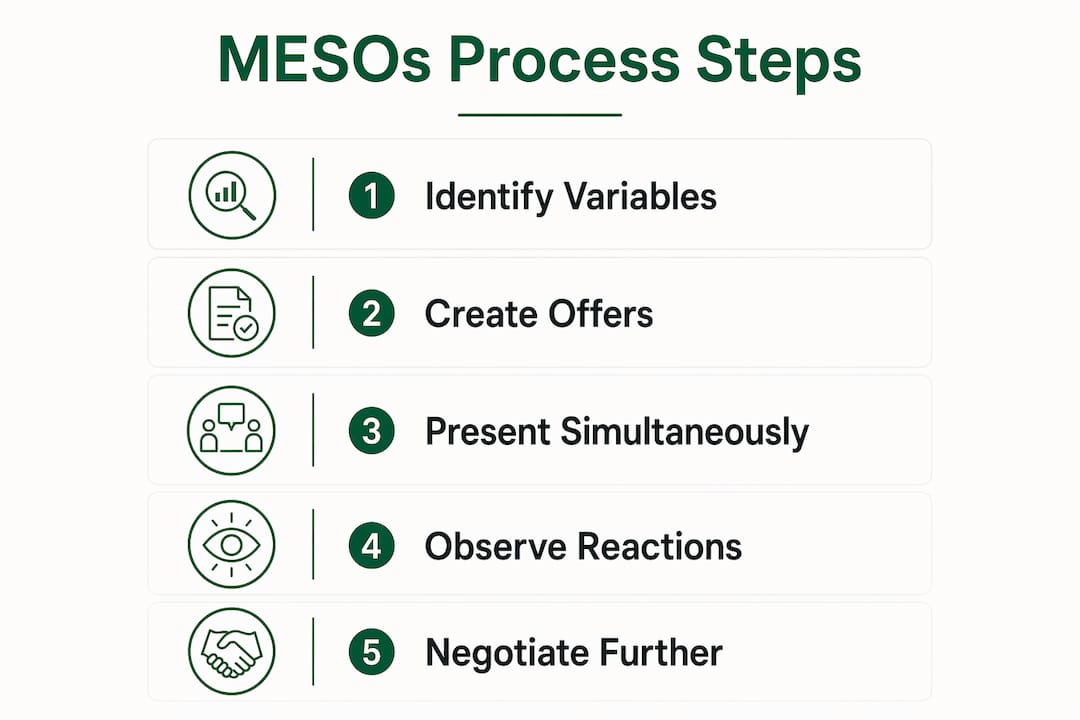
Constructing effective MESOs requires four steps. First, identify the variables in play: price, timeline, terms, contingencies, and support. Second, assign your own value to each variable. Third, build two or three packages that are equivalent in total value to you but differ in their mix. Fourth, present all packages simultaneously and invite a response to any of them.
The contrast between a single offer and a MESO approach is significant:
| Approach | Counterpart’s information | Your flexibility signal | Outcome quality |
|---|---|---|---|
| Single offer | Minimal | Low | Depends on counterpart’s goodwill |
| MESO (2–3 packages) | High (reveals preferences) | High | More efficient value creation |
Pro Tip: When using MESOs in a business acquisition, include one package with a faster close date and another with seller financing. The counterpart’s preference reveals whether they prioritize liquidity or speed, giving you a clear path to a deal.
Reaching mutually beneficial agreements through MESOs also reduces the adversarial tone that single-offer negotiations often produce. That matters in business acquisitions where the seller may stay on as a consultant or transition partner.
What are common pitfalls and ethical considerations when leveraging competitive offers?
The single greatest risk in using competitive offers is bluffing. Bluffing about competing offers is dangerous. If the bluff is called, the negotiator must either resign from the deal or accept serious reputation damage. Neither outcome is acceptable in professional business contexts where relationships extend beyond a single transaction.
Ethical use of competitive offers follows a clear principle: disclose enough to create leverage without disclosing details that harm either party. Experienced negotiators share compensation tiers and totals rather than naming the competing firm. This approach preserves discretion and reduces negative optics on both sides.
Common pitfalls to avoid:
- Overstating offer value. Inflating a competing offer’s terms invites verification requests that expose the exaggeration.
- Naming the competitor directly. This shifts the conversation from your value to a comparison exercise that rarely benefits you.
- Using offers as ultimatums. Framing a competing offer as “take it or leave it” closes off creative solutions and damages the relationship.
- Ignoring competition’s effect on anchoring. Competition modulates buyers’ reactions to price requests. In highly competitive environments, anchoring effects weaken, requiring adjusted communication strategies.
Pro Tip: When disclosing a competing offer, state the tier and total value without naming the source. Say “I have an offer at this compensation level” rather than “Company X offered me this.” The first statement creates leverage. The second creates a comparison contest.
Maintaining trust throughout the process protects the long-term relationship. In business acquisitions, a buyer or seller who feels manipulated will find reasons to renegotiate or exit post-close. Professionalism during negotiation is not a courtesy. It is a deal protection measure.
How to apply competitive offer strategies across different negotiation contexts?
Competitive offer strategies adapt across industries, but the core mechanics remain consistent: anchor high, signal flexibility, and use real data. The application differs by context.
In salary negotiations, the competing offer is the most direct form of leverage available. The 15–30% compensation shift cited earlier applies when the offer is real, the timing is right, and the negotiator is genuinely prepared to accept the alternative. Presenting the offer as a range rather than a fixed number gives the employer room to respond without feeling cornered.
In business acquisitions, the dynamics shift. Competitive bidding strategies in acquisitions involve multiple buyers, each aware that others are in the process. A seller who manages this process well creates competitive tension that drives price upward. A buyer who understands the same dynamic can use their own competing acquisition targets to negotiate better terms on any single deal.
Applying competitive offer tactics by context:
- Salary negotiations. Lead with the competing offer’s total compensation package, not just base salary. Anchor at the top of the range and invite a counter.
- Business acquisitions. Use competitive intelligence in bids to customize proposals around the buyer’s or seller’s known priorities, not just price.
- Vendor and supplier contracts. Present competing supplier quotes as ranges to preserve negotiating room while demonstrating market awareness.
- Real estate and lease negotiations. Reference competing properties with comparable terms to anchor the landlord or seller’s expectations.
Timing decisions require ZOPA analysis in every context. If you know the counterpart’s reservation price, you can anchor aggressively and still close. If you lack that knowledge, a bolstering range is the safer entry point. Negotiators with superior ZOPA knowledge should make aggressive first offers confidently. Those without it should use ranges to gather information before committing to a fixed position.
Price-to-win models in competitive bidding take this further. These models generate target price ranges that integrate technical quality and market positioning. The goal is to avoid unprofitable wins, not just to undercut competitors on price.
Business exit strategies also benefit from competitive offer framing. A seller who enters the market with multiple qualified buyers in play commands better terms than one who approaches a single buyer directly. Creating that competitive environment before negotiations begin is itself a negotiation tactic.
Key Takeaways
Competitive offers generate the most leverage when they are real, timed early, and presented as ranges that anchor high while signaling flexibility.
| Point | Details |
|---|---|
| Anchor early and high | First movers achieve better terms in roughly 60% of negotiations by setting the reference point. |
| Use bolstering ranges | Presenting offers as ranges like $7,000–$7,500 maintains an aggressive anchor while inviting concessions. |
| Deploy MESOs for complex deals | Multiple simultaneous packages reveal counterpart preferences and create more efficient agreements. |
| Keep competing offers verifiable | Bluffing risks reputation damage and deal collapse if the counterpart demands proof. |
| Adapt tactics to context | Salary, acquisition, and bidding scenarios each require adjusted timing, disclosure, and anchoring approaches. |
What I’ve learned about competitive offers that most negotiators miss
The biggest mistake I see professionals make is treating a competing offer as a trump card to play at the last moment. That instinct is backward. The competing offer is most powerful before the counterpart anchors their own number. Once they’ve stated a position, they’re defending it. Before they state it, they’re still forming it. That’s the window.
Preparation separates negotiators who use competing offers well from those who use them recklessly. Knowing your ZOPA, understanding the counterpart’s constraints, and having a genuinely verifiable offer in hand changes the entire dynamic. You’re not bluffing. You’re reporting facts. That confidence reads differently across the table.
The MESOs approach changed how I think about negotiations entirely. Presenting multiple packages simultaneously feels counterintuitive at first. You expect the counterpart to feel overwhelmed. Instead, they feel respected. They have choices. The conversation shifts from “yes or no” to “which one works best for us.” That shift alone produces better outcomes.
One more thing worth stating plainly: the negotiators who build the best long-term records are not the most aggressive. They are the most prepared. Aggressive tactics without preparation produce short-term wins and long-term reputation costs. Preparation with credible data produces consistent results across every deal type.
— Sierra
Compassbusinessacquisitions: expert support for your next deal
Maximizing negotiation outcomes in a business sale or acquisition requires more than tactics. It requires market knowledge, verified financials, and a process that creates genuine competitive tension among buyers.
Compassbusinessacquisitions provides professional valuations, targeted buyer outreach, and deal management that puts sellers in the strongest negotiating position from day one. For buyers, the same market intelligence informs competitive bidding strategies that protect value without overpaying. Whether you are ready to sell your business or actively evaluating acquisition targets, Compassbusinessacquisitions connects you with the right counterparts and the right data to negotiate with confidence. Explore buyer and seller services to see how professional guidance translates directly into better deal terms.
FAQ
What is the role of competitive offers in negotiations?
Competitive offers provide leverage by anchoring the counterpart’s expectations and signaling that alternatives exist. A real, verifiable competing offer can shift compensation or deal terms by 15–30% when introduced at the right moment.
What are MESOs and why do they work?
MESOs are Multiple Equivalent Simultaneous Offers, meaning two or three packages presented at once that are equally valuable to the presenter. They work because the counterpart’s preference among the packages reveals their priorities, making it easier to reach a mutually beneficial agreement.
How do you disclose a competing offer without damaging the relationship?
Share the tier and total value of the competing offer without naming the source. This creates leverage while keeping the conversation professional and focused on your value rather than a direct comparison.
When should you make the first offer in a negotiation?
Make the first offer when you have strong ZOPA knowledge and a credible anchor. First movers achieve better terms roughly 60% of the time, and ambitious first offers lead to superior outcomes in approximately 75% of cases.
How does competitive bidding differ from bilateral negotiation?
In competitive bidding, multiple parties compete simultaneously, which weakens the anchoring effect of any single price request. Negotiators in competitive environments need to adjust their communication strategies and rely more on customized proposals and competitive intelligence than on anchoring alone.