
Lock These 5 LOI Terms Before You Sign a Commercial Lease, U.S. Tenants
Lock These 5 LOI Terms Before You Sign a Commercial Lease, U.S. Tenants
A commercial lease LOI is a short, usually non-binding document that puts the deal’s core economic and timing terms on paper before attorneys draft the actual lease. Its real job is tactical: lock in base rent, rent type, tenant improvement dollars, lease term, and the trigger date for rent commencement. Write those five numbers down before your next call with the landlord, and label clearly which parts of the document, if any, are meant to bind you.
TL;DR:
- Most LOIs should include clear, specific numbers for rent, lease term, tenant improvements, and critical dates to prevent re-trading during lease drafting.
- An explicit non-binding clause is essential, and carve-outs for confidentiality, exclusivity, or expense reimbursement must be separately labeled and clearly intended to be binding if necessary.
- Key negotiation priorities include controlling expenses like CAM caps and escalation formulas, with timing and operational terms taking secondary focus.
- Incomplete or vague LOIs risk unintended enforceability or the inability to protect negotiated terms, making precise wording and legal review critical.
- A well-structured LOI directly influences the final lease draft, reducing delays and legal costs by aligning both parties’ expectations upfront.
Table of Contents
- What to Include in a Commercial Lease LOI
- Non-Binding vs. Binding Clauses: How to Draft Each One
- How to Draft and Negotiate an LOI Step by Step
- Negotiation Priorities: What to Push First
- Legal Risks From Sloppy LOI Wording
- How the LOI Shapes the Final Lease Agreement
- Sample LOI Structure and What Each Clause Does
- Negotiating LOI Terms: Tenant and Landlord Perspectives
- When to Bring in a Broker for Your LOI
- Get Hands-On Help Structuring Your Next Lease Negotiation
- Sources
- FAQ
What to Include in a Commercial Lease LOI
A letter of intent commercial lease document earns its keep only when it captures the terms that actually move money and deadlines. Vague LOIs create more re-trading during lease drafting than no LOI at all, according to guidance from Troutman Pepper, which points to property description, rent, term, and TI allowances as the backbone of any usable draft.
Here’s what belongs on the page, organized the way an attorney will actually read it:
- Premises details: full property address, suite number, rentable square footage versus usable square footage, and whether either side has remeasurement rights before signing the lease.
- Rent economics: base rent stated as both dollars per rentable square foot and a monthly total, the rent structure (Gross, Modified Gross, or NNN), the annual escalation percentage, and the security deposit amount and form (cash, letter of credit, or personal guaranty).
- Tenant improvement terms: the allowance amount, whether it’s a lump sum or a per-square-foot figure, who controls the buildout scope, when reimbursement happens, and what condition the space arrives in.
- Term and options: lease length in months or years, number and length of renewal options, the notice deadline to exercise each option, and how rent gets set for those option periods.
- Critical dates: delivery date, lease commencement date, and rent commencement date, with the trigger for rent commencement spelled out separately from delivery.
- Operational terms: permitted use, signage rights, parking allocation, building hours, and for retail tenants, any exclusivity or co-tenancy protections.
- Expense structure: how CAM charges get calculated, whether there’s a base year, whether controllable expenses carry an annual cap, and whether you retain audit rights over landlord billing.
Ask for estimates on every expense category before you sign anything. A landlord who can’t produce a rough CAM number for the prior year is asking you to negotiate blind.
Non-Binding vs. Binding Clauses: How to Draft Each One
Most commercial LOIs are non-binding by design, but courts don’t take that on faith. If your language reads like a final agreement, a court may treat it like one. Nolo’s legal guide confirms that LOIs lacking a clear non-binding disclaimer risk enforcement, which means the single most important sentence in your document is the one that says the opposite of what you might assume it says.
The fix is a dedicated non-binding clause, stated plainly near the top of the document, that says the LOI does not create a lease, and neither party is obligated until a definitive lease agreement is signed.
That said, a handful of provisions should go the other way and bind you immediately:
- Confidentiality: protects financial details shared during negotiation.
- Exclusivity or no-shop clauses: stop the landlord from shopping your space to another tenant during your negotiation window.
- Expense reimbursement: covers costs like third-party inspections if a deal falls apart.
Troutman Pepper’s guidance is specific on this point: these carve-outs need explicit labeling as binding, separate from the rest of the document, or they may not hold up. Avoid phrases like “binding agreement” or “shall be final” anywhere outside those carve-outs, and skip open-ended “good faith negotiation” covenants that create obligations without defining what good faith actually requires.
Statistic to remember: Legal commentary on enforceability shows that LOIs with complete, definitive terms and no non-binding language have been enforced by courts even when the parties intended otherwise. Ambiguity is the enemy here, not thoroughness. Have counsel licensed in your state review the draft if you’re unsure whether your carve-outs are labeled clearly enough to survive a dispute.
How to Draft and Negotiate an LOI Step by Step
The real estate LOI process moves fastest when you sequence it the same way every time. Skipping steps is what causes landlords and tenants to re-trade terms three weeks into lease drafting.
- Collect your financial inputs first. Know your target rent range, your TI needs, what security deposit you can post, and a rough CAM estimate before you write a word. Set a target date for lease commencement based on your business timeline, not the landlord’s.
- Choose your deal-breakers. Decide upfront which two or three terms actually matter. Common ones: expense caps, the rent commencement trigger, and TI scope. Limit the LOI to those items plus core economics. Everything else can wait for the lease.
- Draft the LOI with a clean structure. Use a short economics table, a clear non-binding clause, and explicitly labeled binding carve-outs. If you’re not confident in the wording, get counsel to review before you send it.
- Negotiate exclusivity only when you need it. Hold periods of 30 to 90 days are typical if you need time for due diligence or financing. Define the exact length and what happens if either side misses it.
- Move into lease drafting. Once the LOI is signed, due diligence, permitting, and lease drafting run in parallel. Tie rent commencement to delivery milestones wherever a buildout is involved.
Pro Tip: Draft your economics section as an actual table, not a paragraph. Landlords comparing your offer against a competing tenant will read the table first, and a clean table gets a faster response than three paragraphs of prose.
Negotiation Priorities: What to Push First
A commercial property lease checklist is only useful if it’s ranked. Not every term deserves the same fight, and small business owners who spend their negotiation capital on signage rights while ignoring expense passthroughs usually regret it within two years.
Push hardest on cost drivers first: how expenses pass through to you, the escalation method, whether CAM charges carry a cap, and how CAM gets calculated in the first place. These affect your monthly cost every year of the lease, not just at signing.
Protect your timing second. Lease commencement and rent commencement are not the same date, and landlords sometimes blur that distinction on purpose. Get delivery obligations and permit responsibilities in writing, tied to specific dates.
Operational terms come third: permitted use language broad enough to cover how your business might grow, exclusivity if you’re a retail tenant worried about a competitor moving in next door, and signage and parking allocation spelled out by count, not by vague reference to “available spaces.”
Watch for these red flags before you sign:
- An escalation formula that isn’t defined in numbers.
- A TI promise without a dollar amount or per-square-foot figure attached.
- “Market rent” language for renewal options with no appraisal method specified.
- A reference to the landlord’s “standard lease form” with no tenant review period offered.
- Indemnity or insurance language left open-ended, which belongs in the lease, not the LOI.
Legal Risks From Sloppy LOI Wording
Improperly worded LOIs create two kinds of exposure, and both cost real money. The first is accidental enforceability: a document you intended as a negotiation placeholder gets treated as a binding contract because the language was too complete or too definitive. Courts look at substance, not intent, and an LOI that states final rent, final term, and final TI numbers without a non-binding disclaimer starts to look a lot like a lease.
The second risk is the opposite problem: an LOI so vague that it fails to protect you during lease drafting, leaving the landlord free to reintroduce terms you thought were settled. This is why practitioners recommend keeping the LOI focused on deal drivers rather than padding it with full lease boilerplate, since detailed indemnity and insurance language belongs in the final lease, not a preliminary document.
“Market rent” clauses for renewal options deserve particular caution. If you leave the rent-setting method undefined, you’re setting up a future dispute over whose appraiser is right. Define the method (independent appraisal, broker panel, or a specific formula) and the timeline for resolving disagreements before you sign the LOI, not after.
The safest posture is a document that says exactly what it is: a preliminary outline, clearly labeled, with only confidentiality and exclusivity terms carrying binding weight. Anything more ambitious than that increases your legal exposure without adding real protection.
How the LOI Shapes the Final Lease Agreement
The LOI doesn’t disappear once you sign it. It becomes the blueprint your attorney and the landlord’s attorney both work from when drafting the actual commercial lease agreement, and every number and deadline you locked in during LOI negotiation shows up again in that document, usually with more detail attached.
This is where a tight, specific LOI pays off. When the economics table in your LOI states $28 per square foot, Modified Gross, with a 3% annual escalation, your attorney drafts around those exact figures instead of guessing at what you and the landlord actually agreed to verbally. A vague LOI forces both attorneys to renegotiate terms that felt settled, which adds weeks to the process and legal fees on both sides.
The relationship runs both directions, though. If your LOI omitted a term entirely, like parking allocation or after-hours HVAC access, the lease draft becomes the first place that gap gets noticed, often by the landlord’s attorney, who has every incentive to fill it in the landlord’s favor. That’s the real cost of an incomplete LOI: it doesn’t just create friction, it hands the other side a drafting advantage on anything you left out.
Sample LOI Structure and What Each Clause Does
A working LOI commercial real estate template typically runs two to four pages, organized in a predictable order. Here’s what each section does and why it’s positioned where it is.
The opening identifies the parties, the property, and states the purpose of the document in one sentence, ideally including the phrase “non-binding letter of intent” right in the title. The economics section follows immediately, usually as a table listing base rent, rent type, escalation, security deposit, and TI allowance side by side, since organizing deal drivers into a single readable table reduces the back-and-forth that comes from scattered rent discussions.
After economics comes the term section: lease length, renewal options, and exercise deadlines. Then operational terms: permitted use, signage, parking, and exclusivity if relevant. Near the end sits the binding language section, which does two things at once: a clear statement that the document overall is non-binding, followed immediately by a separate paragraph naming exactly which clauses (confidentiality, exclusivity, expense reimbursement) are binding regardless of what happens to the rest of the deal. Template providers like ConsumerShield publish forms structured this way specifically because separating the two prevents the ambiguity that gets LOIs enforced by accident.
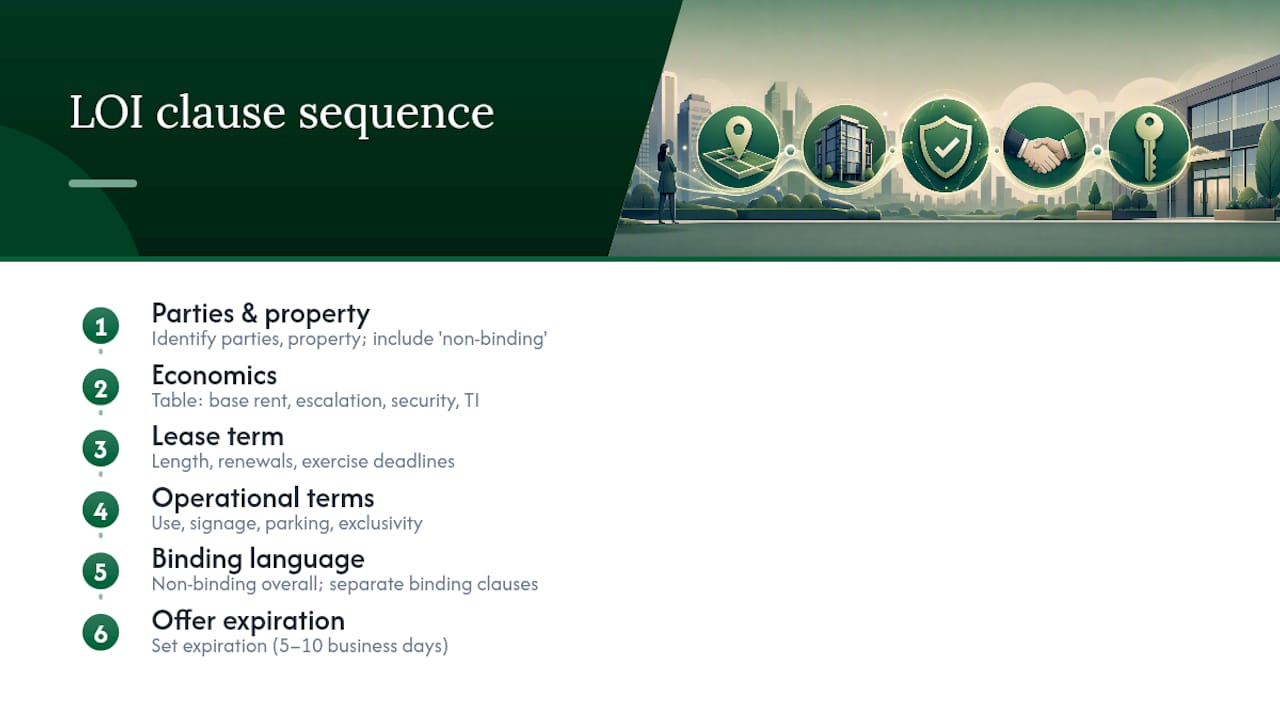
The closing section sets an expiration date for the offer itself, typically 5 to 10 business days, which keeps negotiations moving instead of drifting.
Negotiating LOI Terms: Tenant and Landlord Perspectives
Negotiating lease terms works differently depending on which side of the table you’re on, and understanding the landlord’s incentives helps you negotiate smarter even when you’re only representing yourself.
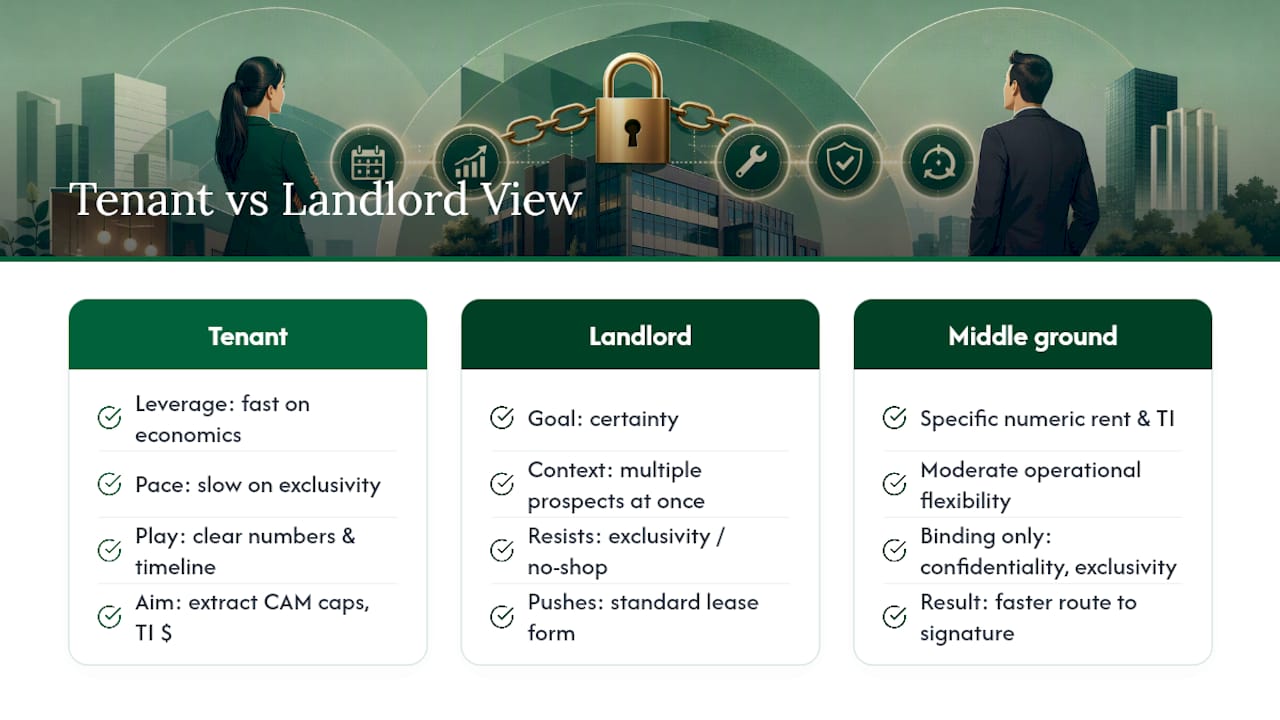
Tenants get the most leverage by moving fast on economics and slow on exclusivity. Landlords want certainty, so a tenant who comes in with clear numbers and a realistic timeline often gets better TI terms than one who negotiates every line item for weeks. Use that speed to extract concessions on the things that matter most to your cash flow, like CAM caps and TI dollars, rather than spending your goodwill on cosmetic terms.
Landlords, meanwhile, are typically negotiating multiple prospective tenants at once, which is exactly why exclusivity and no-shop clauses carry real value to a tenant and real cost to a landlord. A landlord who grants a 60-day exclusivity window is taking other tenants off the table, so expect resistance here proportional to how hot the market is for that space. Landlords also tend to push for “standard lease form” language precisely because it shifts drafting leverage to their side; tenants who push back and reserve a review period at the LOI stage protect themselves from that shift later.
The middle ground both sides usually land on: specific, numeric terms on rent and TI, moderate flexibility on operational details, and binding-only treatment reserved for confidentiality and exclusivity. That’s the structure that gets deals to signature fastest.
When to Bring in a Broker for Your LOI
Complex buildouts, multi-site leases, and large tenant improvement commitments are exactly where a broker’s leverage shows up. Some brokers work through commercial leasing engagements by aligning deal economics with valuation realities, helping structure TI and exclusivity terms so they protect the business’s long-term worth rather than just closing the immediate deal.
If exclusivity matters because a competitor could move into the same center, or if your TI ask runs into six figures, that’s the point where broker representation tends to shorten negotiations and reduce the odds of costly re-trading once the lease is drafted. Faster negotiation and a cleaner LOI usually beat the cost of the broker’s involvement many times over across a multi-year lease term.
— Sierra
Get Hands-On Help Structuring Your Next Lease Negotiation
A practical alternative to negotiating a commercial lease LOI alone is to seek leasing support that sits alongside valuation and acquisition services, so the team that helps structure TI allowances and exclusivity terms also understands how a lease’s economics affect what your business is actually worth if you sell it down the line.

If you’re facing a time-sensitive exclusivity window, negotiating a TI budget that runs into six figures, or you simply want a valuation-driven strategy behind your LOI instead of guesswork, that’s the moment to bring in support. Reach out through the Compass Business Acquisitions site to start a conversation about commercial leasing, or explore the expert valuation services if lease economics are part of a larger decision about buying or selling your business. If tenant improvements require outside capital, tenant improvement financing options are worth reviewing before you finalize your TI ask in the LOI.
Sources
- Letter of Intent to Rent| Negotiating a Commercial Lease - Nolo
- Letters of Intent in Commercial Real Estate Leases - Troutman Pepper
- Commercial Lease LOI: What to Include and Avoid - Dean CRE
- Commercial Lease Letter of Intent - Professional Legal Form - ConsumerShield
- Free Commercial Lease Letter of Intent | PDF & Word - LegalTemplates
FAQ
What Is a Commercial Lease LOI?
A commercial lease LOI is a preliminary, usually non-binding document that outlines the major proposed terms of a lease, including rent, term, and tenant improvements, before a full lease agreement gets drafted.
Is a Commercial Lease LOI Legally Binding?
Most are not, but courts can enforce an LOI that lacks a clear non-binding clause or that states complete, final terms, so an explicit non-binding disclaimer is standard practice.
What’s the Difference Between an LOI and a Lease Agreement?
An LOI outlines proposed terms in a few pages and is generally non-binding except for specific carve-outs, while the commercial lease agreement is the full, binding contract that governs the tenancy.
How Long Does the LOI-to-Lease Process Take?
It varies by deal complexity, but exclusivity or hold periods in the LOI typically run 30 to 90 days, during which due diligence and lease drafting happen in parallel.
Can Compassbusinessacquisitions Help Negotiate a Commercial Lease LOI?
Yes. Some business acquisition and brokerage firms support commercial leasing engagements by helping structure TI allowances, exclusivity terms, and deal economics, particularly for tenants facing complex buildouts or multi-site negotiations.