
What Is a Business Valuation? A Guide for Small Business Owners
What Is a Business Valuation? A Guide for Small Business Owners
A business valuation is the formal process of determining a company’s economic worth using standardized income, market, and asset approaches, typically conducted by credentialed professionals such as those holding ABV or CVA designations. Governed by AICPA SSVS No. 1, this process produces a defensible value conclusion used in mergers, acquisitions, tax filings, estate planning, and litigation. For small business owners, understanding what is a business valuation means knowing how buyers, courts, and the IRS will measure your company’s worth. Whether you plan to sell, attract investors, or resolve a dispute, a credible appraisal gives you the facts you need to act with confidence.
What is a business valuation and how does it work?
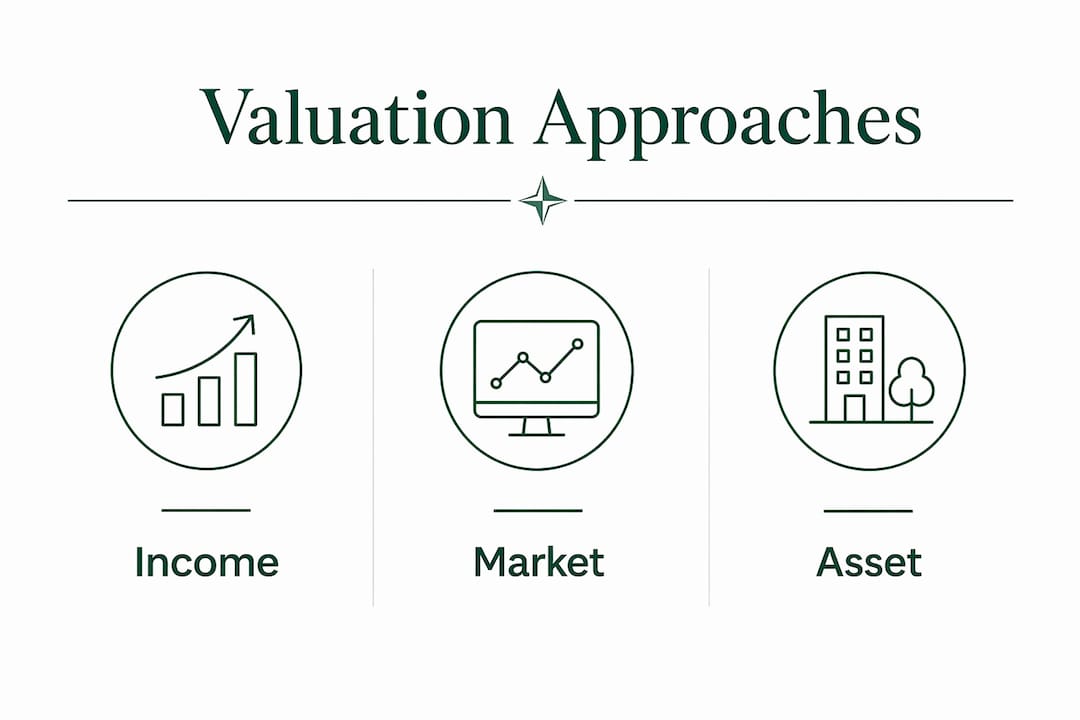
A business valuation is a structured assessment of a company’s economic worth at a specific point in time. Analysts apply one or more of three primary approaches: income, market, and asset. Each approach answers a different question about value, and the right choice depends on your business type, purpose, and available data.
Using at least two methods and reconciling the results is standard practice. This triangulation strengthens the credibility of the final conclusion and helps it withstand challenges from buyers, the IRS, or opposing counsel.
The income approach
The income approach values a business based on its ability to generate future earnings. Analysts project future cash flows or earnings and then discount them to present value using a rate that reflects risk. The Discounted Cash Flow (DCF) method and the Capitalization of Earnings method are the two most common tools within this approach. This method works best for businesses with stable, predictable revenue.

The market approach
The market approach uses comparable company sales as benchmarks. Analysts identify recent transactions involving similar businesses and apply those pricing multiples to your company’s financials. This approach reflects real market conditions and is widely used in small business sales. It requires access to reliable transaction databases, which credentialed analysts maintain.
The asset approach
The asset approach calculates value based on the fair market value of a company’s assets minus its liabilities. This method suits asset-heavy businesses, holding companies, or firms being wound down. It does not capture earning power, so analysts rarely use it alone for operating businesses.
| Approach | Core question | Best used for |
|---|---|---|
| Income | What will this business earn? | Service firms, stable cash flow businesses |
| Market | What do similar businesses sell for? | Small business sales, M&A transactions |
| Asset | What are the net assets worth? | Asset-heavy firms, liquidation scenarios |
Pro Tip: Ask your analyst which approach carries the most weight in your specific valuation. The answer tells you what buyers or courts will focus on first.
What is a business valuation engagement vs. a calculation engagement?
Not all valuations carry the same legal weight. The type of engagement you commission determines how defensible your results are and what you can use them for.
A valuation engagement provides a comprehensive, standards-compliant conclusion of value. The analyst applies full procedures, documents all reasoning, and produces a report that meets IRS and court requirements. This is the correct choice for tax filings, litigation, shareholder disputes, and formal sale negotiations.
A calculation engagement is a limited-scope process. It costs less and takes less time, but it does not carry the rigor of a full valuation. Calculation engagements are suitable for internal planning, early-stage sale preparation, or benchmarking. They are inadequate for tax filings or any situation where a third party will scrutinize the result.
Key differences between the two engagement types:
- Scope: Valuation engagements follow all AICPA SSVS No. 1 procedures. Calculation engagements apply only agreed-upon procedures.
- Output: Valuation engagements produce a detailed report with a defensible conclusion. Calculation engagements produce a summary with limited support.
- Cost: Valuation engagements cost more due to documentation and rigor requirements.
- Use cases: Valuation engagements are required for IRS matters, litigation, and formal transactions. Calculation engagements serve internal planning.
- Defensibility: A misunderstanding between client and analyst about engagement type can invalidate conclusions and create legal or financial risk.
Pro Tip: Before signing an engagement letter, confirm in writing whether you need a valuation engagement or a calculation engagement. The wrong choice can cost you far more than the fee difference.
How to prepare for a business valuation
Preparation directly affects the quality and accuracy of your valuation. Disorganized records slow the process and can reduce the final value conclusion.
Gather these documents before your analyst begins:
- Three to five years of financial statements (income statements, balance sheets, cash flow statements)
- Federal tax returns for the same period
- A current list of assets and liabilities, including equipment, inventory, and real estate
- Ownership agreements, shareholder documents, and any existing buy-sell agreements
- Customer concentration data and key contract details
- Details on any pending litigation, liens, or contingent liabilities
Beyond documents, you and your analyst must agree on two critical definitions before work begins. The standard of value defines what type of value is being measured: fair market value, investment value, or intrinsic value. The premise of value defines the assumed condition: going concern or liquidation. Misapplying either can swing a valuation by millions of dollars. This is not a detail to leave to chance.
A professional valuation report will include the value conclusion, the methodology applied, the data sources used, and the analyst’s full reasoning. Reading this report carefully gives you a clear picture of what drives your company’s worth and where gaps exist. Use those findings to make targeted improvements before going to market.
You can also use the business evaluation calculator from Compassbusinessacquisitions to get an early estimate before engaging a credentialed analyst.
When do you need a business valuation?
Business valuations are required or strongly recommended in a wide range of situations. Knowing when to get one protects you legally and financially.
Common situations that require a formal appraisal:
- Selling your business: Buyers and their advisors will scrutinize your asking price. A credentialed valuation gives you a defensible number and negotiating leverage.
- Mergers and acquisitions: Both sides need an independent assessment to agree on fair terms. Learn more about acquisition criteria that buyers evaluate.
- Tax and estate planning: The IRS requires valuations for gift tax, estate tax, and charitable contribution purposes. The ABV credential from the AICPA is recognized by the IRS and courts, which means the analyst’s certification matters.
- Shareholder disputes: When partners disagree on value, a neutral, credentialed appraisal resolves the conflict with facts.
- Divorce proceedings: Courts require a formal business appraisal to divide marital assets fairly.
- Strategic planning: Regular valuations track business health over time and reveal whether your growth efforts are actually building value.
The practical benefits extend beyond compliance. A current valuation tells you where you stand relative to market conditions, helps you time a sale correctly, and prepares you for conversations with investors or lenders. Reviewing your preparation for a strategic sale alongside a formal valuation gives you the clearest possible picture of your readiness.
Key Takeaways
A business valuation is the formal, standards-governed process of determining economic worth, and choosing the right approach, engagement type, and credentialed analyst determines whether that conclusion holds up when it matters most.
| Point | Details |
|---|---|
| Three core approaches | Income, market, and asset approaches each answer a different question about value. |
| Engagement type matters | Valuation engagements are required for IRS and court purposes; calculation engagements suit internal planning only. |
| Preparation drives accuracy | Organized financials and agreed-upon value standards directly improve the quality of the final conclusion. |
| Credentials carry legal weight | ABV and CVA credentialed analysts produce reports recognized by the IRS and courts. |
| Valuations serve multiple purposes | Sales, tax filings, disputes, and strategic planning all require a current, defensible appraisal. |
Why I think most business owners wait too long to get a valuation
Most small business owners treat a valuation as a transaction step, something you do right before you sell. That is the wrong frame entirely. A valuation is a diagnostic tool. It tells you what your business is actually worth versus what you think it is worth, and those two numbers are often very different.
I have seen owners walk into sale negotiations with a price in their head based on gut feel or a rough revenue multiple they read online. When a buyer’s analyst produces a formal appraisal using DCF or market comparables, the gap can be jarring. The owner feels blind sided. The deal stalls or falls apart. That outcome is preventable.
Getting a valuation two to three years before you plan to sell gives you time to act on the findings. If customer concentration is dragging your multiple down, you can fix it. If your financials are inconsistent, you can clean them up. The report becomes a roadmap, not just a number.
The other mistake I see constantly is choosing the wrong engagement type to save money. A calculation engagement costs less upfront, but if you use it in a context that requires a full valuation, you may face IRS penalties, a failed transaction, or a court challenge. The fee difference is not worth the risk. Always confirm the intended use of the valuation before you sign anything, and work with a credentialed professional who will tell you the truth about which engagement you actually need.
— Sierra
Compassbusinessacquisitions can help you know your business’s worth
Understanding your company’s value is the first step toward any successful transaction. Compassbusinessacquisitions works with small business owners to connect verifiable financials with qualified buyers who recognize real growth potential.

Start with the free valuation calculator to get an initial estimate of what your business may be worth. When you are ready to move forward, the expert team at Compassbusinessacquisitions provides professional guidance through every stage of the sale process. From pricing strategy to buyer matching, Compassbusinessacquisitions brings market knowledge and a proven track record to every engagement. Visit the seller services page to see how Compassbusinessacquisitions supports owners preparing for a successful exit.
FAQ
What is a business valuation in simple terms?
A business valuation is a formal process that determines how much a company is worth in dollar terms, using standardized income, market, or asset approaches conducted by a credentialed analyst.
What does a business valuation report include?
A business valuation report includes the value conclusion, the methodology applied, data sources used, and the analyst’s full reasoning, as required by AICPA SSVS No. 1 standards.
What is the difference between a valuation engagement and a calculation engagement?
A valuation engagement follows full professional standards and produces a defensible conclusion for IRS or court use. A calculation engagement is limited in scope and suited only for internal planning purposes.
How long does a business valuation take?
The timeline depends on the engagement type and the complexity of the business. A full valuation engagement typically takes several weeks, while a calculation engagement can be completed faster due to its limited scope.
How much does a business valuation cost?
Valuation fees vary based on engagement type, business complexity, and intended use. Full valuation engagements with detailed reports cost more than calculation engagements because they require greater documentation and rigor.