
Commercial Lease Negotiation: A Tenant's Playbook
Commercial Lease Negotiation: A Tenant’s Playbook
Yes, commercial leases are negotiable, and the letter of intent is the single most decisive document in the process. Once you and the landlord sign an LOI, the terms inside it become the framework the final lease will follow, so the real negotiation happens before you ever see a lease draft.
Your first move: don’t touch the landlord’s draft lease yet. Settle the LOI first, and bring a broker and attorney into the deal before you sign anything.
Prioritize these three levers first:
- Free rent and tenant improvement (TI) allowance — the largest immediate dollar impact
- Escalation caps and CAM limits — the cost that compounds every year you occupy the space
- Personal guaranty scope — the risk that follows you personally, not just your business
Tenants who negotiate rent structure, CAM, TI, and exit clauses as a package typically secure terms 10 to 20 percent better than the landlord’s initial offer.
Key Takeaways
Commercial lease negotiation succeeds when tenants prioritize personal guaranty limits, CAM caps, and TI allowances before signing the LOI, not after.
| Point | Details |
|---|---|
| Leases are negotiable | Every clause, including definitions and defaults, can be redlined before you sign. |
| LOI is decisive | Settle rent, TI, free rent, and guaranty terms in the LOI since landlords rarely revisit them later. |
| Rank by lifetime cost | Prioritize personal guarantee, CAM structure, and TI allowance over minor lease language. |
| Assemble your team early | A tenant rep broker often costs nothing out of pocket, and an attorney should review before you sign. |
| Get transaction-level support | Compassbusinessacquisitions pairs lease negotiation guidance with valuation and deal support for owners buying, selling, or leasing as part of a business transaction. |
Table of Contents
- Ranked Commercial Lease Negotiation Priorities
- How to Prepare Before You Negotiate a Commercial Lease
- Which Lease Clauses Should You Negotiate Line by Line?
- What Tactics Actually Create Leverage in Lease Negotiations?
- Common Mistakes and Red Flags in Commercial Lease Negotiations
- Realistic Timeline for Negotiating a Commercial Lease
- How Compass Business Acquisitions Supports Lease Negotiations
- An Editorial Take on Lease Negotiation Priorities
- A Practical Next Step for Business Owners Leasing Space
- Sources
Ranked Commercial Lease Negotiation Priorities
Not every clause deserves equal attention. Some cost you money for years; others cost you money once. Rank them by lifetime financial and legal exposure, not by how loudly the landlord’s broker talks about them.
Here’s the order that actually matters:
- Personal guarantee. This is the highest-risk item in the entire lease because it puts your personal assets behind the business’s obligations. A personal guarantee, CAM/NNN structure, holdover penalties, and early termination rights sit at the top of the list because a poorly worded guarantee clause can outlast the business itself.
- CAM/NNN structure. Uncapped operating expense pass-throughs compound every year. Annual increases on CAM charges can compound significantly over several years, increasing costs substantially before any capital expenses are included.
- Free rent and TI allowance. This is where the biggest immediate dollars sit. Landlords in soft markets frequently offer multiple months of free rent on five-year deals, and TI allowances swing widely depending on space condition and use.
- Escalation caps. Fixed 2 to 3% step-ups beat an uncapped CPI clause every time, because CPI has no ceiling.
- Holdover rate and renewal terms. These decide what happens if your buildout runs long or you want to stay past year five.
Don’t negotiate these one at a time. Bundle them. Offer a longer lease term in exchange for a bigger TI allowance, or accept a slightly higher base rent in exchange for a hard cap on CAM increases. Landlords respond better to trades than to a list of demands.
Pro Tip: Write every agreed concession into the LOI the moment you get verbal agreement. Landlords rarely revisit a term once it’s in writing at that stage, but they’ll happily “forget” a verbal promise once the lease draft shows up.
How to Prepare Before You Negotiate a Commercial Lease
Preparation determines whether you walk into the LOI stage with leverage or without it. Pull comparable rents, TI packages, and vacancy data for at least three competing properties in your submarket. If two other landlords are offering four months free on a five-year term and yours is offering one, you now have a number to negotiate against instead of a feeling.
Understanding how market analysis shapes investment decisions applies just as directly to leasing as it does to buying a business. The same comparables discipline that protects a buyer protects a tenant.
The LOI itself needs to cover more than base rent. Include square footage, term length, renewal options, TI allowance, free rent period, CAM structure, and personal guaranty scope. Landlords often refuse to revisit terms once they’re settled in the LOI, so treat the LOI as the negotiation, not a formality before the real one.
Assemble your team before you make an offer:
- A tenant representative broker, since landlords typically pay the commission, meaning tenant-side representation often carries no direct cost to you
- A commercial real estate attorney to review the definitions and default sections before you sign the LOI
- Your accountant or CFO to confirm what rent and TI structure your cash flow can actually absorb
Working with a broker who understands how tenant representation improves negotiated outcomes puts a second set of experienced eyes on every landlord counteroffer.
Which Lease Clauses Should You Negotiate Line by Line?
Every clause in a commercial lease was drafted by the landlord’s attorney to protect the landlord. That’s not cynicism, it’s just how the document gets written, and it means everything in the lease is negotiable, starting with the definitions section that controls how every other clause gets interpreted.
Work through these systematically:
- Rent and commencement. Push for fixed percentage step-ups instead of CPI-linked increases, and demand an explicit commencement trigger tied to a certificate of occupancy or substantial completion, not a vague date the landlord controls.
- Operating expenses (CAM). Negotiate a base year or expense stop, cap controllable expenses (usually 3 to 5% annually), exclude capital expenditures entirely, and secure audit rights so you can check the landlord’s math.
- TI allowance. Get a specific dollar-per-square-foot figure in writing, decide whether it’s turnkey construction or a cash draw against your contractor’s invoices, and negotiate a rent credit for any unused portion.
- Personal guaranty. Push for a “good guy” clause that releases you once you vacate and return the space in good condition, a burn-off schedule that reduces guaranty exposure after a few years of on-time payment, or a hard dollar cap instead of an open-ended guarantee.
- Holdover and remedies. Negotiate a reasonable cure period for default, a cap on rent acceleration, and a requirement that the landlord mitigate damages by re-leasing the space instead of just collecting from you.
- Sublet, assignment, renewal, and termination. Avoid “sole discretion” language on consent to sublet or assign. Push renewal options toward a capped rate or the lesser of fair market value and a stated cap. Consider a kick-out clause tied to a sales threshold if your business model carries real uncertainty.
Small clauses buried in the boilerplate, like an uncapped holdover rate or a broadly worded default section, can cost a tenant thousands of dollars over the life of a lease even when the headline rent number looks competitive.
An assignment clause negotiated with an eye toward a future business sale also protects you if you ever need to transfer the lease as part of selling the business itself.
What Tactics Actually Create Leverage in Lease Negotiations?
Leverage comes from options. A landlord negotiating against a tenant with no other prospects has no reason to move off the first draft.
- Generate competition. Submit LOIs to two or three properties simultaneously. Even a soft second offer changes how a landlord responds to your redlines.
- Let your broker do the pressure work. Since the landlord typically pays the broker’s commission, your tenant rep has every incentive to push hard on your behalf without costing you anything out of pocket.
- Sequence your asks. Settle the big-dollar items (rent, TI, free rent) in the LOI first. Save the granular clause redlines, like CAM audit rights and default cure periods, for the attorney’s pass on the lease draft.
- Trade, don’t just ask. Propose a longer term for more TI, or a lower base rent in exchange for tighter CAM caps. Documenting every concession in the LOI prevents the landlord from backtracking once the lease draft arrives.
- Read the market before you decide what to push on. In a landlord’s market with low vacancy, prioritize TI and escalation caps over base rent. In a soft market, push hard on free rent and base rent since landlords have more room to give.
Pro Tip: Keep every email and redline conversational and specific. A landlord who feels respected is more likely to approve your attorney’s markup quickly instead of slow-walking it while your buildout timeline burns.
Common Mistakes and Red Flags in Commercial Lease Negotiations
The most expensive mistake is signing the landlord’s first draft to save time. A close second: skipping the definitions and default sections because they read like boilerplate.
Watch for these red flags:
- An uncapped personal guarantee with no burn-off or dollar limit
- “Sole discretion” language governing landlord consent for sublet or assignment
- CAM charges with no audit rights, meaning you have no way to verify what you’re being billed for
- CPI-linked escalations with no ceiling, which risk unpredictable annual increases that a fixed step-up avoids entirely
Set three non-negotiables internally before you start bargaining: a maximum guaranty exposure, a maximum acceptable escalation rate, and a minimum TI floor. Know these numbers before the landlord’s broker calls.
Realistic Timeline for Negotiating a Commercial Lease
Straightforward deals move faster than most tenants expect, but complexity adds weeks fast.
- Site selection and comps (1 to 3 weeks). Pull rent, TI, and vacancy comparables for your submarket.
- LOI negotiation (2 to 4 weeks). Initial bargaining on an LOI typically wraps up within two to four weeks for straightforward deals.
- Lease draft and redlines (2 to 6 weeks). Your attorney reviews definitions, defaults, CAM language, and guaranty terms.
- Execution and buildout planning (variable). Confirm insurance requirements, signage approvals, and TI drawdown schedules before you sign.
Full lease negotiation and execution commonly takes 30 to 90 days from LOI to signature, longer for first-generation buildouts or unusual use clauses. Budget extra time if your business needs specialized permits or a landlord approval process for signage.
How Compass Business Acquisitions Supports Lease Negotiations
Negotiating a lease as part of buying, selling, or relocating a business adds a layer most tenants haven’t handled before. Compassbusinessacquisitions works alongside owners on exactly this intersection: valuations, targeted marketing, and negotiation support that carries directly into lease terms like TI allowances and guaranty scope.
- Professional valuation work that clarifies what rent and TI structure a business can actually absorb
- Negotiation support that has helped owners secure capped personal guaranties instead of open-ended exposure
- Buyer-seller matching for owners whose lease decisions are tied to a larger sale or acquisition timeline
A lease negotiated in isolation from the rest of a business transaction almost always leaves value on the table, whether that value is a lower guaranty cap, a better TI number, or cleaner assignment language.
Pro Tip: If you’re leasing space as part of buying or selling a business, loop in your broker before you touch the LOI. Lease terms and deal terms need to move together, not get negotiated in separate silos.
An Editorial Take on Lease Negotiation Priorities
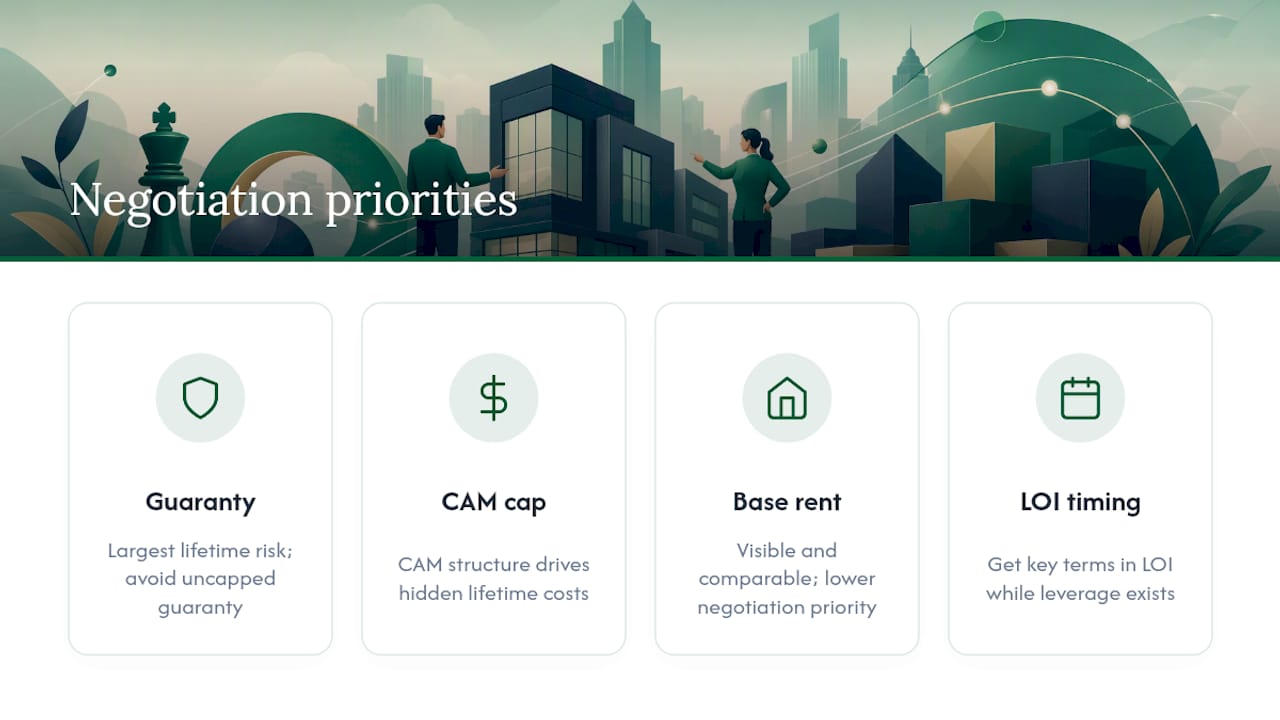
Most lease advice treats every clause as equally important, which is exactly backward. A tenant who spends three weeks arguing over signage rights while accepting an uncapped personal guarantee has negotiated the wrong things well. The research here points to a clear ranking: guaranty exposure and CAM structure carry the most lifetime risk, yet they get the least attention because they’re less visible than the headline rent number.
The conventional wisdom to “get everything in writing” is true but incomplete. What matters more is getting the right things into the LOI before the landlord’s attorney ever drafts a lease, because that’s the point where leverage still exists. After the LOI, you’re negotiating around the edges of terms that are functionally locked.
If you take one thing from this playbook, prioritize the guaranty and the CAM cap over the base rent number. Rent is visible and easy to compare. The clauses that quietly cost tenants the most money are the ones nobody reads twice.
— Sierra
A Practical Next Step for Business Owners Leasing Space
If you’re negotiating a lease as part of buying, selling, or growing a business, you’re managing two negotiations at once, and most owners handle them separately when they shouldn’t. Compassbusinessacquisitions is built for that overlap. Rather than treating your lease as a side conversation, Compass connects valuation work, buyer-seller matching, and negotiation support so your lease terms reflect what your business can actually carry financially, not just what a landlord’s broker proposes first.

If you’re weighing a lease decision against a business sale or acquisition, start with a free business valuation to see what your numbers can support before you sign anything. Owners further along can review how Compass structures the sale process for support that extends from valuation through the final signature.
Sources
- How to read a commercial lease (LeaseLens)
- Commercial lease negotiation checklist (PulseRevOps)
- How to negotiate a commercial lease (CommercialLeaseCost)