
Negotiation Leverage in Deals: A 2026 Strategy Guide
Negotiation Leverage in Deals: A 2026 Strategy Guide
Negotiation leverage is defined as the power one party holds to influence deal terms in their favor, derived from alternatives, timing, information, and the counterpart’s need to close. The role of negotiation leverage in deals determines who concedes, who walks away, and who captures the most value. The Harvard Business School Program on Negotiation identifies five core drivers of leverage: strong alternatives (BATNA), time constraints, information asymmetry, competitive interest, and asymmetric need. Each driver either strengthens or weakens your position at the table. Professionals who understand these forces close better deals with fewer concessions.
What are the primary types and sources of negotiation leverage?
Negotiation leverage falls into three categories: positive, negative, and normative. Each type shapes the power dynamic differently, and skilled negotiators use all three depending on the situation.
Positive leverage is the ability to give the counterpart something they want. A seller with multiple qualified buyers holds positive leverage because the counterpart fears losing the deal. Negative leverage is the ability to harm the counterpart if they do not agree, such as walking away or pursuing litigation. Normative leverage uses shared standards, precedents, or fairness arguments to shift the moral weight of the negotiation.

The foundation of all three types is BATNA quality. A strong Best Alternative to a Negotiated Agreement means you can credibly walk away. That credibility alone shifts the counterpart’s calculus. A weak BATNA, by contrast, signals desperation and invites aggressive terms.
Time is a second major source of power. Deadlines, fiscal year closings, and personal circumstances all create urgency. The party with more time almost always holds the advantage. Information asymmetry is equally powerful. Knowing the counterpart’s financial pressures, internal deadlines, or competing priorities gives you a structural edge before a single term is discussed.
- BATNA strength: The clearer and more credible your alternative, the more freely you can reject unfavorable terms.
- Timing: Urgency on one side shifts power to the other. Identify who is under time pressure before negotiations begin.
- Information: Knowing the counterpart’s constraints is worth more than most tactical moves at the table.
- Competitive interest: Multiple bidders or buyers create real or perceived competition, raising your position’s value.
- Asymmetric need: When one party needs the deal far more than the other, that imbalance defines the negotiation ceiling.
Pro Tip: Before any negotiation, write down your BATNA and assign it a concrete dollar value. Abstract fallback plans are easily dismissed. Quantified alternatives carry real weight when the counterpart tests your resolve.
How can negotiators effectively create and enhance leverage?
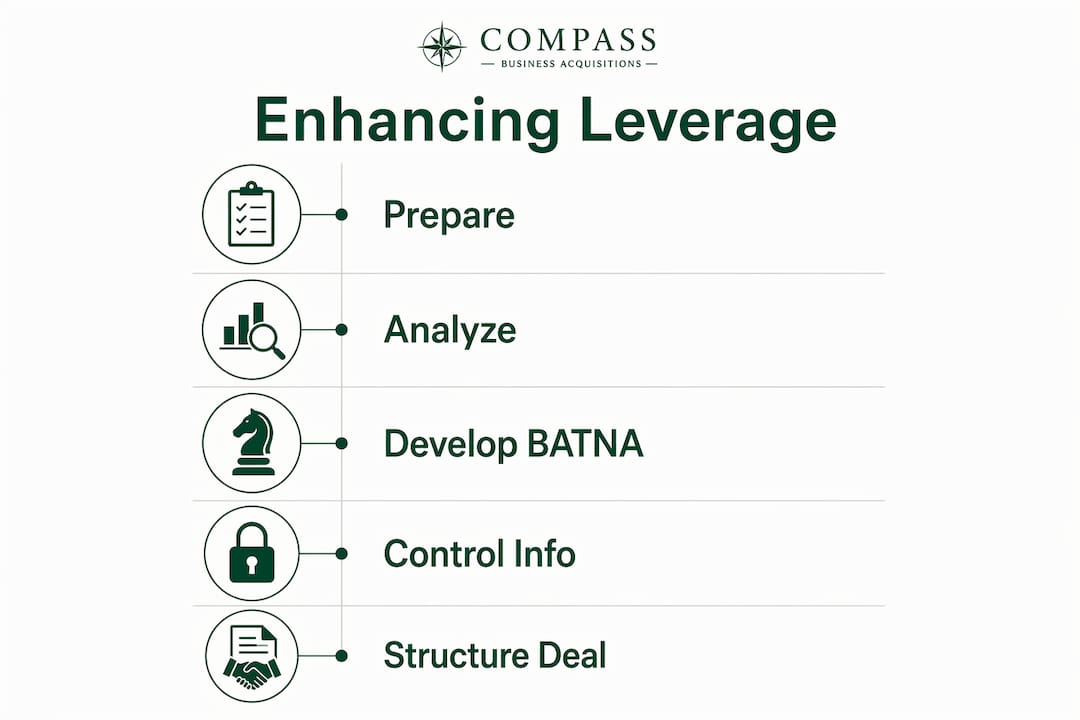
Building leverage is not reserved for parties with strong alternatives. Negotiators can create power even from a weak position by using structure, accountability, and disclosure tactics.
-
Develop a partial alternative. A BATNA does not need to be perfect to be useful. Even a partial alternative, such as a letter of intent from a less ideal buyer, signals that you have options. Hidden leverage arises when you reveal just enough of an alternative to shift the counterpart’s risk perception without fully disclosing your position.
-
Increase counterpart accountability. Asking a powerful counterpart to justify their position or explain their decision criteria creates a subtle shift in power. Accountability tactics increase empathy and cooperation, reducing the power imbalance without confrontation.
-
Use deal structure as a lever. Price is only one dimension of a deal. Earnouts, escrow arrangements, representations and warranties, and closing conditions all shift risk between parties. Structuring these terms carefully can give you continuing leverage well past the signing date.
-
Time your disclosures. Sharing information strategically, rather than all at once, preserves your ability to respond to new developments. Releasing financial details after the counterpart has committed to exclusivity, for example, changes the negotiating context entirely.
-
Assess the counterpart’s timeline. A seller facing a personal deadline, a tax event, or a partnership dispute is under pressure you can use. Identifying these factors through market analysis and due diligence is one of the most reliable ways to build positional advantage.
Pro Tip: Preparation is the highest-return activity in any negotiation. Professionals who use market analysis before entering a deal consistently identify leverage points their counterparts miss.
What are common pitfalls in applying negotiation leverage?
The most common mistake negotiators make is overusing negative leverage. Threats and ultimatums can produce short-term compliance, but negative leverage damages relationships) and often stalls deals entirely. The counterpart stops cooperating and starts defending, which raises transaction costs for both sides.
A second major error is failing to recognize when leverage has shifted. Leverage is dynamic. A seller who holds strong leverage before due diligence may lose it entirely once the buyer uncovers operational risks. Maintaining leverage requires discipline throughout the deal cycle, not just at the opening offer.
“Interest-based bargaining shifts focus from individual gains to mutual problem solving, increasing fairness and cooperation.” — Program on Negotiation, Harvard Law School
The best practice is to ground leverage in objective criteria rather than pressure tactics. Referencing market comparables, industry standards, or precedent transactions depersonalizes the negotiation. It moves the conversation from “what I want” to “what the data supports,” which is far harder for a counterpart to reject.
- Avoid ultimatums early. Reserve hard positions for moments when the deal is nearly closed and the cost of walking away is real for both parties.
- Track leverage shifts actively. Assign someone on your team to monitor changes in the counterpart’s position, timeline, and alternatives throughout the process.
- Separate upfront from post-closing leverage. Pre-signing leverage focuses on price and structure. Post-closing leverage lives in escrow terms, earnout conditions, and indemnification clauses. Conflating the two leads to poor deal architecture.
- Use fairness as a tool. Collaborative problem-solving produces better outcomes than power plays, particularly in deals where the parties will have an ongoing relationship after closing.
How does leverage apply in mergers and acquisitions?
Mergers and acquisitions present the most structured environment for applying negotiation power dynamics. Four levers define every M&A negotiation: price, structural adjustments, protective provisions, and closing conditions. Matching risk to the right lever is what separates experienced deal teams from amateurs.
Exclusivity periods in Letters of Intent (LOIs) are one of the most underappreciated sources of time-based leverage. Typical exclusivity lasts 60–90 days and prevents the seller from soliciting competing bids during due diligence. That restriction transfers significant power to the buyer. Sellers who understand this dynamic negotiate shorter exclusivity windows or include performance milestones that trigger early termination rights.
Post-LOI, deal structure becomes the primary arena for leverage. Phased closings tied to integration benchmarks give buyers the right to withdraw or adjust terms based on actual performance. Segmenting acquisitions into milestones with conditions creates continuing leverage that extends well beyond the initial agreement.
| Lever | How it shifts leverage | Who typically benefits |
|---|---|---|
| Price adjustment | Ties final payment to verified financials | Buyer |
| Earnout | Defers value based on post-close performance | Buyer |
| Escrow holdback | Retains funds against indemnification claims | Buyer |
| Closing conditions | Allows exit if conditions are not met | Buyer or Seller |
| Exclusivity period | Limits seller’s ability to solicit other offers | Buyer |
Pro Tip: Sellers can reclaim leverage by negotiating a well-prepared business sale prospectus before entering any LOI discussion. A thorough prospectus signals credibility and reduces the information asymmetry buyers rely on.
Key takeaways
Negotiation leverage in deals is determined by BATNA strength, timing, information control, and deal structure, and it shifts continuously throughout the transaction.
| Point | Details |
|---|---|
| BATNA is the foundation | Quantify your best alternative before any negotiation begins to make it credible. |
| Leverage is dynamic | Monitor shifts in the counterpart’s position and timeline throughout the deal cycle. |
| Structure creates leverage | Earnouts, escrows, and closing conditions extend your power well past the signing date. |
| Negative leverage has limits | Threats produce short-term compliance but damage relationships and stall deals. |
| Preparation multiplies power | Market analysis and due diligence reveal counterpart constraints before talks begin. |
What I’ve learned about leverage that most negotiators get wrong
Most negotiators treat leverage as a fixed asset. They assess it once at the start of a deal and assume it holds. That assumption costs them.
Leverage shifts every time new information enters the room. A buyer who discovers a key employee is leaving, or a seller who learns the buyer’s financing is shaky, holds a completely different hand than they did at the LOI stage. The negotiators I’ve seen succeed consistently are the ones who treat leverage as a live variable, not a starting position.
The second thing most professionals underestimate is the power of fairness. Reframing a demand as a market standard, a precedent transaction, or an industry norm removes the personal element from the pressure. The counterpart stops feeling attacked and starts evaluating the logic. That shift alone can move a stalled deal forward.
Collaboration is not weakness. The most durable deals I’ve observed are ones where both parties felt the process was fair, even when the terms favored one side. That perception of fairness reduces post-closing disputes, speeds integration, and protects the relationship for future transactions. Threats might win a round. Principled negotiation wins the deal and the next one.
— Sierra
How Compassbusinessacquisitions supports your deal outcomes
Compassbusinessacquisitions brings deep market knowledge and proven deal experience to every transaction it handles, whether you are buying, selling, or evaluating a business opportunity.

Working with a professional broker changes your negotiation position from the first conversation. Compassbusinessacquisitions provides professional valuations, targeted buyer marketing, and structured deal guidance that gives sellers measurable advantages at the table. Buyers benefit from access to vetted opportunities and expert guidance on deal terms. If you are preparing to sell, the seller resources at Compass are built to help you enter negotiations with the strongest possible position. Experienced brokers who improve deal outcomes are one of the most reliable ways to protect your leverage from first contact through closing.
FAQ
What is negotiation leverage in a business deal?
Negotiation leverage is the power one party holds to influence deal terms in their favor. It derives from five core drivers: strong alternatives (BATNA), time constraints, information asymmetry, competitive interest, and asymmetric need.
What is BATNA and why does it matter?
BATNA stands for Best Alternative to a Negotiated Agreement. A strong, quantified BATNA gives you the credibility to walk away, which is the single most powerful source of leverage in any negotiation.
How do exclusivity periods affect leverage in M&A?
Exclusivity periods in LOIs typically last 60–90 days and prevent sellers from soliciting competing bids. This restriction transfers significant time-based leverage to the buyer during the due diligence phase.
Can you build leverage without a strong alternative?
Yes. Partial alternatives, accountability tactics, and strategic information disclosure all create leverage even when your BATNA is weak. Quantifying your fallback position, even a modest one, makes it far harder for the counterpart to dismiss.
When does negative leverage become counterproductive?
Negative leverage becomes counterproductive when it damages the relationship or signals bad faith. Using objective criteria and market standards instead of threats produces more durable outcomes and preserves the working relationship after closing.