
Why Negotiation Strategy Affects Sale Price for Sellers
Why Negotiation Strategy Affects Sale Price for Sellers
Negotiation strategy is the single most controllable factor determining your final sale price in any business transaction. The Harvard Program on Negotiation, Simon-Kucher & Partners, and the Kellogg School of Management all confirm that how you negotiate shapes buyer expectations, controls deal terms, and directly moves the number on the closing check. Small business owners who treat negotiation as an afterthought routinely leave money on the table. Those who treat it as a structured discipline consistently close at higher valuations. This article breaks down exactly why negotiation strategy affects sale price and what you can do about it before your next deal.
What negotiation techniques most impact sale price?
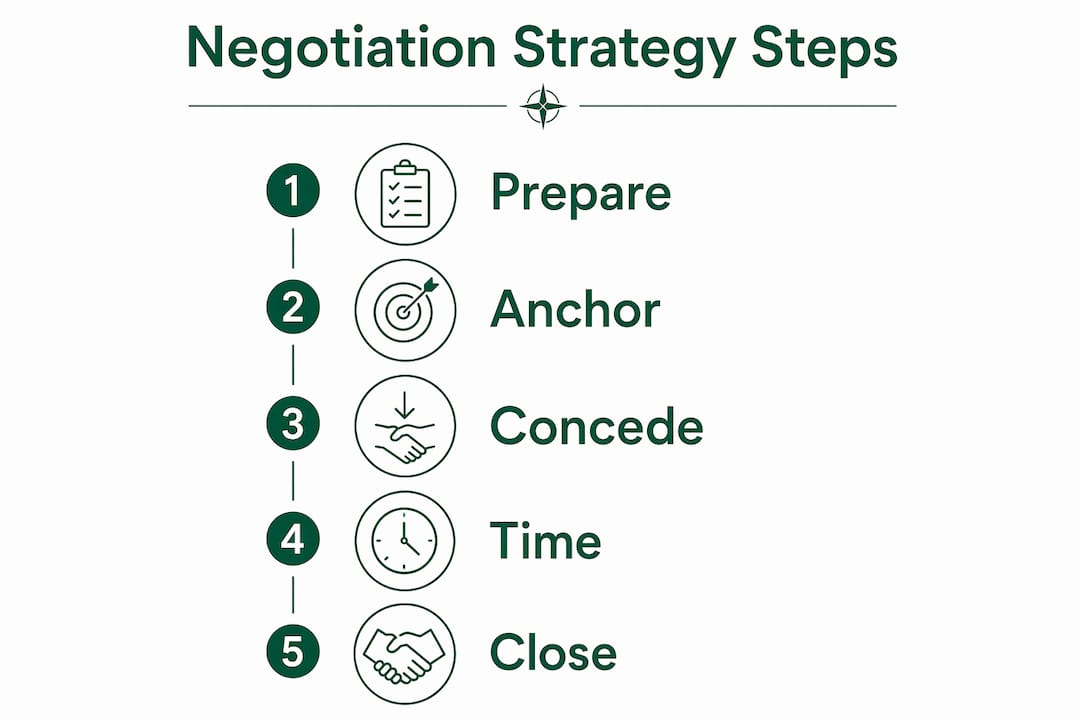
Anchoring bias is the most powerful price-setting mechanism in any negotiation. The first number introduced in a deal becomes the psychological reference point for every subsequent discussion. A well-researched high first offer, structured as a bolstering range such as $7,000–$7,500, signals both confidence and flexibility while keeping the buyer’s expectations anchored near your target.
Concession patterns matter just as much as the opening number. Decelerating concessions signal to buyers that you are approaching your real limit. When your discounts shrink from $500 to $200 to $75 across successive rounds, buyers psychologically interpret that as a bottom line. That perception protects your price far better than a single large concession ever could.

Timing your counteroffers also carries measurable weight. Responding too quickly can signal desperation. Waiting too long risks losing the deal entirely. The goal is deliberate pacing that communicates confidence without stalling momentum.
Key techniques that directly influence sale price:
- Anchor high with a credible range. A 5% price difference at the anchor stage can translate into significant revenue shifts across the full deal.
- Use decelerating concession patterns. Smaller and smaller discounts signal a firm floor and prevent buyers from expecting unlimited flexibility.
- Trade concessions, never give them away. Every price reduction you offer should come with a request for something in return, such as faster closing, fewer contingencies, or better payment terms.
- Avoid volunteering discounts. Offering discounts before buyers ask signals weakness and creates a pattern of future discount expectations that erodes your price repeatedly.
Pro Tip: Before entering any negotiation, write down your anchor number, your target price, and your walk-away point. Sellers who define these three figures in advance make far fewer reactive concessions under pressure.
How does buyer psychology influence the final price?
Loss aversion is the behavioral economic principle that explains why buyers respond more strongly to what they might lose than to what they might gain. Framing price in terms of value outcomes rather than cost shifts the buyer’s mental calculation from “how much am I spending” to “what do I lose if I don’t close this deal.” That shift reduces discount pressure and supports a higher final price.
Certainty also drives willingness to pay. Buyers who feel confident about what they are acquiring, including verified financials, clear operational processes, and documented revenue, are more willing to pay a premium. Uncertainty creates hesitation, and hesitation creates price pressure. Reducing ambiguity before price discussions begin is one of the most underused tactics in small business sales.
“Negotiation success is mostly determined before price is discussed, through discovery, certainty-building, and vendor selection.” — B2B Sales Training
Value alignment before price discussion is the practical application of this principle. When a buyer already sees the business as the right fit for their goals, they negotiate from a position of wanting to close rather than wanting to discount. Sellers who invest time in demonstrating fit and value before naming a price consistently achieve better outcomes than those who lead with numbers.
Avoiding discounting as a default response also matters here. Discounting signals unclear value. When you hold your price and instead reframe what the buyer receives, you reinforce the perception that the asking price is justified.
Does negotiation preparation actually improve sale price?
Preparation is the most reliable predictor of negotiation outcomes. Top-performing companies invest 31% more in negotiation training and have 28% better-defined processes than average performers. That investment correlates directly with 31% higher target attainment on pricing goals. Preparation is not a soft advantage. It is a measurable one.
Structured preparation includes four specific steps:
- Define your BATNA. Your Best Alternative to a Negotiated Agreement is your walk-away option. A clearly defined BATNA gives you the confidence to reject a low offer without panic. Sellers without a BATNA often accept poor terms simply because they have no alternative in mind.
- Build a concession plan. Map out in advance which concessions you are willing to make and what you will ask for in return. The best negotiators prepare concession plans that trade price reductions for other deal elements, preventing margin erosion.
- Use data and ROI tools. Companies that use data-backed preparation see up to 30% better win rates and 25% reduced sales cycles. Entering a negotiation with verified financials, comparable sale data, and documented growth potential removes the buyer’s ability to challenge your price on factual grounds.
- Map stakeholder motivations. Understanding what the buyer actually wants beyond price, whether that is a fast close, seller financing, or operational continuity, gives you leverage to structure a deal that meets their needs without reducing your price.
Pro Tip: Run a sales opportunity qualification process before entering price discussions. Sellers who qualify buyer intent and financial readiness early avoid wasting concessions on buyers who were never serious.
How does timing affect negotiation outcomes and price?
Response timing in negotiation is a direct lever on both price and deal probability. Research from the Kellogg School of Management shows that doubling seller response time increased the final price by $0.74 relative to the buyer’s initial offer but lowered the probability of completing the sale by 4.4%. That tradeoff is real and must be managed deliberately.
| Response timing strategy | Effect on price | Effect on deal probability |
|---|---|---|
| Faster seller response | Lower final price | Higher deal completion rate |
| Slower seller response | Higher final price | Lower deal completion rate |
| Buyer delays response | Increases seller concessions | Neutral to negative |
| Balanced pacing | Moderate price gain | Maintained deal momentum |
Strategic silence, the practice of deliberately delaying a response to shift power, works best when you have a strong BATNA and the buyer is highly motivated. Without those conditions, silence reads as disorganization or disinterest rather than confidence.
Buyer response delays work differently. When buyers slow down, sellers often interpret it as disinterest and respond with concessions to re-engage. Recognizing this pattern prevents you from discounting unnecessarily. The buyer may simply be running their own internal approval process.
Balancing patience with responsiveness is the practical skill here. Fast, well-timed communication builds deal momentum and signals professionalism. Deliberate pauses at key moments, such as after receiving a low offer, signal that you are not desperate. Strategic follow-up communication that maintains engagement without appearing anxious is one of the most effective tools for protecting price through the final stages of a deal.
Practical strategies to maximize sale price in your next negotiation
These six steps translate research findings into direct actions for small business owners preparing to sell.
- Anchor high with a credible range. Open with a bolstering range that sets your target at the low end. This gives buyers the feeling of flexibility while keeping the entire discussion near your desired outcome.
- Structure concessions to decelerate. Plan your concessions before the negotiation starts. Each successive reduction should be smaller than the last to signal a firm floor.
- Use multi-variable deal structuring. Negotiate payment terms, contract length, transition support, and seller financing alongside price. This protects revenue better than focusing on price alone and gives you more levers to trade.
- Define your walk-away point. Know your BATNA before you sit down. Walk-away power is the strongest lever a seller has to protect sale price.
- Control signals of desperation. Calm, deliberate negotiation presence signals power. Rushing to close, volunteering discounts, or over-explaining your price all weaken your position.
- Leverage expert frameworks. Sellers who use structured negotiation frameworks, whether through professional training or experienced brokers, consistently achieve better pricing outcomes than those who rely on instinct alone.
Pro Tip: Consider seller financing options as a negotiation tool. Offering flexible payment structures can justify a higher total sale price while making the deal more accessible to qualified buyers.
Key takeaways
Negotiation strategy directly determines sale price by controlling anchoring, concession patterns, timing, and buyer psychology before and during every deal.
| Point | Details |
|---|---|
| Anchor high from the start | Use a bolstering price range to set buyer expectations near your target from the first offer. |
| Decelerate your concessions | Shrinking discounts signal a firm floor and prevent buyers from expecting unlimited reductions. |
| Prepare your BATNA | Walk-away power is the strongest lever for protecting sale price under pressure. |
| Frame value before price | Buyers who see clear value and certainty pay more and negotiate less aggressively. |
| Use multi-variable structuring | Negotiating payment terms and deal conditions alongside price protects total deal value. |
Why I think most small business sellers underestimate negotiation
After working through dozens of business sale transactions, the pattern I see most often is not that sellers ask for too little. It is that they give too much away too early. A buyer pushes back once, and the seller immediately drops the price or adds concessions without any real pressure to do so. That single moment costs more than any valuation error.
The research from Harvard and Kellogg confirms what I have observed directly. Preparation and process discipline separate sellers who close at their target from those who rationalize a lower number after the fact. Defining your BATNA is not a theoretical exercise. It is the difference between negotiating from confidence and negotiating from fear.
The other thing I have seen consistently is that sellers who treat negotiation as a relationship process rather than a price battle close better deals. When you understand what a buyer actually needs, including certainty, a clean transition, or specific deal terms, you can give them that without reducing your price. That is value-based negotiation in practice, and it works.
Small business owners often skip the preparation phase because they assume their knowledge of their own business is enough. It is not. Knowing your business and knowing how to negotiate the sale of your business are two different skills. The sellers who invest in both consistently walk away with more.
— Sierra
How Compassbusinessacquisitions helps you negotiate a better sale price
Selling a business at the right price requires more than a good product. It requires a negotiation process built on preparation, data, and proven tactics.
Compassbusinessacquisitions applies structured negotiation frameworks to every transaction, from setting the right anchor price to managing concession patterns and timing counteroffers strategically. Their team uses verified financial data, market comparables, and buyer psychology principles to protect your sale price through every stage of the deal. Whether you are preparing for your first sale or managing a complex acquisition, expert broker guidance reduces the risk of leaving value on the table. Contact Compassbusinessacquisitions today to start with a professional valuation and a negotiation strategy built around your goals.
FAQ
Why does the first offer matter so much in a sale negotiation?
The first offer sets the anchor point for the entire negotiation. Research from the Harvard Program on Negotiation confirms that a high, well-researched opening offer yields significantly better final prices than a conservative one.
What is BATNA and how does it protect sale price?
BATNA stands for Best Alternative to a Negotiated Agreement. A clearly defined BATNA gives sellers the confidence to reject low offers, which prevents reactive discounting and protects the final sale price.
How do concession patterns affect what a buyer pays?
Decelerating concessions, where each discount is smaller than the last, signal to buyers that the seller is near their limit. This psychological signal reduces buyer expectations for further reductions and supports a higher closing price.
Does response timing really change the final sale price?
Yes. Kellogg School of Management research shows that doubling seller response time increased the final price slightly but reduced deal completion probability by 4.4%. Timing must be balanced against deal risk.
What is the biggest negotiation mistake small business sellers make?
Volunteering discounts before buyers ask is the most common and costly mistake. It signals unclear value and creates a pattern of discount expectations that erodes the final sale price across the entire negotiation.