
The Role of Market Analysis in Business Investing
The Role of Market Analysis in Business Investing
Market analysis is defined as the systematic process of validating customer demand, competitive viability, and market conditions before committing investment resources to a business. For small business investors and buyers evaluating acquisitions, it is the difference between a calculated bet and a costly mistake. The role of market analysis in business investing extends well beyond confirming a market exists. It tests whether real customers will pay a viable price, whether competitors leave room for growth, and whether the business model can sustain returns over time. Sources including the U.S. Small Business Administration, BDC, OGSCapital, and Woozle Research all treat market analysis not as optional preparation but as a core investment discipline.
How does market analysis reduce investment risk?
Market analysis reduces investment risk by replacing assumptions with verified data on customers, competitors, and demand. The SBA recommends assessing competition by market share, strengths and weaknesses, barriers to entry, and competitive forces before making any investment decision. That framework forces investors to confront uncomfortable realities about a market before money changes hands.
The BDC frames market analysis as a direct challenge to entrepreneurial intuition. Starting a business is risky, and gut feel is not a reliable substitute for data on actual customer behavior and spending patterns. When you test assumptions early, you avoid building financial models on demand that does not exist.

Market analysis also supports revenue forecasting and performance benchmarking. Business News Daily advocates updating market analysis annually to stay current with shifts in pricing, competition, and customer preferences. That ongoing discipline keeps investment theses grounded in current conditions rather than outdated projections.
Three specific risk areas that market analysis addresses directly:
- Customer validation: Confirms real buyers exist at a price point that supports profitability
- Competitive positioning: Identifies whether the market has room for another entrant or acquirer
- Revenue benchmarking: Provides KPIs to compare target business performance against industry norms
Pro Tip: Run competitive analysis before reviewing a target company’s financials. Knowing the competitive landscape first prevents you from rationalizing weak numbers with an optimistic market story.
What are the key components of market analysis for investors?
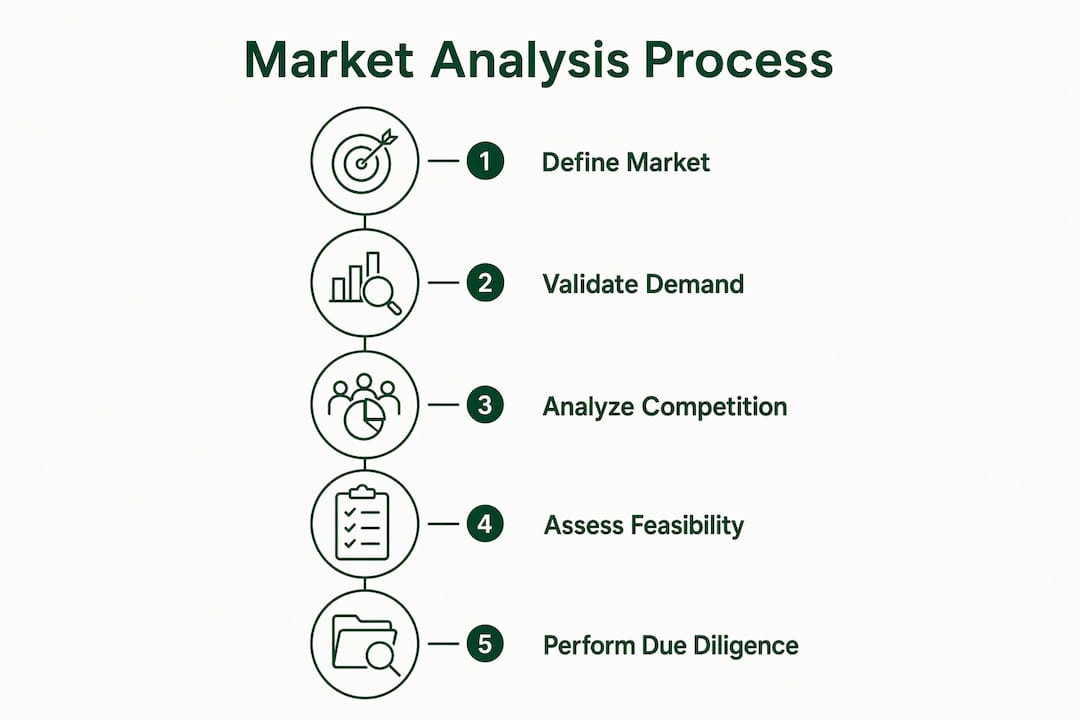
Market analysis for investment decisions covers five distinct components, each answering a different question about viability.
-
Market sizing. How large is the addressable market, and is it growing? VantaInsights advises that lenders and investors validate market size claims with real data and credible sources. A large market number without a credible source signals weak due diligence.
-
Customer segmentation. Who buys, how often, and at what price? BDC’s framework breaks customers into segments by needs, habits, and price sensitivity. Knowing which segment drives the most revenue tells you whether the business has a defensible customer base or a fragile one.
-
Competitive landscape assessment. The SBA’s framework covers direct competitors, indirect substitutes, and secondary competitors alongside barriers to entry. A market with low barriers and many direct competitors compresses margins and raises acquisition risk.
-
Primary research methods. Woozle Research identifies expert calls, channel checks, and B2B customer surveys as the core tools for validating market claims independently. These methods produce proprietary data that management presentations and industry reports cannot replicate.
-
Distinguishing between research types. Market research answers who the customers are. Market feasibility analysis answers whether enough of them exist at a viable price. Commercial due diligence answers whether the investment thesis holds under pressure from real market data.
Each layer builds on the previous one. Investors who skip straight to financial modeling without completing the first three steps are pricing a business without understanding the market it operates in.
Pro Tip: Use B2B customer surveys and expert interviews to verify claims made in a seller’s information memorandum. Sellers present their best case. Independent primary research reveals what customers and channel partners actually think.
How does market feasibility analysis fit into the investment process?
Market feasibility analysis is defined as the evaluation of whether sufficient demand exists at a price that makes a business viable, conducted before committing to fixed costs. OGSCapital frames feasibility as the missing step between identifying an opportunity and investing resources in it. Most investors move too quickly from idea to financial model, skipping the demand test entirely.
The practical cost of skipping feasibility is significant. Investors who sign leases, fund build-outs, or hire staff based on unvalidated demand assumptions face losses that no amount of operational efficiency can recover. Market feasibility studies prevent premature commitment of capital to ideas that have not been tested against real market conditions.
“Market feasibility analysis answers the most fundamental investment question before any other: Is there enough demand, at a price that works, for this business to survive?” — OGSCapital
What feasibility studies reveal that basic market research does not:
- Whether price points are realistic given actual customer willingness to pay
- Whether demand is concentrated in a narrow segment or broadly distributed
- Whether the timing of market entry or acquisition aligns with demand cycles
- Whether competitive responses would erode demand quickly after entry
Feasibility analysis belongs before financial modeling, not after. Running detailed projections on unvalidated demand produces precise numbers built on a weak foundation.
What role does commercial due diligence play in acquisition investing?
Commercial due diligence is defined as the structured evaluation of a target company’s market position, demand sustainability, and competitive dynamics using primary research. Woozle Research identifies expert interviews, channel checks, and B2B surveys as the primary tools for pressure-testing investment theses independently of management narratives.
The distinction between commercial due diligence and standard financial due diligence matters. Financial due diligence reviews historical numbers. Commercial due diligence tests whether those numbers are repeatable given current market conditions. A business with strong historical revenue but deteriorating competitive positioning is a different investment than its financials suggest.
Emporia Research identifies demand quality and competitive intensity as the two dimensions that separate attractive acquisition narratives from durable commercial fundamentals. Demand quality measures whether customers buy out of genuine preference or simply because no better alternative exists yet. Competitive intensity measures how quickly new entrants or substitutes could erode market share.
| Due Diligence Dimension | What It Measures | Why It Matters for Investors |
|---|---|---|
| Market sizing | Total addressable market and growth rate | Sets the ceiling for revenue potential |
| Demand quality | Customer loyalty, switching costs, repeat purchase rates | Predicts revenue durability post-acquisition |
| Competitive intensity | Number of competitors, barriers to entry, pricing pressure | Signals margin sustainability |
| Growth potential | Expansion opportunities, adjacent markets | Supports post-acquisition value creation |
Pro Tip: Treat management’s growth narrative as a hypothesis, not a fact. Commercial due diligence exists to test that hypothesis with independent data from customers, competitors, and channel partners before you close.
Primary research that validates claims through multiple independent sources reduces bias and increases confidence in investment decisions. Investors who rely solely on seller-provided materials are evaluating a business through a lens the seller designed.
Key Takeaways
Market analysis is the foundational discipline that separates informed business investment decisions from expensive guesses based on unverified assumptions.
| Point | Details |
|---|---|
| Validate demand before committing | Market feasibility analysis tests customer demand before leases, build-outs, or hiring decisions. |
| Assess competition systematically | Use the SBA framework to evaluate market share, barriers to entry, and competitive forces. |
| Use primary research independently | Expert calls, channel checks, and B2B surveys produce data that seller materials cannot replicate. |
| Separate demand quality from market size | Large market claims mean little without evidence of durable, loyal customer demand. |
| Update analysis regularly | Annual market analysis updates keep investment theses aligned with current competitive conditions. |
Why I think most investors underuse market analysis at the worst moment
The most common mistake I see investors make is treating market analysis as a box to check rather than a decision filter. They commission a market report, confirm the industry is growing, and move forward. That approach misses the entire point.
The real value of market analysis shows up when it challenges your thesis, not when it confirms it. Demand quality and competitive sustainability matter more than raw market size for investment decisions. A $10 billion market with three dominant players and high switching costs is a harder entry than a $500 million market with fragmented competition and loyal niche customers.
I have also seen investors run full financial models before completing basic feasibility work. That sequence is backwards. Feasibility analysis is fast and inexpensive relative to the cost of a failed acquisition. Running it first narrows the field before you spend serious time and money on financial modeling and legal review.
The other underused tool is multi-source validation. One data point is a claim. Three independent sources confirming the same finding is evidence. Expert calls, customer surveys, and channel checks each reveal a different angle on the same market. Used together, they build a picture that no single report can produce.
For investors evaluating acquisitions specifically, the combination of market feasibility analysis and commercial due diligence is the most reliable path to a defensible investment decision. Skip either one, and you are pricing a business on incomplete information.
— Sierra
How Compassbusinessacquisitions supports market-informed investment decisions
Compassbusinessacquisitions works with buyers and sellers who understand that market analysis is not a formality. It is the foundation of every sound acquisition decision.

Compassbusinessacquisitions brings in-depth market insights and professional valuations to every transaction, connecting buyers with businesses that have verified growth potential and sellers with buyers who understand the market they are entering. Whether you are evaluating your first acquisition or selling a business you have built, the team at Compassbusinessacquisitions provides the market knowledge and broker expertise to maximize value on both sides of the deal. Investors looking for acquisition guidance backed by real market data can connect with the Compassbusinessacquisitions team directly to get started.
FAQ
What is the role of market analysis in business investing?
Market analysis validates customer demand, competitive viability, and revenue potential before an investor commits capital. It reduces risk by replacing assumptions with data on real market conditions.
How does market feasibility analysis differ from market research?
Market research identifies who the customers are and how the market is structured. Market feasibility analysis tests whether enough customers exist at a price point that makes the business financially viable, and it comes before financial modeling.
What is commercial due diligence and when should investors use it?
Commercial due diligence evaluates a target company’s market position, demand sustainability, and competitive dynamics using primary research methods like expert interviews and customer surveys. Investors use it during acquisition evaluation to pressure-test the seller’s growth narrative.
Why does demand quality matter more than market size?
A large market does not guarantee a profitable investment if demand is fragile, customer loyalty is low, or competitive pressure is high. Emporia Research notes that separating durable fundamentals from attractive narratives is the core challenge of investment due diligence.
How often should investors update their market analysis?
Business News Daily recommends updating market analysis at least annually. For active investors evaluating acquisitions, updating competitive and demand data at the start of each deal process reflects current conditions rather than outdated market assumptions.