
Spot Undervalued Business Opportunities: A Buyer's Playbook
Spot Undervalued Business Opportunities: A Buyer’s Playbook
You find undervalued small-to-medium businesses by screening for three things: earnings distortions, asset mispricing, and off-market seller motivation. Apply a normalized cash flow filter first, then validate with targeted diligence. The fastest practical entry point is a quick earnings-normalization check: flag any seller whose reported Seller’s Discretionary Earnings (SDE) drops significantly after removing owner add-backs and one-time items. That single step separates real acquisition targets from overpriced listings.
Three filters to apply immediately:
- Earnings quality: Normalize SDE by stripping owner salary, personal expenses, related-party transactions, and nonrecurring revenue. Small owner-operated businesses typically trade at 2–4x Seller’s Discretionary Earnings (SDE), but that multiple depends on the quality and cleanliness of the earnings figure.
- Asset and liability mispricing: Compare the asking price against tangible asset value, deferred maintenance backlog, and working-capital requirements. A business priced at 2.5x SDE with $400,000 in deferred capex is not cheap.
- Seller motivation and off-market status: Motivated sellers who have not run a formal process often accept better terms. SBA 7(a) financing is available for qualifying acquisitions, which expands your buyer pool and negotiating position.
Pro Tip: Before contacting a single seller, write a one-page acquisition brief that defines your target SDE range, preferred sectors, geography, and deal-breaker criteria. It takes 30 minutes and eliminates weeks of unfocused outreach.
Table of Contents
- What signals tell you a business may be undervalued?
- How do you validate value through earnings normalization?
- Where do undervalued SMBs actually appear?
- Which due diligence items destroy apparent value fastest?
- What does a typical acquisition timeline and cost look like?
- How Compassbusinessacquisitions helps you find and validate targets
- Key Takeaways
- Price discipline is what most buyers underestimate
- Run a valuation before your next offer
- Useful sources and further reading
What signals tell you a business may be undervalued?
Quantitative signals are the fastest triage layer. Watch for:
- SDE or EBITDA multiples below the sector median (use industry-specific benchmarks, not a flat 2–4x)
- High tangible asset value relative to asking price, particularly real estate, equipment, or long-term contracts
- Customer concentration above a substantial portion in a single account (a red flag, but also a negotiating lever if fixable)
- Owner add-backs that represent a large share of reported SDE, which often signals aggressive normalization by the seller
- Negative working-capital cycles that generate cash before expenses come due (a structural advantage often missed by unsophisticated sellers)
Qualitative signals are equally telling. Hidden gems often have solid fundamentals masked by mismanagement or under-marketing: a family-owned manufacturer with valuable real estate, a service firm with long-term contracts but no digital presence, or a business with strong repeat customers and zero marketing spend. Owner-dependence is the most common qualitative signal. If the business stops functioning when the owner takes a two-week vacation, the multiple should reflect that risk.
Additional qualitative flags:
- Weak or absent management layer below the owner
- Deferred maintenance on core equipment or facilities
- Poor seller presentation (“priced to sell” language, incomplete financials, no CIM)
- Motivated seller language tied to health, retirement, or partnership disputes
Pro Tip: Build a one-page acquisition brief and share it with every broker, accountant, and lender in your network. Structured screening criteria reduce wasted diligence and keep your pipeline focused on high-fit targets.

How do you validate value through earnings normalization?
Price discipline is the decisive skill in SMB acquisitions. Normalizing earnings means converting reported SDE into a transferable, owner-independent cash flow figure before applying any multiple.
Step-by-step normalization checklist:
- Start with reported net income from the most recent tax return.
- Add back owner’s compensation (salary, benefits, payroll taxes).
- Add back personal expenses run through the business (vehicle, travel, insurance).
- Add back one-time or nonrecurring items (legal settlements, equipment write-offs, COVID relief funds).
- Remove nonrecurring revenues (a one-time government contract, a related-party sale).
- Adjust for below-market or above-market rent if the owner controls the real estate.
- The result is normalized SDE. To estimate an owner-independent EBITDA, subtract a market-rate management salary from normalized SDE.
| Adjustment Item | Example Amount | Direction |
|---|---|---|
| Owner salary and benefits | — | Add back |
| Personal vehicle expense | — | Add back |
| One-time legal settlement | — | Add back |
| Nonrecurring government grant | — | Remove |
| Below-market rent (owner-controlled) | — | Remove (add to cost) |
| Normalized SDE | $247,000 |
A business reported at $180,000 net income becomes $247,000 normalized SDE after these adjustments. At a typical 2–4x SDE multiple for small owner-operated businesses, that means the indicative value ranges from $494,000 to $988,000 depending on earnings quality and owner independence. The normalization step alone shifts the offer range by six figures.
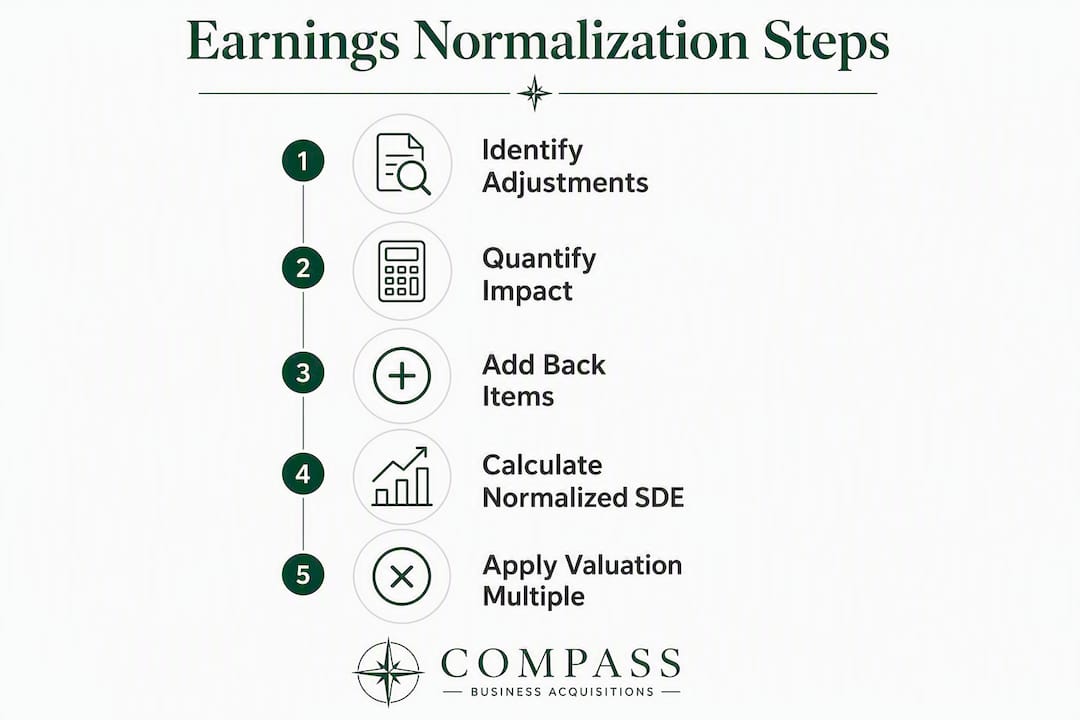
Compassbusinessacquisitions applies this methodology as part of its professional valuation service, reconciling tax returns against bank statements across a 3- to 5-year trend to confirm coherent earnings patterns.
Pro Tip: When financial access is limited pre-LOI, use conservative assumptions and build in a 10–15% contingency on normalized SDE. Price the deal on what you can verify, not what the seller projects.
Where do undervalued SMBs actually appear?
Off-market sourcing consistently produces better terms and less competition than on-market processes. Contested listings on business-for-sale platforms attract multiple bidders and compress negotiating leverage. The best deals come before a formal process starts.
Primary sourcing channels:
- Off-market outreach: Direct letters or calls to owners in your target sector, using industry association directories, LinkedIn, or county business license records.
- Professional referral networks: Accountants, commercial lenders, and estate attorneys regularly encounter owners considering a sale. A brief, professional introduction and your one-page acquisition brief are enough to get on their radar.
- Distressed and motivated sellers: PACER bankruptcy searches surface Chapter 11 and Subchapter V filings. Creditor pressure creates motivated sellers who prioritize speed over price.
- Broker networks: Quality brokers carry off-market inventory and pre-screen sellers. Building relationships with two or three active SMB brokers in your target market gives you early access to listings before they go public.
- On-market listings: Business-for-sale platforms remain useful for benchmarking pricing and identifying sectors with motivated sellers, even when the best deals come from elsewhere.
Sequencing by buyer type:
- Operator-buyers: Start with broker relationships and professional referrals. You need deal flow with verified financials, not raw leads.
- Financial buyers: Add PACER research and direct outreach to your pipeline. Volume matters more, and you can absorb more triage work.
- Both types: Prioritize leads for valuation work based on earnings quality first, then sector fit, then geography.
Which due diligence items destroy apparent value fastest?
Due diligence must go beyond financial statements. On-site observation and multi-year reconciled records reveal operational fragility and hidden costs that no spreadsheet captures.
Request these documents within the first 10 business days:
- 3–5 years of federal tax returns (business and personal if sole proprietor)
- 3–5 years of bank statements, reconciled against reported revenues
- Major customer contracts and renewal terms
- Lease agreement, including assignability clause and remaining term
- Asset register with age and condition of major equipment
- Employee records, including key-person agreements and non-competes
- Any pending or threatened legal claims
Red flags and their deal implications:
- Unverifiable revenues: Bank deposits don’t match reported sales. Walkaway or require seller financing with an earnout tied to verified post-close performance.
- Customer concentration above 30%: Require escrow holdback or price reduction proportional to the revenue at risk.
- Lease not assignable or expiring within 18 months: Renegotiate the lease before close or reduce price to reflect relocation risk.
- Deferred maintenance backlog: Get a third-party equipment appraisal and deduct the remediation cost from the offer price.
- Owner-performative roles: If the owner is the primary salesperson, technician, or client relationship, price in a transition period and a management replacement cost.
- Unresolved legal claims: Require indemnification, escrow holdback, or walk away entirely depending on exposure size.
Pro Tip: Operational inspection, including watching work flow and interviewing two or three key employees, reveals owner-buffer dependencies that three years of financials will never show.
What does a typical acquisition timeline and cost look like?
| Phase | Duration | Typical Cost Range |
|---|---|---|
| Initial screening and outreach | 1–2 weeks | — |
| Valuation and LOI | 2–4 weeks | — |
| Due diligence | 4–8 weeks | — |
| Closing | 2–4 weeks | — |
| — | — | $10,000–$37,500+ |
Broker commissions on SMB transactions typically run 8–12% of the sale price, paid by the seller. Buyers should still budget for their own legal and accounting representation.
SBA 7(a) loan processing can add several weeks to months to closing timelines. Seller financing or a short escrow window can accelerate the close, but seller notes shift negotiating leverage: a seller carrying a significant portion of the purchase price has a financial incentive to support your transition, which can be valuable beyond the speed of a clean cash close.
How Compassbusinessacquisitions helps you find and validate targets
Compassbusinessacquisitions provides the full stack of services a serious buyer needs: professional valuation and earnings normalization, off-market sourcing through an established broker network, brokered deal flow with pre-screened financials, negotiation and transaction management, and commercial lease assistance.
Key services for buyers:
- Business Evaluation Calculator: — A fast, structured tool to convert your screening signals into an indicative valuation range before committing to full diligence.
Pro Tip: Use the Business Evaluation Calculator as your first step after identifying a target. It takes minutes and tells you whether the asking price is in a defensible range before you spend time on a full NDA and document request.
Key Takeaways
Spotting undervalued SMB acquisition targets requires earnings normalization first, off-market sourcing second, and disciplined due diligence to confirm that apparent value survives scrutiny.
| Point | Details |
|---|---|
| Normalize earnings first | Strip owner add-backs and one-time items before applying any SDE multiple. |
| Use the 2–4x SDE benchmark | Small owner-operated businesses typically trade at 2–4x SDE; adjust down for owner-dependence. |
| Prioritize off-market sources | Direct outreach, broker networks, and PACER searches produce better terms than contested listings. |
| Budget $10,000–$37,500 in diligence costs | Plan for valuation, legal, accounting, and inspection fees before committing to a deal. |
| Compassbusinessacquisitions validates targets | Professional normalization, off-market deal flow, and the Business Evaluation Calculator convert signals into prioritized acquisition targets. |
Price discipline is what most buyers underestimate
Most buyers focus on finding deals. The buyers who consistently generate returns focus on pricing them correctly. The difference shows up in the normalization step. A business reporting $300,000 in net income can normalize to $180,000 in transferable SDE once you remove the owner’s $80,000 salary, $25,000 in personal expenses, and a $15,000 one-time insurance recovery. At a typical 2–4x SDE multiple for small owner-operated businesses, that is a $360,000 to $720,000 business—significantly less than the unadjusted $900,000 figure the seller may ask. The seller’s asking price often reflects the unadjusted number.
The second thing buyers underestimate is deal structure. When information access is imperfect, which it almost always is pre-close, structure protects you more than price. A seller note, an escrow holdback tied to customer retention, or an earnout on a key contract each transfer risk back to the seller in a way that a simple price reduction does not. Negotiating the right terms is as important as getting the right price.
Run a valuation before your next offer
Compassbusinessacquisitions gives buyers a faster path from signal to verified opportunity. The Business Evaluation Calculator delivers an indicative valuation in minutes, using the same normalization methodology described in this article. For buyers ready to move beyond screening, the buyer intake process connects you with pre-screened, off-market deal flow and a professional team that handles valuation, negotiation, and transaction management end to end.
Three reasons buyers work with Compassbusinessacquisitions:
- Speed: Indicative valuations before you commit to full diligence.
- Prioritized shortlists: Pre-screened targets matched to your acquisition criteria.
- Professional normalization: Defensible earnings analysis that holds up through LOI and closing.
Start with the Business Evaluation Calculator, then request a buyer consultation to build your prioritized acquisition shortlist.
Useful sources and further reading
- Due Diligence for Acquiring a Company: Go Beyond the Balance Sheet — Peer-reviewed guidance on reconciling financials, on-site inspection, and operational risk assessment; foundational for the due diligence section.
- How to Buy a Small Business (Step-by-Step Guide) — Practical walkthrough of SDE normalization, market multiples, and price discipline for U.S. SMB acquisitions.
- How to Find and Evaluate Acquisition Targets: A Practical Guide — Professional-grade screening methodology covering EV/EBITDA, earnings quality, and off-market sourcing tactics.
- How to Spot Undervalued Businesses for Acquisition — Sourcing tactics including PACER searches, direct outreach, and qualitative signals for identifying hidden-value targets.
- BizScout: How to Spot Undervalued Small Businesses — Structured screening and acquisition brief methodology for reducing wasted diligence and focusing on high-fit opportunities.
- Business Evaluation Calculator, Compassbusinessacquisitions — Interactive tool for converting triage signals into an indicative valuation range; the recommended first step before formal diligence.