
Role of Broker Representation in Negotiations
Role of Broker Representation in Negotiations
Broker representation in negotiations is defined as a formal arrangement where a licensed professional acts as your dedicated legal and strategic advocate throughout a business deal. The broker’s fiduciary duty places your financial interests above all other parties, including their own. This is the core distinction between having a broker and simply having help. For small business owners and entrepreneurs, understanding the role of broker representation in negotiations means the difference between closing a deal on your terms and accepting whatever the other side offers.
What legal and ethical duties define broker representation?
Broker representation establishes a legally binding fiduciary relationship. That relationship carries five specific duties: loyalty, confidentiality, disclosure, obedience, and reasonable care. Each duty protects you in a different way during negotiations.
Loyalty means your broker puts your financial outcome first, not a quick commission. Confidentiality means your negotiating position, budget ceiling, and timeline stay protected. Disclosure means your broker must tell you everything material about the deal. Obedience means they follow your lawful instructions. Reasonable care means they apply professional skill to every decision they make on your behalf.
The type of representation you secure matters as much as having representation at all. A buyer’s broker represents the buyer exclusively. A seller’s broker represents the seller exclusively. A tenant representation agreement formalizes the broker’s duty to the tenant, not the landlord. These agreements are not formalities. They are the legal foundation that gives your broker authority to act and the obligation to protect you.
Dual agency occurs when one broker represents both sides of a transaction. It creates an inherent conflict of interest because full advocacy for both parties simultaneously is not possible. Dual agency is regulated or banned in many jurisdictions, and where it is permitted, it requires written disclosure and informed consent. Small business owners should treat dual agency with caution.
- Buyer/Broker Agreement: Formalizes the broker’s exclusive duty to the buyer and defines compensation terms.
- Tenant Representation Agreement: Commits the broker to act solely in the tenant’s interest during lease negotiations.
- Seller Representation Agreement: Establishes the broker’s fiduciary duty to the seller and outlines listing terms.
- Dual Agency Disclosure: Required written consent when one broker represents both parties, limiting full advocacy for either side.
Pro Tip: Before signing any representation agreement, ask the broker directly: “Who do you legally represent in this transaction?” The answer tells you everything about whose interests they are protecting.
How do brokers influence negotiations? Key strategies and tactics
Professional brokers do not simply relay offers back and forth. They control the negotiation process from start to finish using specific, repeatable tactics that produce measurable results.
- Market data as leverage. Brokers arrive at the table with comparable transactions, current pricing benchmarks, and market trend data. This removes guesswork and gives every counteroffer a factual foundation the other side must address.
- Competitive tension. Broker presence signals sophistication to the opposing party. When a landlord or seller knows you have a professional evaluating alternatives, they price more competitively and offer better terms to secure the deal.
- The 15–20% formula. Brokers use a structured approach to rate negotiations: accept deals within 5% of target and deploy formal counteroffers beyond that range. This prevents emotional decision-making and keeps negotiations anchored to objective benchmarks.
- The silence tool. A 3–5 second pause after an offer is a standard broker tactic that prompts the other party to improve their position. Most untrained negotiators fill silence with concessions.
- Information control. Brokers decide what to share and when. Revealing your deadline, budget ceiling, or motivation too early transfers leverage to the other side. Brokers manage this flow deliberately.
- Concession structuring. Experienced brokers negotiate beyond the headline price. Free rent periods, tenant improvement allowances, renewal option terms, and exit clauses are all negotiable. Most business owners never ask for them because they do not know the market standard.
“Representation is not about getting deals done quickly. It is about controlling outcomes and protecting client interests.” — Commercial Real Estate Representation Explained
Pro Tip: Ask your broker for a list of every concession they plan to request before negotiations begin. If they cannot produce one, they are not prepared to advocate for your full financial interest.
Understanding negotiation tactics in business sales gives you a clearer picture of what a skilled broker brings to the table before a single offer is made.

What are the consequences of not having dedicated broker representation?
Negotiating without a broker does not put you on equal footing. It puts you at a structural disadvantage from the first conversation.
Directly contacting a listing broker means you are negotiating against a professional whose fiduciary duty runs entirely to the other party. That broker is not a neutral facilitator. They are a trained advocate for the seller or landlord, and they will use every piece of information you share against your position.
The financial consequences are real and specific:
- Above-market terms on renewals. Tenants without representation routinely accept renewal rates above market because they have no benchmark data and no competing offers to reference.
- Lost concessions. Free rent periods and tenant improvement allowances are standard in many markets. Business owners negotiating alone rarely secure them because they do not know to ask.
- Forfeited brokerage fee benefit. When you go unrepresented, the listing broker often collects both sides of the commission. You receive no advocacy and the other party’s broker receives a larger fee.
- Weaker exit terms. Without a broker structuring renewal options, termination clauses, and assignment rights, you can find yourself locked into unfavorable terms with no exit path.
- Conflict of interest exposure. Conflicts of interest arise when brokers represent both sides. Without exclusive representation, you have no protection against this.
Many business owners believe that negotiating directly saves brokerage fees. In practice, it transfers the advantage to the opposing party’s broker. The perceived savings disappear quickly when the deal terms are compared to what a represented buyer or tenant would have secured.
How to effectively engage broker representation for better outcomes
Selecting the right broker and working with them correctly determines how much value you actually capture. The process starts before you sign anything.
Vet the broker’s representation type first
Confirm in writing that the broker will represent you exclusively. Ask about their track record with deals similar to yours in size, industry, and market. A broker who specializes in market analysis for business investing brings quantitative leverage that generalists cannot match.
Understand the fee structure before you negotiate
Broker compensation in business acquisitions typically comes from the transaction itself, often as a percentage of the deal value. Clarify whether the fee is paid by the buyer, the seller, or split. Understand what triggers payment and what happens if the deal falls through. This conversation should happen before you sign a representation agreement.
Give your broker complete information
Your broker can only protect what they know about. Share your real budget ceiling, your timeline, your alternatives, and your priorities. Withholding information from your own advocate weakens your position. Confidentiality obligations mean that information stays protected.
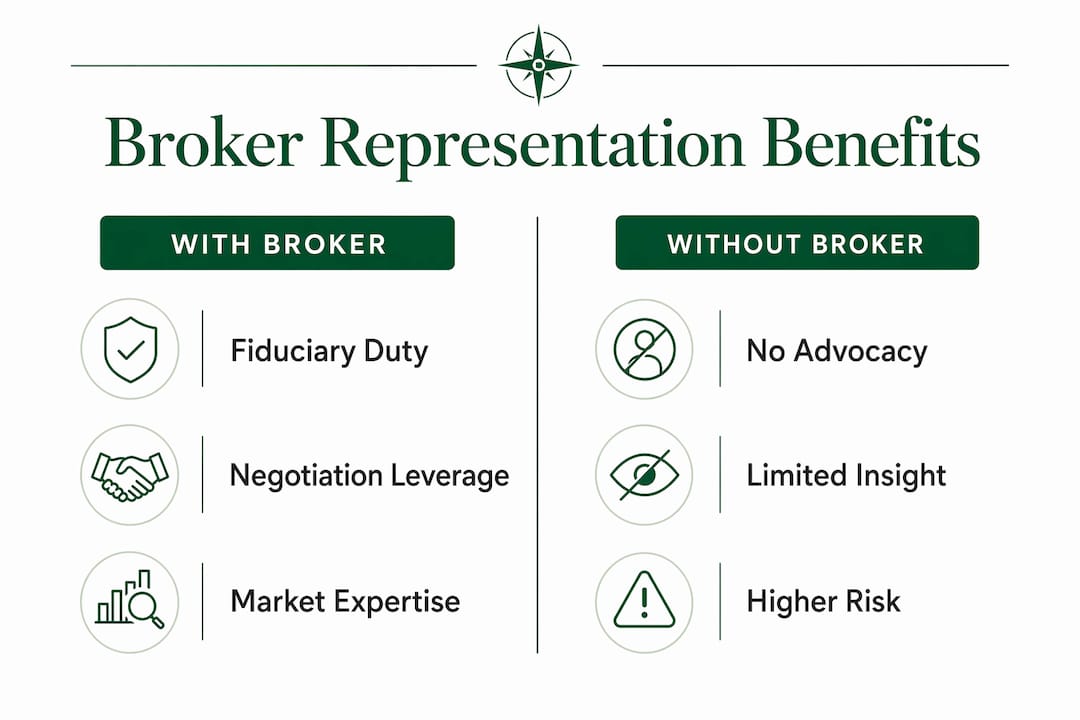
| Approach | With broker representation | Without broker representation |
|---|---|---|
| Market pricing knowledge | Benchmarked against comparable deals | Based on the other party’s claims |
| Concession negotiation | Free rent, TI allowances, renewal terms | Rarely requested or secured |
| Information control | Managed strategically | Disclosed without structure |
| Conflict of interest risk | Eliminated through exclusive agreement | Present in every dual-agency situation |
| Renewal terms | Evaluated against market alternatives | Accepted at landlord or seller’s rate |
Tenant representation has become a standard practice for businesses that want to control costs and reduce risk in leasing. The same principle applies to business acquisitions. Exclusive representation signals to the other party that you are prepared, informed, and not easily pressured.
Pro Tip: Review the broker’s proposed negotiation boundaries with them before talks begin. Know your walk-away point, your target terms, and the concessions you will accept. A broker who cannot articulate this plan is not ready to represent you.
Understanding why negotiation strategy affects sale price reinforces why the preparation phase matters as much as the negotiation itself.
Key Takeaways
Broker representation delivers its greatest value not at the closing table but in the preparation, information control, and leverage-building that happens before the first offer is made.
| Point | Details |
|---|---|
| Fiduciary duty is the foundation | Your broker is legally required to put your financial interests first in every decision. |
| Dual agency limits full advocacy | One broker representing both parties cannot fully protect either side; get exclusive representation. |
| Brokers create leverage through process | Market data, competitive tension, and structured counteroffers produce better terms than direct negotiation. |
| Going unrepresented transfers advantage | The listing broker’s duty runs to the other party, not to you, making direct negotiation a structural disadvantage. |
| Concessions are negotiable but rarely requested | Free rent, improvement allowances, and exit clauses are standard asks for represented buyers and tenants. |
Why I think most business owners underestimate what a broker actually does
The most common misconception I encounter is that a broker’s job is to find a deal and hand it over. That framing misses the entire point. The real work happens in the weeks before and during negotiations, not in the listing search.
Professional representation is standard practice for global corporations with in-house real estate teams precisely because they understand what unrepresented negotiation costs them. Small business owners rarely have that institutional knowledge, which makes professional advocacy even more critical for them, not less.
The market has also shifted. Sellers and landlords are more sophisticated, more data-driven, and better advised than they were a decade ago. Showing up to a negotiation without a broker today is the equivalent of walking into a legal proceeding without an attorney. The other side has one. You should too.
What I find most telling is the renewal scenario. Business owners who negotiated their original lease without a broker almost always accept renewal terms above market because they have no reference point and no competing offers. That single oversight can cost more over a five-year term than the broker’s fee would have been on the original deal.
The business owners who get the best outcomes treat their broker as a strategic partner from day one. They share full financial information, they define their walk-away terms clearly, and they let the broker control the communication cadence. That discipline is what separates a good deal from a great one.
— Sierra
How Compassbusinessacquisitions supports your negotiation outcomes
Compassbusinessacquisitions brings dedicated broker representation to business buyers and sellers who want professional advocacy from valuation through closing.

Whether you are selling a business or acquiring one, the terms you secure depend directly on the quality of representation behind you. Compassbusinessacquisitions combines market analysis, targeted buyer-seller matching, and proven negotiation support to protect your financial interests at every stage. Their team works exclusively to align deal terms with your goals, not the other party’s. Business owners ready to sell can maximize their sale value with a broker who understands how to create leverage and close on favorable terms. Buyers can access expert acquisition guidance built around deal screening and negotiation strategy. Contact Compassbusinessacquisitions to schedule a consultation and put professional representation behind your next deal.
FAQ
What is broker representation in a business negotiation?
Broker representation is a formal arrangement where a licensed broker acts as your legal advocate with a fiduciary duty to protect your financial interests. The broker negotiates on your behalf using market data, structured tactics, and exclusive loyalty to your position.
How do brokers create leverage in negotiations?
Brokers create leverage by benchmarking terms against comparable deals, generating competitive tension through alternative options, and controlling information flow to prevent the other party from exploiting your timeline or budget.
What is dual agency and why does it matter?
Dual agency occurs when one broker represents both the buyer and seller in the same transaction. It limits full advocacy for either party and is regulated or banned in many jurisdictions, making exclusive representation the safer choice.
Does going without a broker actually save money?
Going without a broker typically transfers the listing broker’s full commission to the other party’s advocate while leaving you without professional representation. The terms you accept unrepresented often cost more than the broker fee would have.
What concessions can a broker negotiate that I might miss?
Brokers regularly negotiate free rent periods, tenant improvement allowances, renewal option terms, exit clauses, and assignment rights. These concessions are standard in many markets but rarely secured by business owners negotiating without professional representation.