
How to Conduct Market Analysis Before Acquiring
How to Conduct Market Analysis Before Acquiring
Pre-acquisition market analysis is the process of systematically evaluating a target market, its customers, and the competitive landscape to validate an investment decision before committing capital. Skipping this step is one of the most expensive mistakes an acquirer can make. The good news: a structured, hypothesis-driven approach to market research prior to acquisition gives you verifiable data to confirm growth potential, competitive positioning, and demand before price discussions ever begin. This guide covers the prerequisites, step-by-step execution, common pitfalls, and why continuous market intelligence matters long after the deal closes.
What do you need to conduct market analysis before acquiring?
The right inputs determine the quality of your analysis. Before you run a single interview or pull a single report, you need three things: reliable data sources, the right tools, and a clear hypothesis about why this acquisition makes sense.
Data Sources Worth Using
Federal databases are your most credible starting point. The U.S. Census Bureau, the Bureau of Labor Statistics, and SEC EDGAR provide industry size, CAGR, and competitive concentration data that no seller can manipulate. Supplement these with independent market reports from IBISWorld or Statista, and request seller financials, customer lists, and existing research as a secondary layer.

Tools That Deliver Results
| Tool / Source | Primary Use | Relative Cost |
|---|---|---|
| U.S. Census Bureau / BLS | Market sizing, labor trends | Free |
| SEC EDGAR | Competitor financials, filings | Free |
| IBISWorld / Statista | Industry reports, CAGR data | Moderate |
| Survey platforms (e.g., SurveyMonkey, Qualtrics) | Quantitative customer research | Low to moderate |
| Expert network platforms (e.g., GLG, AlphaSights) | Practitioner interviews | High |
| Competitive intelligence tools (e.g., Crayon, Klue) | Ongoing competitor tracking | Moderate |
Skills You Cannot Outsource
Hypothesis-driven thinking is the most underrated skill in pre-acquisition research. You must enter the process with a clear thesis: “This business grows because X, and the market supports Y.” Every data point you collect either confirms or challenges that thesis. You also need the ability to talk directly to customers, competitors, and former employees without leading the conversation.
Pro Tip: Start your market analysis during initial screening, well before price discussions begin. Due diligence runs 30–90 days, and market analysis completed early gives you the leverage to negotiate from a position of knowledge rather than assumption.
How do you execute market research step by step?
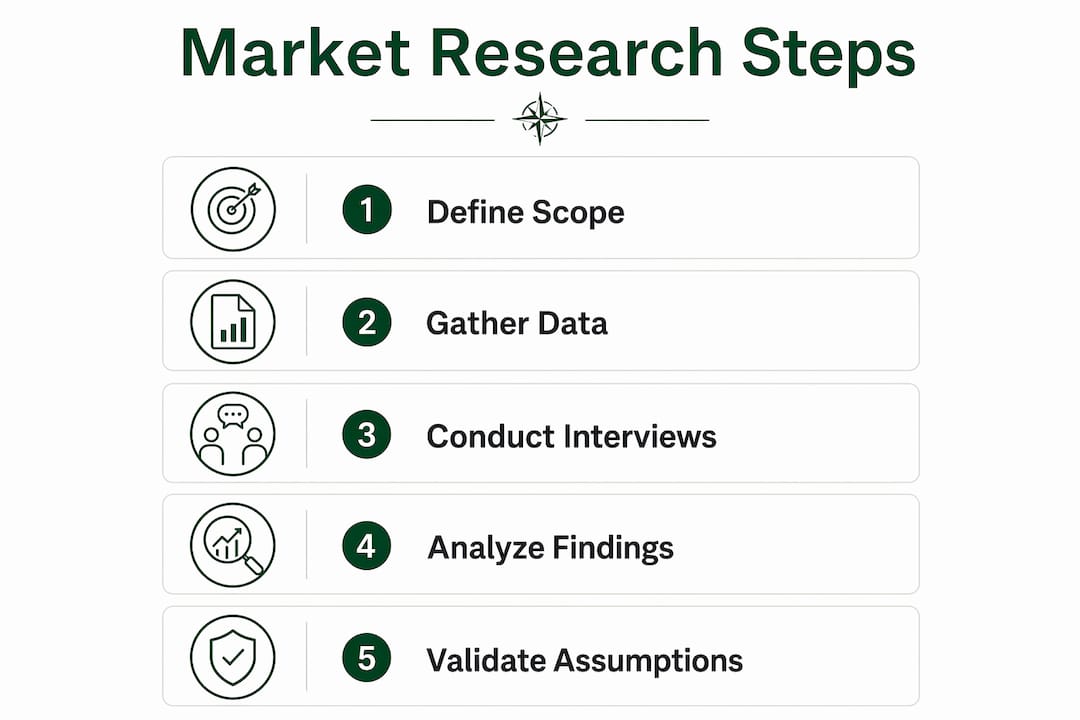
A disciplined process separates acquirers who overpay from those who build durable businesses. The following six steps reflect 2026 best practices for commercial due diligence and primary research.
-
Define scope and hypotheses. Write down your acquisition thesis in plain language. Identify the two or three assumptions that, if wrong, would kill the deal. Every subsequent step tests those assumptions directly.
-
Conduct secondary research. Pull industry size, growth rates, competitive concentration, and economic sensitivity data from federal sources and independent reports. This establishes the baseline before you talk to anyone.
-
Run expert interviews. Target 8–15 calls with customers, competitors, channel partners, and former employees. These conversations surface qualitative signals that no database captures, including cultural issues, hidden churn drivers, and competitive threats.
-
Deploy quantitative surveys. Use B2B surveys with 30–100+ respondents to quantify satisfaction levels, switching intent, and competitive positioning. Surveys validate or challenge what interviews suggest.
-
Triangulate findings. Compare secondary data, interview themes, and survey results. Inconsistencies are not problems. They are signals. Dig into any finding where sources disagree.
-
Summarize and decide. Produce a clear memo that either validates or invalidates your acquisition thesis. This document becomes your negotiating anchor before you engage on price.
| Step | Key Activity | Goal | Outcome |
|---|---|---|---|
| 1. Define scope | Write acquisition thesis | Clarify assumptions | Focused research agenda |
| 2. Secondary research | Pull federal and industry data | Establish market baseline | Verified industry fundamentals |
| 3. Expert interviews | 8–15 practitioner calls | Surface qualitative signals | Competitive and cultural insights |
| 4. Surveys | 30–100+ respondent surveys | Quantify customer sentiment | Statistical validation of claims |
| 5. Triangulate | Cross-check all sources | Identify inconsistencies | Refined, reliable conclusions |
| 6. Summarize | Write thesis validation memo | Inform price negotiation | Go or no-go decision |
Pro Tip: Select interviewees from outside the seller’s provided reference list. Sellers curate advocates. You need critics. Ask competitors who lost deals to this business and customers who churned. Their answers reveal what the seller’s data never will.
One nuance worth noting: when evaluating tech acquisitions, infrastructure buys are more durable than feature-focused ones. A business built around a core platform commands a different valuation and risk profile than one built around a single product capability. Your market analysis must distinguish between the two.
What mistakes derail market analysis during acquisitions?
Even experienced acquirers make predictable errors. Recognizing them before they cost you is the point of this section.
-
Over-relying on seller-provided data. Sellers curate information to support their asking price. Exit surveys and internal reports reflect the story the seller wants to tell. Independent interviews reveal divergent root causes that seller data consistently misses.
-
Confirmation bias. You want the deal to work. That desire shapes which data you notice and which you dismiss. Structured, iterative market analysis combats this by forcing you to test your thesis against disconfirming evidence, not just supporting evidence.
-
Skipping quantitative validation. Interviews are powerful but not sufficient. Without surveys of 30 or more respondents, you cannot distinguish a pattern from an anecdote. Quantitative data is what converts a hunch into a defensible investment thesis.
-
Ignoring competitor and channel checks. Talking only to the seller’s customers gives you a partial picture. Distributors, resellers, and direct competitors hold information about market share, pricing pressure, and customer switching behavior that customers themselves often cannot articulate.
-
Using synthetic AI-generated participants. Some researchers now use AI-generated personas to simulate customer feedback. Synthetic participants produce overly cooperative answers that miss real market divergence. Real voices are not optional.
-
Misreading why deals are lost. Price appears in 62.3% of lost deals but is the primary driver in only 18.1%. That gap means most sellers and buyers misdiagnose competitive weakness. Independent demand research corrects this.
The most dangerous assumption in any acquisition is that the seller’s explanation for customer behavior is accurate. Validate every claim with independent sources before you accept it as fact.
Pro Tip: Update your assumptions in writing every time a new data point contradicts your thesis. Iterative validation is not a sign of weakness. It is the discipline that separates acquirers who build value from those who inherit problems.
Why does continuous market intelligence matter after acquisition?
Pre-acquisition research answers one question: should you buy? Post-acquisition market intelligence answers a different question: how do you win? Treating market analysis as a one-time event is a structural mistake.
Companies that maintain ongoing market intelligence respond 2–3 times faster to threats and identify growth opportunities earlier than those who research only during transactions. That speed advantage compounds over time. A competitor who spots a market shift six months before you do has six months to act on it.
A practical cadence looks like this:
- Quarterly reviews: Track competitor moves, pricing changes, and customer sentiment shifts using tools like Crayon or Klue.
- Annual deep dives: Revisit industry sizing, CAGR, and competitive concentration using updated federal data and independent reports.
- Event-driven research: Trigger a focused study whenever a major competitor enters or exits the market, a key customer churns, or a regulatory change affects the industry.
Continuous intelligence also supports operational planning. When your team understands market trends in real time, resource allocation decisions become data-driven rather than reactive. For acquirers building a portfolio acquisition approach, this ongoing discipline creates a compounding advantage across every asset in the portfolio.
The acquirers who outperform over five-year horizons are not the ones who did the best pre-deal research. They are the ones who never stopped doing it.
Key takeaways
Conducting thorough market analysis before acquiring a business requires combining secondary data, expert interviews, and quantitative surveys to validate your investment thesis before price negotiations begin.
| Point | Details |
|---|---|
| Start analysis early | Begin market research during initial screening, before price discussions, to retain negotiating leverage. |
| Use independent sources | Supplement seller data with federal databases, expert interviews, and surveys to avoid confirmation bias. |
| Quantify with surveys | Deploy 30–100+ respondent surveys to convert qualitative interview themes into statistically defensible findings. |
| Avoid synthetic research | Use real customer and competitor voices; AI-generated participants produce unreliable, biased feedback. |
| Sustain intelligence post-deal | Maintain quarterly and annual market reviews to react faster and identify growth opportunities after acquisition. |
What most acquirers get wrong about market analysis
I have seen buyers spend months on financial modeling and two weeks on market research. That ratio is backwards. The financial model is only as good as the market assumptions feeding it. If the market assumptions are wrong, the model is fiction with a spreadsheet attached.
The most consistent mistake I observe is treating the seller’s narrative as a starting point for analysis rather than a hypothesis to be tested. Sellers are not lying, necessarily. They genuinely believe their story. But their story is built from internal data, and internal data has blind spots. Won-loss interviews with churned customers and lost prospects reveal competitive dynamics that no internal report captures.
The second mistake is confusing thoroughness with volume. Running 40 expert calls does not make your analysis better if all 40 interviewees come from the seller’s approved contact list. Diversity of perspective matters more than quantity. One candid conversation with a former employee or a direct competitor is worth more than ten calls with satisfied customers.
The acquirers I respect most treat market analysis as a living discipline. They do not close the research file when the deal closes. They build market intelligence into their operating rhythm, review it quarterly, and update their assumptions when the data changes. That discipline is what separates businesses that grow post-acquisition from those that stagnate.
If you are evaluating an acquisition right now, start with your thesis. Write it down. Then spend the next two weeks trying to prove it wrong. What you find will either give you confidence to move forward or save you from a very expensive mistake.
— Sierra
How Compassbusinessacquisitions supports your acquisition research
Compassbusinessacquisitions brings deep market knowledge and a proven track record to every stage of the acquisition process, from initial screening through final negotiation.

Whether you are evaluating your first acquisition or expanding an existing portfolio, Compassbusinessacquisitions provides professional valuations, targeted deal sourcing, and expert guidance grounded in real market data. Their network connects serious buyers with sellers whose businesses have verifiable financials and confirmed growth potential. Explore the full range of buyer acquisition services to see how structured market analysis and broker expertise work together to maximize your investment outcome. For direct support from experienced acquisition specialists, visit Compassbusinessacquisitions today.
FAQ
What is market analysis in the context of an acquisition?
Pre-acquisition market analysis is the process of evaluating industry size, competitive positioning, customer demand, and growth trends to validate an investment thesis before committing to a purchase price.
When should you start market research before an acquisition?
Market due diligence should begin during initial screening, well before price discussions, so findings can directly inform your negotiating position.
How many expert interviews are enough for acquisition research?
The standard recommendation is 8–15 expert calls combined with surveys of 30 or more respondents to achieve both qualitative depth and quantitative validation.
Why can’t you rely on seller-provided market data?
Sellers curate data to support their asking price. Exit surveys miss true lost-deal drivers, and independent interviews consistently reveal competitive and customer dynamics that internal reports do not capture.
Does market analysis end when the acquisition closes?
No. Companies that maintain continuous market intelligence respond significantly faster to threats and identify growth opportunities earlier than those who treat market research as a one-time pre-deal activity.