
Earnout Tax Treatment: What Buyers and Sellers Must Know
Earnout Tax Treatment: What Buyers and Sellers Must Know
Earnouts are taxed one of two ways in the United States: as deferred purchase price, taxed at capital gains rates, or as compensation for services, taxed as ordinary income with payroll tax exposure. Which treatment applies depends on facts you can control before closing, chiefly whether payments hinge on continued employment, track proportional equity ownership, and get documented consistently across your purchase agreement and accounting records. Get those facts wrong and the IRS, not your deal team, decides your tax bill.
TL;DR:
- Payments contingent on employment or continuing involvement are more likely to be taxed as ordinary income and payroll taxes, especially if aligned with job duties.
- If earnouts scale proportionally with equity ownership and are paid at market rates, they are more likely to qualify as deferred purchase price and taxed at capital gains rates.
- Proper documentation, consistent deal language, and valuation support are critical to avoid the IRS recharacterizing payments as compensation.
- Buyers benefit from deducting compensation-classified earnouts when paid, while sellers prefer purchase-price characterization for long-term capital gains treatment.
- International earnouts involve withholding tax obligations and potential double taxation risks, making cross-border legal and tax advice essential.
Table of Contents
- Purchase Price vs. Compensation: How the IRS Draws the Line
- What Sellers Owe: Capital Gains, Ordinary Income, and Payroll Tax
- Buyer-Side Consequences: Deductions, Basis, and Compliance Traps
- GAAP, Auditors, and the Accounting Record That Follows You
- Drafting Moves That Protect Your Intended Tax Outcome
- Pre-Signing Checklist: Mistakes That Trigger IRS Scrutiny
- State Tax Implications and Jurisdictional Variability
- Earnouts and Entity-Level Taxation: Partnerships and S-Corporations
- Cross-Border Earnouts: What Changes in International Deals
- Compass Perspective: Structuring Earnouts to Hold Up Later
- Sources
Purchase Price vs. Compensation: How the IRS Draws the Line
Tax authorities and courts apply an origin-of-claim analysis to earnouts. They ask what the payment is actually buying: continued ownership value transferred at closing, or the seller’s ongoing labor after closing. That single question controls most disputes, and it explains why two earnouts that look identical on paper can receive opposite tax treatment.
Venable’s analysis of earnout tax treatment identifies the factors that push characterization in each direction. Payments tied to the seller staying on as an employee, especially when the earnout period mirrors an employment agreement term, read as compensation. Payments that scale proportionally with the seller’s original equity stake, paired with market-rate post-closing pay, read as purchase price.
Practical factors worth checking against your own deal:
- Is eligibility for the earnout contingent on the seller remaining employed, or does it survive termination without cause?
- Does the payout track ownership percentage, or does it track hours worked or accounts managed?
- Is the seller’s regular salary set at fair market value, separate from the earnout math?
- Do the letter of intent and purchase agreement use consistent language, or did drafting shift the framing midstream?
- Has the company historically treated similar deferred payments as one type or the other?
Court precedent backs this factors-based approach. Arrowsmith supports treating deferred proceeds as tied to the original sale (capital gain), while Lane Processing Trust shows courts will recharacterize payments as compensation once employment ties become the dominant fact, a distinction covered in The Tax Adviser’s review of service-related earnouts. No single factor decides the case. The IRS and courts weigh the whole record, which is exactly why documentation discipline matters more than clever drafting.
What Sellers Owe: Capital Gains, Ordinary Income, and Payroll Tax
If your earnout qualifies as deferred purchase price, you generally report it as long-term capital gain, assuming the underlying sale itself met the holding period. Basis gets allocated proportionally as payments arrive, and gain above your basis is taxed at capital gains rates. High earners should also factor in the net investment income tax on top of the federal capital gains rate.
If the earnout instead reads as compensation, the picture changes sharply:
- The payment is ordinary income, taxed at your marginal rate, not the capital gains rate.
- It’s subject to payroll withholding and employment taxes, cutting into what you actually receive.
- If the arrangement functions as deferred compensation without proper structuring, Section 409A penalties can apply, including immediate income inclusion and an additional 20% tax.
Installment sale reporting can help sellers who receive purchase-price earnouts over multiple years, spreading gain recognition across the payment schedule rather than accelerating it into the closing year. It has limits, though: it generally isn’t available for publicly traded stock, and contingent payment sales carry their own basis recovery rules that a tax advisor needs to model against your specific payment structure. Morse Law’s overview of earnout taxation notes that the IRS looks hard at contemporaneous deal documents when deciding which regime applies, which is one more reason your paperwork needs to match your intended outcome from day one.
Buyer-Side Consequences: Deductions, Basis, and Compliance Traps
Buyers face a mirror-image question: does this payment produce a current deduction, or does it add to the basis of the acquired business? Compensation-classified earnout payments are generally deductible when paid, which softens the cash outlay. Purchase-price payments instead increase the buyer’s basis in the acquired assets or stock, recovered later through depreciation, amortization, or reduced gain on a future resale.
That basis-versus-deduction split shapes negotiating leverage. Buyers often prefer compensation treatment because of the immediate deduction; sellers prefer purchase-price treatment because capital gains rates beat ordinary income rates. That tension is exactly why the Venable earnout analysis flags upfront negotiation as essential rather than optional.
Two compliance issues deserve close attention:
- Imputed interest. Deferred payments without a stated interest component can trigger imputed interest rules, recasting part of each payment as interest income to the seller and interest expense to the buyer, as Gesmer Updegrove explains.
- Section 409A and Section 280G. If the earnout functions as deferred compensation, 409A noncompliance can accelerate taxation and add penalties. If the seller is also a disqualified individual under a change-in-control event, 280G can limit the buyer’s deduction entirely.
Pro Tip: Price a stated interest rate into any multi-year earnout schedule before signing. It’s a small drafting step that removes an entire category of surprise tax exposure for both sides.
GAAP, Auditors, and the Accounting Record That Follows You
Earnouts sit on the balance sheet as contingent consideration under U.S. GAAP, measured at fair value and remeasured each reporting period. That accounting treatment isn’t just a bookkeeping exercise. It creates a paper trail the IRS and courts can read later, and BDO’s guidance on earnout accounting points out that auditors scrutinize service-based triggers closely, since those triggers affect both compensation expense recognition and tax characterization.
The practical risk: if your accounting team books an earnout as compensation expense while your tax return treats it as purchase price, that inconsistency invites exactly the recharacterization argument you were trying to avoid.
- Loop in accounting and tax advisors together, not sequentially.
- Keep letters of intent and draft agreements consistent with your final accounting position.
- Document any deliberate divergence between book and tax treatment, with the underlying reasoning preserved.
Drafting Moves That Protect Your Intended Tax Outcome
Getting the tax result you want starts in the drafting room, not on the tax return.
- Anchor the earnout formula to objective equity metrics such as revenue multiples or EBITDA targets tied to the business itself, not to the seller’s personal performance metrics.
- Avoid service-based triggers if capital gains treatment is the goal. If the seller must keep working to earn the payout, expect the IRS to read that as compensation.
- Use a separate services agreement when continued involvement is genuinely necessary, so the earnout and the seller’s post-closing job description don’t blur into one instrument.
- Document valuation support and negotiation history. A contemporaneous record showing the earnout was priced against enterprise value, not against a compensation benchmark, is your best evidence if the IRS challenges the return years later.
- Raise tax characterization early in negotiations, and consider a tax indemnity provision or a pre-closing tax opinion when the stakes are large enough to justify the cost.
Pro Tip: If your earnout period happens to match the length of the seller’s new employment agreement almost exactly, that overlap alone is the kind of coincidence an IRS examiner notices first.
Pre-Signing Checklist: Mistakes That Trigger IRS Scrutiny
The recurring pattern behind bad earnout outcomes: an earnout tied to continued employment with no separate compensation rationale, no contemporaneous valuation support, no stated interest rate on deferred payments, and no 409A or 280G review before signing.
Before you sign, confirm:
- The earnout formula ties to equity value, not personal service metrics, if capital gains treatment is the goal.
- A valuation document supports the purchase-price allocation.
- Deferred payments carry a stated interest rate.
- Tax counsel has cleared the structure against Section 409A and Section 280G.
- Accounting treatment and tax return positions match, or the divergence is documented.
State Tax Implications and Jurisdictional Variability
Federal characterization rules set the foundation, but state tax treatment adds another layer that catches many sellers off guard. States generally follow the federal characterization of an earnout as either capital gain or ordinary income, but the rate consequences differ enormously depending on where you live and where the business operated.

States with no personal income tax, including Texas, Florida, and Nevada, remove a major variable entirely for individual sellers residing there. States that tax capital gains at the same rate as ordinary income, California among them, erase the federal capital-gains advantage that made purchase-price characterization worth fighting for in the first place. That changes the calculus on how hard to negotiate for capital gains treatment if your state taxes both income types identically.
Multi-state complications arise when the seller resides in one state but the business, and the earnout payments, originate from operations in another. Nonresident withholding rules, apportionment formulas, and reciprocity agreements between states can all affect how much of the earnout each state taxes. A seller who relocates during the earnout payment period, which can run three to five years, may face allocation questions state tax authorities haven’t settled with much clarity.
Because these rules vary so much by state and shift with legislative sessions, confirm your specific state’s treatment with a tax professional before finalizing deal terms, particularly if the payment schedule stretches across multiple tax years or multiple state residencies.
Earnouts and Entity-Level Taxation: Partnerships and S-Corporations
How your business is structured changes who reports the earnout income and when. In a partnership or an S-corporation, income generally passes through to owners rather than being taxed at the entity level, and an earnout received by the entity, or by individual sellers of entity interests, has to be traced through that pass-through structure correctly.
Sellers of partnership interests face particularly intricate issues. A sale of a partnership interest with an earnout component can trigger installment sale rules at the partner level, while the partnership’s own asset basis and any Section 754 elections affect how gain flows through over the earnout period. Get the entity classification wrong at the front end, and every downstream earnout payment inherits that error.
S-corporation sellers face a related wrinkle: if the earnout is characterized as compensation rather than purchase price, it has to run through payroll for a shareholder-employee, which affects the corporation’s reasonable-compensation analysis and can draw IRS attention if compensation levels look artificially low elsewhere in the business. Sellers exiting an S-corp through a stock sale with an earnout should model both characterization scenarios against their K-1 history before agreeing to deal terms, since the entity’s prior compensation patterns become part of the factual record examiners will review.
Buyers acquiring through a partnership or LLC structure also need to track how earnout payments affect basis step-ups under Section 754, since purchase-price treatment at the entity level flows through to partner-level basis adjustments that affect future depreciation and gain calculations.
Cross-Border Earnouts: What Changes in International Deals
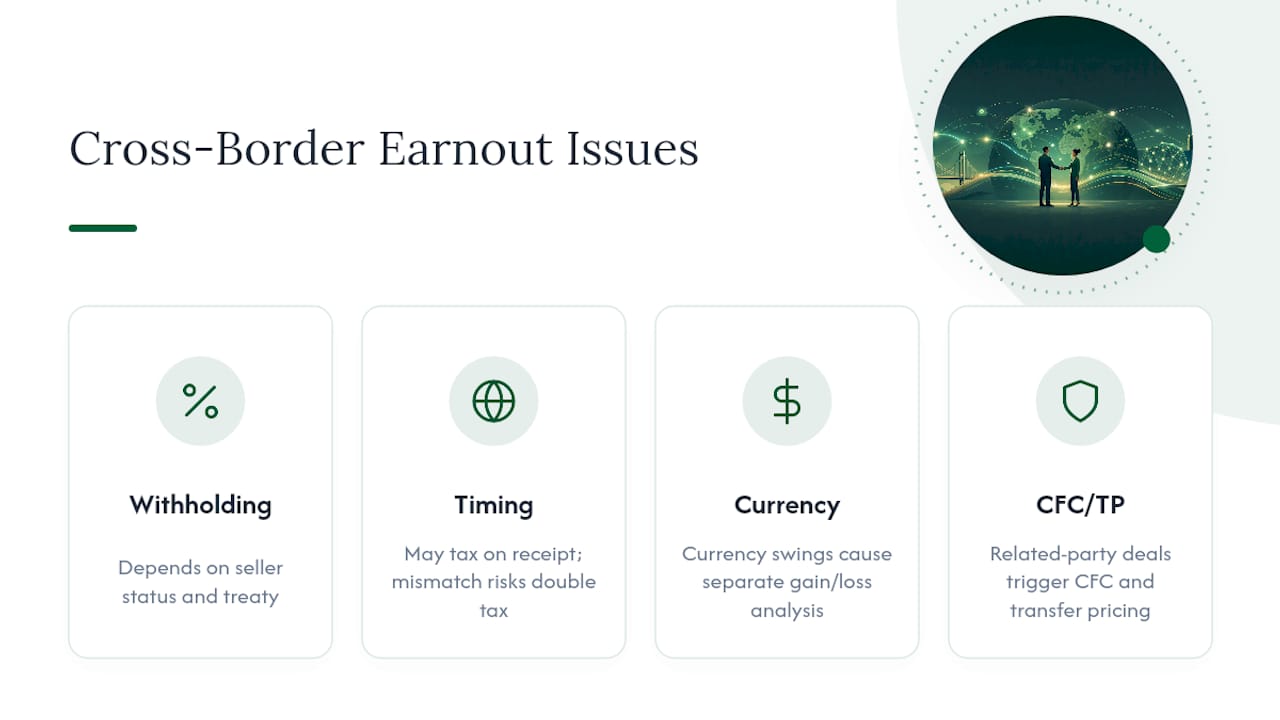
International transactions add treaty analysis, withholding tax, and foreign entity classification questions on top of the domestic characterization test. A U.S. buyer paying an earnout to a foreign seller may need to withhold under U.S. tax law depending on the seller’s status and any applicable income tax treaty between the United States and the seller’s country of residence. That withholding obligation exists independent of whether the payment is ultimately characterized as capital gain or compensation, though the rate and mechanics differ between the two.
Foreign sellers face their own layered question: does their home country tax the earnout as it’s received, or does it wait for U.S. characterization to settle first? Timing mismatches between U.S. recognition rules and a foreign jurisdiction’s own rules can create double taxation exposure that a treaty’s foreign tax credit provisions only partially resolve.
For U.S. sellers receiving earnout payments from a foreign buyer, currency fluctuation between the earnout’s stated currency and the dollar adds a layer the domestic cases in this article don’t address at all. Gain or loss on currency movement gets analyzed separately from the underlying capital gain or ordinary income question, and the mechanics depend heavily on whether the obligation is denominated in dollars or foreign currency.
Cross-border earnouts also raise controlled foreign corporation and transfer pricing questions when the buyer and seller are related parties operating across borders, questions that rarely surface in a purely domestic deal. Any earnout structure crossing a border warrants international tax counsel alongside your M&A tax advisor, not as a substitute for one.
Compass Perspective: Structuring Earnouts to Hold Up Later
Every earnout dispute we’ve seen traces back to documentation gaps, not bad intentions. When Compass Business Acquisitions supports a sale, our valuation work and Business Evaluation Calculator build the contemporaneous record that supports a purchase-price rationale, and we routinely recommend decoupling earnout eligibility from continued employment before tax counsel ever reviews the draft. If an earnout is part of your transaction plan, talk to us early, while the structure is still negotiable.
— Sierra
Sources
- Earnouts and Their Tax Treatment
- The Earnout Equation: Tax Tips for Both Buyers and Sellers
- Book and tax implications of earnouts
- Earnouts and Deferred Payments: Surprising Tax Outcomes
If you’re deciding whether the earnout in front of you needs outside tax counsel before you sign, this guide on when a small business needs a tax professional is a useful gut check, and Compass’s own seller services page walks through how valuation and deal structuring work together from listing to close.
This article is general information, not a substitute for advice from a qualified financial advisor. Consult a qualified financial professional about your own circumstances before acting on anything here.